
 Afrika
 Asien
Asien Europa
 Südamerika
 Australien & Ozeanien
 Antarktis
 Pazifischer Ozean
 Atlantischer Ozean
 Indischer Ozean
 Nordpolarmeer
 Mittelmeer
 Rotes Meer
 Karibisches Meer
 Korallenmeer
 Südchinesisches Meer
 Philippinensee
 Andamanensee
 Nordsee
 Timorsee & Arafurasee
 Golf von Bengalen
 Golf von Kalifornien
Bald-faced hornet
 Stiche
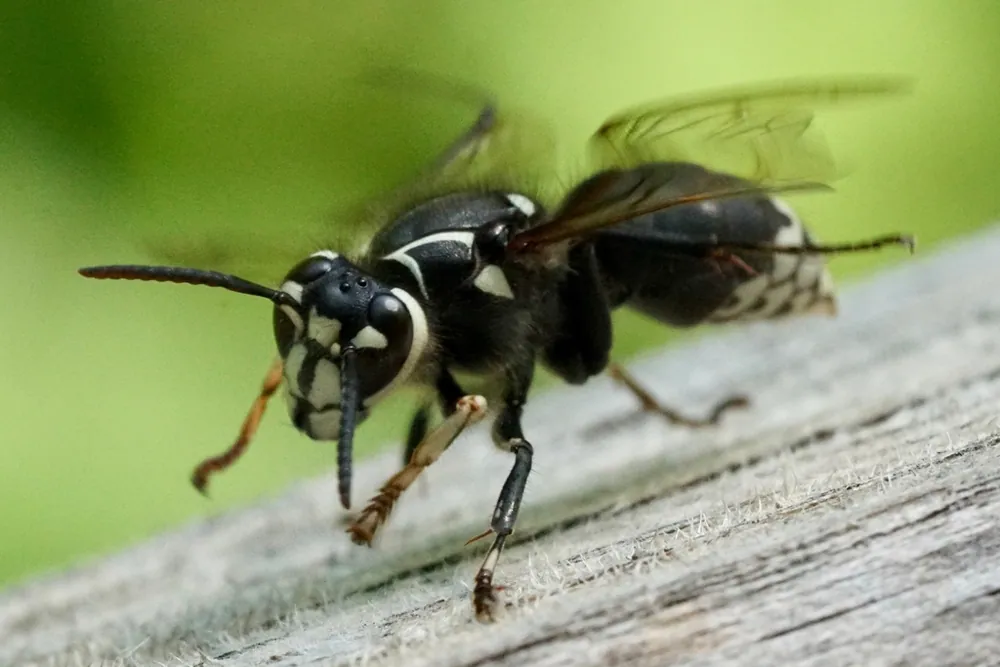
The bald-faced hornet is a wasp with a striking black and white body and a white face. It builds large, hanging paper nests in trees and bushes across North America. Its workers will defend the nest by stinging repeatedly, so it is important to keep well away from its nests.1



 So erkennst du es
- Black and white colouring, unlike other yellowjackets of its genus, which are mostly black and yellow1
- A white or "bald" face1
- Three white stripes at the end of the body1
- Adults average about 19 mm long, larger than other Dolichovespula species1
- A large, egg-shaped, grey paper nest that hangs from trees or bushes, up to 58 cm long1
Oft verwechselt mit: Other Dolichovespula wasps are mostly black and yellow. The bald-faced hornet's black and white colouring and white face set it apart. It is not one of the true hornets, which belong to the genus Vespa.1
Giftkraft
Das Gift kommt durch einen Stachel heraus.
Was macht sein Gift, wenn es beißt oder sticht?
Workers can squirt venom from the stinger into the eyes of animals that intrude on the nest. The venom makes the eyes water immediately and causes temporary blindness.1
Wie gefährlich ist es für Menschen?
Gefahr für Menschen: SchmerzhaftEs kann richtig wehtun, ist aber fast nie gefährlich.It is aggressive when defending its nest. Workers sting repeatedly, and colonies can have 400 to 700 workers. The risk is highest when people walk too close to a nest or when a nest is built near homes.1
Was macht es, wenn es Angst hat?
Workers defend the nest by stinging repeatedly and can squirt venom into the eyes of intruders.1
 Wenn es sticht
- Kratz den Bienenstachel heraus und kühl die Stelle.
- Wenn die Person Atemnot hat, Gesicht oder Hals anschwellen oder ihr schwindlig wird, ist das ein allergischer Notfall: Ruf deine Notrufnummer an und benutze ihren Adrenalin-Autoinjektor, wenn sie einen hat.
Ruf immer zuerst deine Notrufnummer an (112, 000, 911). Das sind allgemeine Erste-Hilfe-Hinweise, keine ärztliche Beratung. Erste-Hilfe-Grundlagen
 Bleib sicher
- Fass ein wildes Tier niemals an, fang es nicht und ärgere es nicht, auch kein kleines, und auch nicht, wenn es schlafend aussieht oder tot.
- Halte Abstand. Wenn du einem begegnest, bleib ruhig, geh langsam zurück und lass es seiner Wege gehen.
- Wenn dich eines sticht: Bleib ruhig, halt still, ruf deine Notrufnummer an (112, 000, 911) oder fahr schnell in ein Krankenhaus. Merk dir, wie es aussah, ein Foto hilft.
Es hat es nicht auf dich abgesehen. Es benutzt sein Gift, um Futter zu fangen oder sich zu schützen, und versteckt sich viel lieber. Mehr über Sicherheit
Wo auf der Welt?
Wie groß ist es?
Wie lang ist es?
 kürzer als dein kleiner Finger
 könnte in 15 Sekunden über ein ganzes Fußballfeld fliegen
Wie groß ist Bald-faced hornet im Vergleich zu DIR?
Nur Rechnen in deinem Browser. Nichts wird gespeichert oder irgendwohin geschickt.
Wie schnell ist es?


Fakten
It can spray venom from its stinger into the eyes of nest intruders, causing temporary blindness.1
Its colony can have 400 to 700 workers, the largest recorded colony size in its genus, Dolichovespula.1
Female bee moths can lay eggs in its nests, and the hatched larvae feed on the eggs, larvae and pupae inside, sometimes destroying large parts of the nest.1
Its nests are made from chewed wood fibres mixed with saliva, which dries into a papery structure.1
A colony lasts about 4 months in Washington, from mid-May to mid-September. Colonies in lower latitudes last longer.1
Mythen-Check
Mythos: It is a true hornet.
Wahrheit: It is a yellowjacket wasp. True hornets belong to the genus Vespa.1
Für Giftexperten
- Wissenschaftlicher Name
- Dolichovespula maculata
- Gruppe
- Bienen, Wespen & Hornissen
- Familie
- Vespidae2
- Ordnung
- Hymenoptera
- Kontinente
- Nordamerika
- Babys
- A single queen starts each new nest in spring, laying eggs that hatch into workers, and later lays eggs that become males and new queens.1
- Gefahr für Menschen
- 2 / 5: Schmerzhaft3
Woher die Fakten kommen
- Dolichovespula maculata (Wikipedia (CC BY-SA 4.0))
- Dolichovespula maculata (iNaturalist): Namen und Klassifikation.
- Venom Wiki: die Gefahrenstufe, die typische Größe und die geschätzte Geschwindigkeit sind von uns. So berechnen wir sie: So bewerten wir die Gefahr.
Jeder Fakt auf dieser Seite hat eine Nummer, die auf seine Quelle zeigt. Wenn wir etwas falsch haben: Entschuldigung, wir sind Tierfans, keine Fachzeitschrift. Schreib uns an [email protected] und wir korrigieren es.
 Der Skorpion hat Hunger! Venom Wiki ist ein Ein-Mann-Projekt: kostenlos, ohne Werbung und ohne Tracker. Ein kleines Trinkgeld hilft, es online zu halten.Füttere den Skorpion
Mehr aus derselben Gruppe: Bienen, Wespen & Hornissen
 Tarantula hawkBienen, Wespen & HornissenTut nur weh
 Executioner waspBienen, Wespen & HornissenBraucht einen Arzt
 Warrior waspBienen, Wespen & HornissenBraucht einen Arzt
 Cow killer velvet antBienen, Wespen & HornissenTut nur weh
 Eastern cicada killerBienen, Wespen & HornissenHarmlos
 Aerial yellowjacketBienen, Wespen & HornissenTut nur weh
 Terciopelo-Lanzenotter
 Eastern coral snake
 Eastern diamondback rattlesnake
 Eyelash viper
 Timber rattlesnake
 Western diamondback rattlesnake