
 Afrika
 Asien
Asien Europa
 Südamerika
 Australien & Ozeanien
 Antarktis
 Pazifischer Ozean
 Atlantischer Ozean
 Indischer Ozean
 Nordpolarmeer
 Mittelmeer
 Rotes Meer
 Karibisches Meer
 Korallenmeer
 Südchinesisches Meer
 Philippinensee
 Andamanensee
 Nordsee
 Timorsee & Arafurasee
 Golf von Bengalen
 Golf von Kalifornien
Tarantula hawk
 Stiche
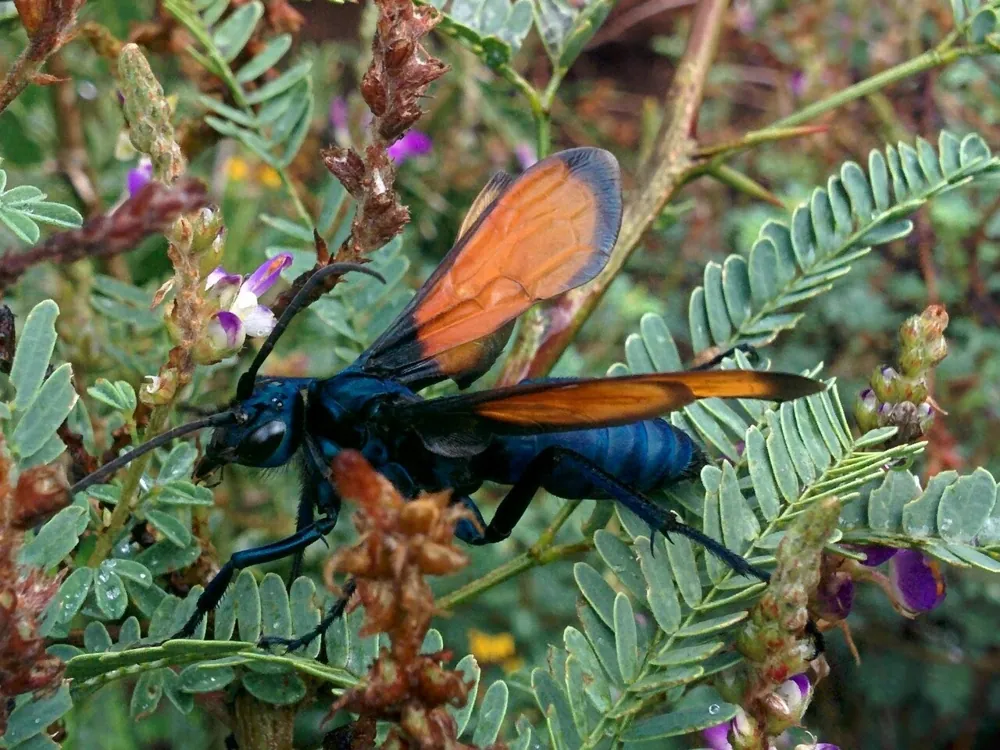
The tarantula hawk is a very large wasp that hunts tarantulas, which are big hairy spiders. It lives from the southern United States through Mexico and Central America to northern South America, and also on the Caribbean islands. Its sting is among the most painful of any insect.1

 So erkennst du es
- Black and orange colours, with several colour forms: an orange-winged form, a black-winged form, and in northern South America a form with a dark wing base, dark amber patches and a pale wing tip1
- Females are 30–51 mm long; males are 24–40 mm long1
- Jerky movements and a strong odour1
- Males have 12 antennal segments, which separates them from other Pepsis species, which have 131
Oft verwechselt mit: The black-winged form is hard to tell apart from Pepsis mexicana, but that species is always noticeably smaller. The robber fly Wyliea mydas copies the tarantula hawk's black body and bright orange wings, and makes stinging movements, but it cannot sting.1
Giftkraft
Das Gift kommt durch einen Stachel heraus.
Was macht sein Gift, wenn es beißt oder sticht?
Tarantula hawks produce large amounts of venom. A sting causes immediate, intense pain that is short-lived, and it is among the greatest pain recorded for any stinging insect. The venom itself is not very toxic, so its defence works almost entirely through pain.1
Wie gefährlich ist es für Menschen?
Gefahr für Menschen: SchmerzhaftEs kann richtig wehtun, ist aber fast nie gefährlich.Only females can sting. The sting is considered the second most painful of any insect sting, scoring 4.0 on the Schmidt sting pain index, compared with 4.0+ for the bullet ant.1
Was macht es, wenn es Angst hat?
Its black and orange colours, jerky behaviour and strong odour warn predators that it can sting.1
 Wenn es sticht
- Kratz den Bienenstachel heraus und kühl die Stelle.
- Wenn die Person Atemnot hat, Gesicht oder Hals anschwellen oder ihr schwindlig wird, ist das ein allergischer Notfall: Ruf deine Notrufnummer an und benutze ihren Adrenalin-Autoinjektor, wenn sie einen hat.
Ruf immer zuerst deine Notrufnummer an (112, 000, 911). Das sind allgemeine Erste-Hilfe-Hinweise, keine ärztliche Beratung. Erste-Hilfe-Grundlagen
 Bleib sicher
- Fass ein wildes Tier niemals an, fang es nicht und ärgere es nicht, auch kein kleines, und auch nicht, wenn es schlafend aussieht oder tot.
- Halte Abstand. Wenn du einem begegnest, bleib ruhig, geh langsam zurück und lass es seiner Wege gehen.
- Wenn dich eines sticht: Bleib ruhig, halt still, ruf deine Notrufnummer an (112, 000, 911) oder fahr schnell in ein Krankenhaus. Merk dir, wie es aussah, ein Foto hilft.
Es hat es nicht auf dich abgesehen. Es benutzt sein Gift, um Futter zu fangen oder sich zu schützen, und versteckt sich viel lieber. Mehr über Sicherheit
Wo auf der Welt?
Wie groß ist es?
Wie lang ist es?
 kürzer als dein kleiner Finger
 könnte in 8,4 Sekunden über ein ganzes Fußballfeld fliegen
Wie groß ist Tarantula hawk im Vergleich zu DIR?
Nur Rechnen in deinem Browser. Nichts wird gespeichert oder irgendwohin geschickt.
Wie schnell ist es?


Fakten
The female chooses the spider's size and sex for her eggs. Fertilised eggs go on large spiders and become females, and unfertilised eggs go on male spiders and become males.1
Roadrunners sometimes steal the tarantula from a wasp and leave the wasp unharmed. Others beat the wasp against the ground before eating it.1
The tarantula hawk is the state insect of New Mexico. Almost 10,000 schoolchildren voted for it, and it was made official by a law signed in 1989.1
Wasps of the genus Pepsis are important pollinators of milkweeds, which are poisonous to grazing livestock.1
Mythen-Check
Mythos: The tarantula hawk's sting is dangerous mainly because its venom is strongly poisonous.
Wahrheit: The venom itself is not very toxic. Its main defence is the intense pain of the sting.1
Für Giftexperten
Woher die Fakten kommen
- Pepsis grossa (Wikipedia (CC BY-SA 4.0))
- Pepsis grossa (iNaturalist): Namen und Klassifikation.
- Venom Wiki: die Gefahrenstufe, die typische Größe und die geschätzte Geschwindigkeit sind von uns. So berechnen wir sie: So bewerten wir die Gefahr.
Jeder Fakt auf dieser Seite hat eine Nummer, die auf seine Quelle zeigt. Wenn wir etwas falsch haben: Entschuldigung, wir sind Tierfans, keine Fachzeitschrift. Schreib uns an [email protected] und wir korrigieren es.
 Der Skorpion hat Hunger! Venom Wiki ist ein Ein-Mann-Projekt: kostenlos, ohne Werbung und ohne Tracker. Ein kleines Trinkgeld hilft, es online zu halten.Füttere den Skorpion
Mehr aus derselben Gruppe: Bienen, Wespen & Hornissen
 Executioner waspBienen, Wespen & HornissenBraucht einen Arzt
 Warrior waspBienen, Wespen & HornissenBraucht einen Arzt
 Bald-faced hornetBienen, Wespen & HornissenTut nur weh
 Cow killer velvet antBienen, Wespen & HornissenTut nur weh
 Eastern cicada killerBienen, Wespen & HornissenHarmlos
 Armadillo waspBienen, Wespen & HornissenBraucht einen Arzt
 Terciopelo
 Eastern coral snake
 Eastern diamondback rattlesnake
 Eyelash viper
 Timber rattlesnake
 Western diamondback rattlesnake
.jpg)