
 Afrika
 Asien
Asien Europa
 Südamerika
 Australien & Ozeanien
 Antarktis
 Pazifischer Ozean
 Atlantischer Ozean
 Indischer Ozean
 Nordpolarmeer
 Mittelmeer
 Rotes Meer
 Karibisches Meer
 Korallenmeer
 Südchinesisches Meer
 Philippinensee
 Andamanensee
 Nordsee
 Timorsee & Arafurasee
 Golf von Bengalen
 Golf von Kalifornien
Eastern cicada killer
 Stiche
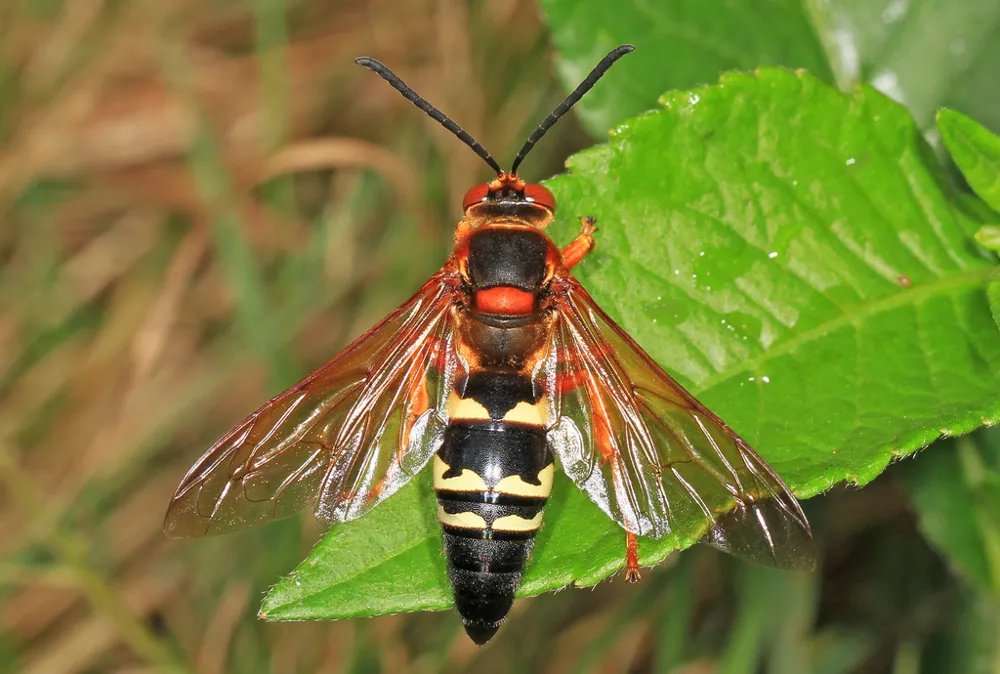
The eastern cicada killer is a large wasp that hunts cicadas, the loud insects that buzz in summer trees. It lives in the Eastern and Midwest United States and further south into Mexico and Central America. Females are not aggressive and rarely sting, so the sight of them flying over lawns is usually harmless.1


 So erkennst du es
- Large, at 1.5 to 5.0 cm long1
- Hairy thorax with reddish and black areas1
- Black to reddish brown abdomen marked with light yellow stripes1
- Brownish wings1
- Females are somewhat larger than males1
Oft verwechselt mit: Its colours resemble some yellowjacket and hornet species, and European hornets are often mistaken for it. European hornets are about 3.5 cm long, so they are smaller than the largest cicada killers.1
Giftkraft
Das Gift kommt durch einen Stachel heraus.
Was macht sein Gift, wenn es beißt oder sticht?
The female's sting paralyses cicadas so that they can be stored as food for the young.1
Wie gefährlich ist es für Menschen?
Gefahr für Menschen: LeichtWie ein Bienenstich oder weniger. Für Menschen praktisch harmlos.Females are not aggressive and rarely sting unless they are grasped roughly, stepped on with bare feet, or caught in clothing. One author who was stung said the sting felt like not much more than a pinprick. Males cannot sting.1
Was macht es, wenn es Angst hat?
Females sting only if handled roughly. Males may jab with a sharp spine on the tip of the abdomen if handled roughly, but they usually fly away when swatted at.1
 Wenn es sticht
- Kratz den Bienenstachel heraus und kühl die Stelle.
- Wenn die Person Atemnot hat, Gesicht oder Hals anschwellen oder ihr schwindlig wird, ist das ein allergischer Notfall: Ruf deine Notrufnummer an und benutze ihren Adrenalin-Autoinjektor, wenn sie einen hat.
Ruf immer zuerst deine Notrufnummer an (112, 000, 911). Das sind allgemeine Erste-Hilfe-Hinweise, keine ärztliche Beratung. Erste-Hilfe-Grundlagen
 Bleib sicher
- Fass ein wildes Tier niemals an, fang es nicht und ärgere es nicht, auch kein kleines, und auch nicht, wenn es schlafend aussieht oder tot.
- Halte Abstand. Wenn du einem begegnest, bleib ruhig, geh langsam zurück und lass es seiner Wege gehen.
- Wenn dich eines sticht: Bleib ruhig, halt still, ruf deine Notrufnummer an (112, 000, 911) oder fahr schnell in ein Krankenhaus. Merk dir, wie es aussah, ein Foto hilft.
Es hat es nicht auf dich abgesehen. Es benutzt sein Gift, um Futter zu fangen oder sich zu schützen, und versteckt sich viel lieber. Mehr über Sicherheit
Wo auf der Welt?
Wie groß ist es?
Wie lang ist es?
 kürzer als dein kleiner Finger
 könnte in 9,7 Sekunden über ein ganzes Fußballfeld fliegen
Wie groß ist Eastern cicada killer im Vergleich zu DIR?
Nur Rechnen in deinem Browser. Nichts wird gespeichert oder irgendwohin geschickt.
Wie schnell ist es?


Fakten
A female often carries a cicada up into a tree before flying to her burrow, because the cicada can weigh more than twice as much as she does.1
Males are seen in groups and may lock together in midair combat until one breaks away.1
Cicada killers may help trees by reducing the number of cicadas that feed on them.1
The parasitic velvet ant wasp, also called the cow-killer wasp, often lays its egg in cicada killer nest cells.1
A single burrow may eventually have 10 or more nest cells.1
Mythen-Check
Mythos: Male cicada killers are dangerous and will sting people.
Wahrheit: Males only grapple with other insects and cannot sting. They investigate things that move near them because they are looking for females.1
Für Giftexperten
- Wissenschaftlicher Name
- Sphecius speciosus
- Gruppe
- Bienen, Wespen & Hornissen
- Familie
- Crabronidae2
- Ordnung
- Hymenoptera
- Kontinente
- Nordamerika
- Babys
- Each female lays one egg on a cicada inside a nest cell, and the egg hatches in one or two days. Males receive one cicada per egg and females receive two or sometimes three.1
- Gefahr für Menschen
- 1 / 5: Leicht3
Woher die Fakten kommen
- Sphecius speciosus (Wikipedia (CC BY-SA 4.0))
- Sphecius speciosus (iNaturalist): Namen und Klassifikation.
- Venom Wiki: die Gefahrenstufe, die typische Größe und die geschätzte Geschwindigkeit sind von uns. So berechnen wir sie: So bewerten wir die Gefahr.
Jeder Fakt auf dieser Seite hat eine Nummer, die auf seine Quelle zeigt. Wenn wir etwas falsch haben: Entschuldigung, wir sind Tierfans, keine Fachzeitschrift. Schreib uns an [email protected] und wir korrigieren es.
 Der Skorpion hat Hunger! Venom Wiki ist ein Ein-Mann-Projekt: kostenlos, ohne Werbung und ohne Tracker. Ein kleines Trinkgeld hilft, es online zu halten.Füttere den Skorpion
Mehr aus derselben Gruppe: Bienen, Wespen & Hornissen
 Tarantula hawkBienen, Wespen & HornissenTut nur weh
 Executioner waspBienen, Wespen & HornissenBraucht einen Arzt
 Warrior waspBienen, Wespen & HornissenBraucht einen Arzt
 Bald-faced hornetBienen, Wespen & HornissenTut nur weh
 Cow killer velvet antBienen, Wespen & HornissenTut nur weh
 Aerial yellowjacketBienen, Wespen & HornissenTut nur weh
 Terciopelo
 Eastern coral snake
 Eastern diamondback rattlesnake
 Eyelash viper
 Timber rattlesnake
 Western diamondback rattlesnake