
 Afrika
 Asien
Asien Europa
 Südamerika
 Australien & Ozeanien
 Antarktis
 Pazifischer Ozean
 Atlantischer Ozean
 Indischer Ozean
 Nordpolarmeer
 Mittelmeer
 Rotes Meer
 Karibisches Meer
 Korallenmeer
 Südchinesisches Meer
 Philippinensee
 Andamanensee
 Nordsee
 Timorsee & Arafurasee
 Golf von Bengalen
 Golf von Kalifornien
European purseweb spider
 Bisse
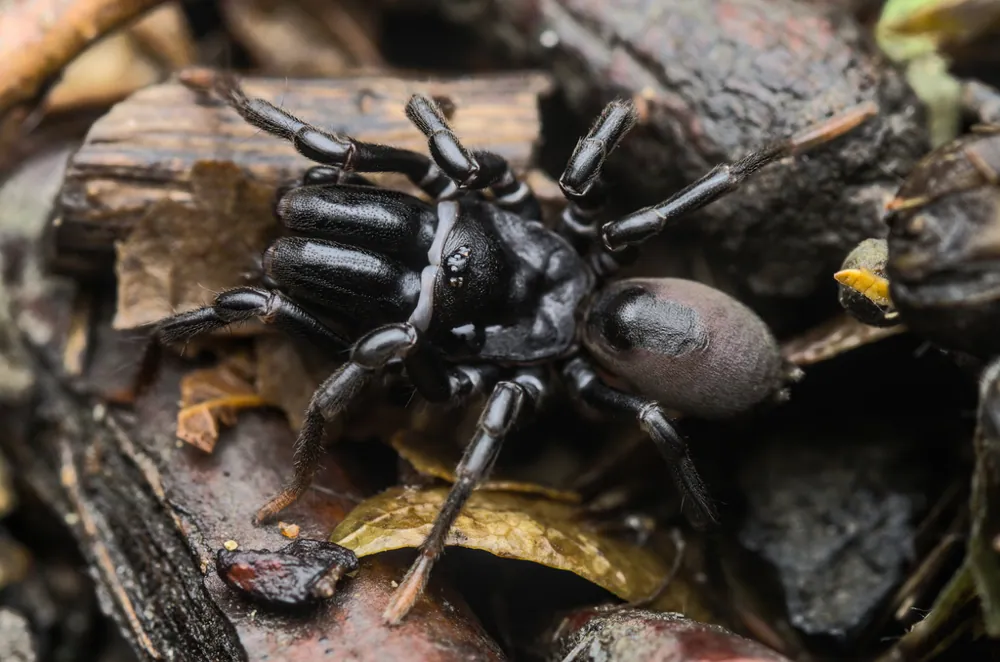
BisseThe European purseweb spider is a small, hidden spider that lives in the ground. It is found in mainland Europe, Great Britain and North Africa, and it is the only mygalomorph spider found in the Nordic countries and the United Kingdom. It is special because it builds a silk tube partly under the ground and catches insects that walk onto it.1

 So erkennst du es
- Black or brownish in colour1
- Not particularly large: males are 7–9 mm and females are 10–15 mm long1
- Builds a silk tube that is partly underground, with the part above ground covered in leaves and other debris1
- Usually stays inside its web and does not leave except to mate1
- Young spiderlings are often very lightly coloured1
Oft verwechselt mit: It looks much like Atypus piceus. Spiderlings of the European purseweb spider are often very lightly coloured, and its three-part posterior spinnerets do not have a light blot, which helps tell them apart.1
Giftkraft
Das Gift kommt beim Beißen durch die Giftzähne oder Zähne heraus.
Wie gefährlich ist es für Menschen?
Gefahr für Menschen: LeichtWie ein Bienenstich oder weniger. Für Menschen praktisch harmlos. Wenn es beißt
- Wasch den Biss und kühl ihn. Hol ärztliche Hilfe, wenn die Schmerzen stark sind oder es der Person schlecht geht.
Ruf immer zuerst deine Notrufnummer an (112, 000, 911). Das sind allgemeine Erste-Hilfe-Hinweise, keine ärztliche Beratung. Erste-Hilfe-Grundlagen
 Bleib sicher
- Fass ein wildes Tier niemals an, fang es nicht und ärgere es nicht, auch kein kleines, und auch nicht, wenn es schlafend aussieht oder tot.
- Halte Abstand. Wenn du einem begegnest, bleib ruhig, geh langsam zurück und lass es seiner Wege gehen.
- Wenn dich eines beißt: Bleib ruhig, halt still, ruf deine Notrufnummer an (112, 000, 911) oder fahr schnell in ein Krankenhaus. Merk dir, wie es aussah, ein Foto hilft.
Es hat es nicht auf dich abgesehen. Es benutzt sein Gift, um Futter zu fangen oder sich zu schützen, und versteckt sich viel lieber. Mehr über Sicherheit
Wo auf der Welt?
Wie groß ist es?
Wie lang ist es?
 kürzer als dein kleiner Finger
 könnte 100 Meter in 330 Sekunden schaffen (der schnellste Mensch braucht 9,6)
Wie groß ist European purseweb spider im Vergleich zu DIR?
Nur Rechnen in deinem Browser. Nichts wird gespeichert oder irgendwohin geschickt.
Wie schnell ist es?


Fakten
Its fangs point straight down rather than crossing, as in other mygalomorph spiders.1
Autumn is its mating season. The male enters the female's burrow, where they live together until the male dies soon after mating.1
It is a mygalomorph spider, and it is the only mygalomorph spider found in the Nordic countries and the United Kingdom.1
It becomes sexually mature at about 4 years old.1
Mythen-Check
Mythos: The European purseweb spider lives in Ireland.
Wahrheit: It was once listed for Ireland, based on a single silk tube found in 1896. This is now thought to be most likely from a plant nursery import, and the species is no longer recognised as living on the island.1
Für Giftexperten
- Wissenschaftlicher Name
- Atypus affinis
- Gruppe
- Vogelspinnen & Trichternetzspinnen
- Familie
- Atypidae2
- Ordnung
- Araneae
- Kontinente
- Europa
- Babys
- The female lays her egg sac inside the tube. The spiderlings hatch the following summer and stay with their mother for nearly another year.1
- Gefahr für Menschen
- 1 / 5: Leicht3
Woher die Fakten kommen
- Atypus affinis (Wikipedia (CC BY-SA 4.0))
- Atypus affinis (iNaturalist): Namen und Klassifikation.
- Venom Wiki: die Gefahrenstufe, die typische Größe und die geschätzte Geschwindigkeit sind von uns. So berechnen wir sie: So bewerten wir die Gefahr.
Jeder Fakt auf dieser Seite hat eine Nummer, die auf seine Quelle zeigt. Wenn wir etwas falsch haben: Entschuldigung, wir sind Tierfans, keine Fachzeitschrift. Schreib uns an [email protected] und wir korrigieren es.
 Der Skorpion hat Hunger! Venom Wiki ist ein Ein-Mann-Projekt: kostenlos, ohne Werbung und ohne Tracker. Ein kleines Trinkgeld hilft, es online zu halten.Füttere den Skorpion
Mehr aus derselben Gruppe: Vogelspinnen & Trichternetzspinnen
 Gibraltar funnel-web spiderVogelspinnen & TrichternetzspinnenTut nur weh
 Andalusian tarantulaVogelspinnen & TrichternetzspinnenHarmlos
 Sydney-TrichternetzspinneVogelspinnen & TrichternetzspinnenTödlich
 Goliath birdeaterVogelspinnen & TrichternetzspinnenTut nur weh
 Mexican redknee tarantulaVogelspinnen & TrichternetzspinnenHarmlos
 Northern tree-dwelling funnel-web spiderVogelspinnen & TrichternetzspinnenTödlich
Lebt auch in: Europa
 Common European adderVipern & OtternBraucht einen Arzt
 Spanish flyAndere passiv giftige TiereBraucht einen ArztNicht anfassen
 Common waspBienen, Wespen & HornissenTut nur weh
 European hornetBienen, Wespen & HornissenTut nur weh
 Fire salamanderPfeilgiftfrösche, Kröten & MolcheTut nur wehNicht anfassen
 Western honey beeBienen, Wespen & HornissenTut nur weh