
 Afrika
 Asien
Asien Europa
 Südamerika
 Australien & Ozeanien
 Antarktis
 Pazifischer Ozean
 Atlantischer Ozean
 Indischer Ozean
 Nordpolarmeer
 Mittelmeer
 Rotes Meer
 Karibisches Meer
 Korallenmeer
 Südchinesisches Meer
 Philippinensee
 Andamanensee
 Nordsee
 Timorsee & Arafurasee
 Golf von Bengalen
 Golf von Kalifornien
Kuhl's maskray
 Stiche
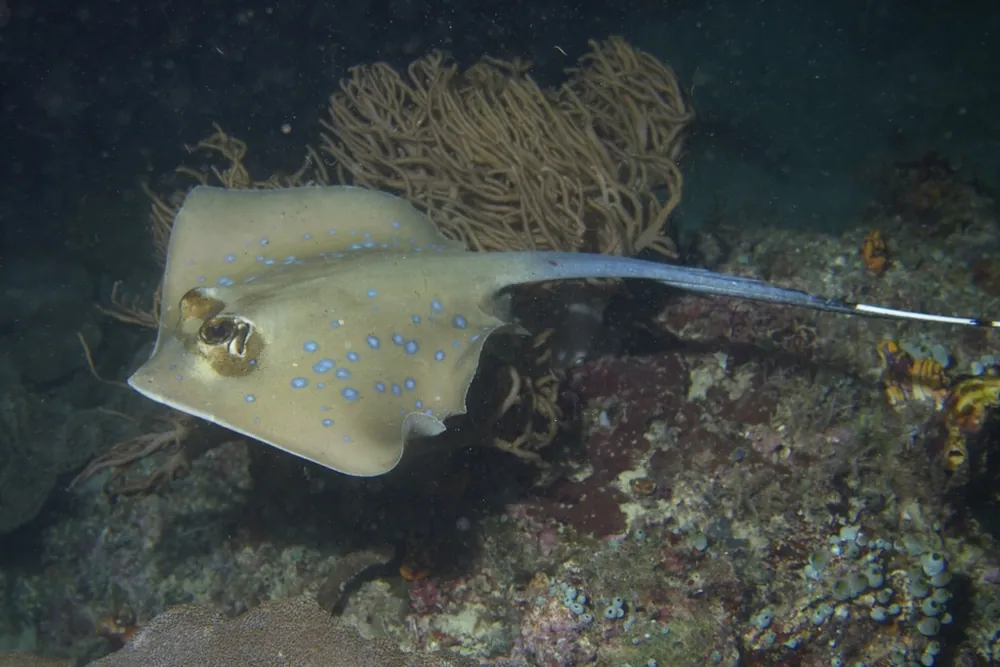
Kuhl's maskray is a flat, diamond-shaped stingray with green skin and blue spots. It lives on sandy and muddy seabeds in warm coastal waters from Indonesia to Japan and around most of Australia. Its tail has venomous spines, so it is important to know what it looks like and to keep a safe distance.1



 So erkennst du es
- Flat, diamond-shaped (rhomboid) body that is dark green with blue spots1
- Light white underside1
- Very short snout with an angular disc1
- Bright yellow eyes1
- Long tail, about twice the length of the body, with two venomous spines at its base, one large and one medium in size1
Oft verwechselt mit: It is often confused with the blue-spotted ribbontail ray, which is common in aquaria. The ribbontail has a rounded body, brighter green colouring and more vivid spots. Kuhl's maskray is larger.1
Giftkraft
Das Gift kommt durch einen Stachel heraus.
Was macht sein Gift, wenn es beißt oder sticht?
The venom contains serotonin, 5' nucleotidase and phosphodiesterase. These are active compounds that act on the body's tissues.1
Wie gefährlich ist es für Menschen?
Gefahr für Menschen: ErnstEin Stich gehört zum Arzt. Todesfälle sind sehr selten.It is very venomous. Its barb can be about 30 cm long.1
Was macht es, wenn es Angst hat?
Its bright colouring warns predators of its venomous spines. It buries itself in sand to hide from predators.1
 Wenn es sticht
- Leg die Wunde in heißes Wasser, so heiß, wie die Person es aushält, ohne sich zu verbrühen (prüf es mit deiner eigenen Hand), 30 bis 90 Minuten lang. Hol ärztliche Hilfe, besonders bei Steinfischen und Stachelrochen.
Ruf immer zuerst deine Notrufnummer an (112, 000, 911). Das sind allgemeine Erste-Hilfe-Hinweise, keine ärztliche Beratung. Erste-Hilfe-Grundlagen
 Bleib sicher
- Fass ein wildes Tier niemals an, fang es nicht und ärgere es nicht, auch kein kleines, und auch nicht, wenn es schlafend aussieht oder tot.
- Halte Abstand. Wenn du einem begegnest, bleib ruhig, geh langsam zurück und lass es seiner Wege gehen.
- Wenn dich eines sticht: Bleib ruhig, halt still, ruf deine Notrufnummer an (112, 000, 911) oder fahr schnell in ein Krankenhaus. Merk dir, wie es aussah, ein Foto hilft.
Es hat es nicht auf dich abgesehen. Es benutzt sein Gift, um Futter zu fangen oder sich zu schützen, und versteckt sich viel lieber. Mehr über Sicherheit
Wo auf der Welt?
Wie groß ist es?
Wie lang ist es?
 so lang wie 4 Bananen hintereinander
 könnte die Länge eines großen Schwimmbeckens (50 m) in 12 Sekunden schwimmen
Wie groß ist Kuhl's maskray im Vergleich zu DIR?
Nur Rechnen in deinem Browser. Nichts wird gespeichert oder irgendwohin geschickt.
Wie schnell ist es?

Fakten
Large sharks such as hammerhead sharks prey on it. A hammerhead pins it down with its head while the ray is in shock and much weaker.1
Its tail is about twice as long as its body and carries two venomous spines.1
Unlike most stingrays, which bury themselves to hunt, Kuhl's maskray buries itself in sand only to hide from predators.1
Its skin is used to make drums, such as the Arab and Turkish darbuka goblet drum and the riq tambourine.1
Two short peptides found in its hydrolysed proteins have shown protective effects against the oxidation of lipids, DNA and proteins. They may be useful as functional food ingredients or nutraceuticals.1
Für Giftexperten
- Wissenschaftlicher Name
- Neotrygon kuhlii
- Gruppe
- Giftfische
- Familie
- Dasyatidae2
- Ordnung
- Myliobatiformes
- Kontinente
- Indischer Ozean, Pazifischer Ozean, Korallenmeer, Andamanensee, Südchinesisches Meer, Philippinensee, Timorsee & Arafurasee, Golf von Bengalen, Die Ozeane
- Babys
- It gives birth to live young. The embryos develop inside eggs held in the mother's body and are fed by uterine fluid. A litter can have up to seven pups, each 15 to 33 cm long at birth.1
- Lebensdauer
- etwa 13 Jahre1
- Gefahr für Menschen
- 3 / 5: Ernst3
Woher die Fakten kommen
- Kuhl's maskray (Wikipedia (CC BY-SA 4.0))
- Neotrygon kuhlii (iNaturalist): Namen und Klassifikation.
- Venom Wiki: die Gefahrenstufe, die typische Größe und die geschätzte Geschwindigkeit sind von uns. So berechnen wir sie: So bewerten wir die Gefahr.
Jeder Fakt auf dieser Seite hat eine Nummer, die auf seine Quelle zeigt. Wenn wir etwas falsch haben: Entschuldigung, wir sind Tierfans, keine Fachzeitschrift. Schreib uns an [email protected] und wir korrigieren es.
 Der Skorpion hat Hunger! Venom Wiki ist ein Ein-Mann-Projekt: kostenlos, ohne Werbung und ohne Tracker. Ein kleines Trinkgeld hilft, es online zu halten.Füttere den Skorpion
Mehr aus derselben Gruppe: Giftfische
 Reef stonefishGiftfischeKann tötenNicht anfassen
 Red lionfishGiftfischeBraucht einen ArztNicht anfassen
 Estuarine stonefishGiftfischeKann tötenNicht anfassen
 Short-tail stingrayGiftfischeKann töten
 Striped eel catfishGiftfischeKann tötenNicht anfassen
 Bluespotted ribbontail rayGiftfischeBraucht einen Arzt
Lebt auch in: Indischer Ozean
 Australian box jellyfishQuallen & Nesseltiere im MeerTödlichNicht anfassen
 Geography coneKegelschnecken & KrakenTödlich
 Greater blue-ringed octopusKegelschnecken & KrakenTödlich
 Southern blue-ringed octopusKegelschnecken & KrakenTödlich
 Hawksbill sea turtleAndere passiv giftige TiereKann töten
 Irukandji jellyfishQuallen & Nesseltiere im MeerKann tötenNicht anfassen