
 Afrika
 Asien
Asien Europa
 Südamerika
 Australien & Ozeanien
 Antarktis
 Pazifischer Ozean
 Atlantischer Ozean
 Indischer Ozean
 Nordpolarmeer
 Mittelmeer
 Rotes Meer
 Karibisches Meer
 Korallenmeer
 Südchinesisches Meer
 Philippinensee
 Andamanensee
 Nordsee
 Timorsee & Arafurasee
 Golf von Bengalen
 Golf von Kalifornien
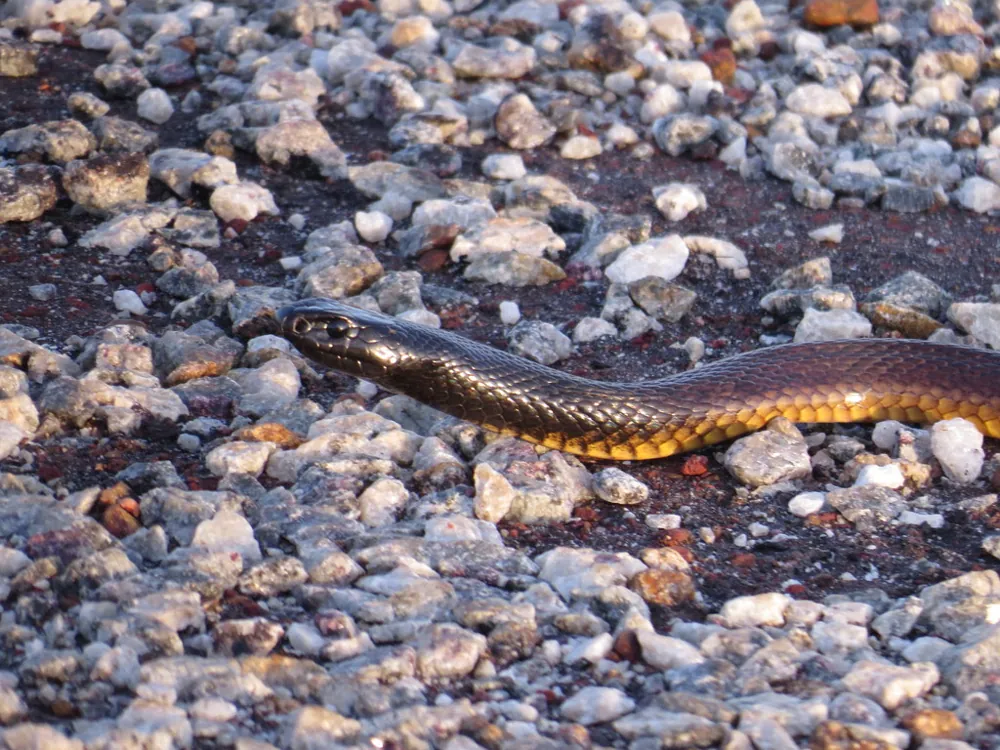
Northern brown snake
 Bisse
BisseThe northern brown snake is a fast, highly venomous snake found across the north of Australia. It lives in dry country, woodlands and grasslands, and sometimes near towns. It matters because its bite can be deadly, so it is important to know what it looks like and to keep your distance.1


 So erkennst du es
- Its back can be shades of orange-brown with flecks and bands, or it can be plain.1
- Its belly is cream to orange with pink blotches.1
- Some individuals have jet black heads.1
- Others have a black 'V' shape on the back of the neck, just below the head.1
- It grows up to 1.8 m in total length, including the tail.1
Oft verwechselt mit: Some northern brown snakes have jet black heads, which can cause them to be confused with the black-headed python.1
Giftkraft
Das Gift kommt beim Beißen durch die Giftzähne oder Zähne heraus.
Was macht sein Gift, wenn es beißt oder sticht?
Its venom contains neurotoxins, which attack the nerves, nephrotoxins, which damage the kidneys, and a procoagulant, which affects blood clotting. Although its venom is not the most toxic in the brown snake genus, each bite can deliver a relatively large amount, so it has a high potential to cause a deadly bite. Human symptoms include headache, nausea or vomiting, abdominal pain, severe coagulopathy (serious blood clotting problems) and sometimes kidney damage.1
Wie gefährlich ist es für Menschen?
Gefahr für Menschen: Sehr gefährlichEs kann einen Menschen töten, der keine Behandlung bekommt.The northern brown snake has a high potential to deliver a deadly bite. The bite is usually painless and is difficult to see because the fangs are small, so a bite can go unnoticed. In dogs and cats, paralysis is also likely to occur.1
Was macht es, wenn es Angst hat?
It usually prefers to retreat from danger, but it is very aggressive when disturbed or threatened and will defend itself if cornered.1
 Wenn es beißt
- Druck-Immobilisation: Wickle eine feste elastische Binde über den Biss und dann über den ganzen Arm oder das ganze Bein, leg eine Schiene an und halte die Person völlig still, bis Hilfe kommt.
- Wasch den Biss nicht ab: Im Krankenhaus kann man das Gift auf der Haut testen, um das richtige Gegengift (Antiserum) auszuwählen.
Ruf immer zuerst deine Notrufnummer an (112, 000, 911). Das sind allgemeine Erste-Hilfe-Hinweise, keine ärztliche Beratung. Erste-Hilfe-Grundlagen
 Bleib sicher
- Fass ein wildes Tier niemals an, fang es nicht und ärgere es nicht, auch kein kleines, und auch nicht, wenn es schlafend aussieht oder tot.
- Halte Abstand. Wenn du einem begegnest, bleib ruhig, geh langsam zurück und lass es seiner Wege gehen.
- Wenn dich eines beißt: Bleib ruhig, halt still, ruf deine Notrufnummer an (112, 000, 911) oder fahr schnell in ein Krankenhaus. Merk dir, wie es aussah, ein Foto hilft.
Es hat es nicht auf dich abgesehen. Es benutzt sein Gift, um Futter zu fangen oder sich zu schützen, und versteckt sich viel lieber. Mehr über Sicherheit
Wo auf der Welt?
Wie groß ist es?
Wie lang ist es?
 so lang wie 4 Hauskatzen von Nase bis Schwanz
 so lang wie 10 Bananen hintereinander
 könnte 100 Meter in 48 Sekunden schaffen (der schnellste Mensch braucht 9,6)
Wie groß ist Northern brown snake im Vergleich zu DIR?
Nur Rechnen in deinem Browser. Nichts wird gespeichert oder irgendwohin geschickt.
Wie schnell ist es?


Fakten
Although it is generally shy, it has been known to practise cannibalism, though this is not common.1
It can climb small shrubs or trees, although it is not a tree-dwelling species.1
Its name, gwardar, is an Aboriginal word meaning "go the long way around".1
It may become active at night during the warmer months, but it is otherwise active during the day and enjoys sunlight.1
Mythen-Check
Mythos: Snakes like this one always attack people.
Wahrheit: The northern brown snake is generally cautious and shy, and it usually retreats rather than attacks. It only defends itself strongly when it is cornered or threatened.1
Für Giftexperten
- Wissenschaftlicher Name
- Pseudonaja nuchalis
- Gruppe
- Australische Schlangen
- Familie
- Elapidae2
- Ordnung
- Squamata
- Kontinente
- Australien & Ozeanien
- Babys
- The mating season is roughly from September to November, and the female usually produces around 11 to 14 eggs, but may produce up to 38.1
- Gefahr für Menschen
- 4 / 5: Sehr gefährlich3
Woher die Fakten kommen
- Pseudonaja nuchalis (Wikipedia (CC BY-SA 4.0))
- Pseudonaja nuchalis (iNaturalist): Namen und Klassifikation.
- Venom Wiki: die Gefahrenstufe, die typische Größe und die geschätzte Geschwindigkeit sind von uns. So berechnen wir sie: So bewerten wir die Gefahr.
Jeder Fakt auf dieser Seite hat eine Nummer, die auf seine Quelle zeigt. Wenn wir etwas falsch haben: Entschuldigung, wir sind Tierfans, keine Fachzeitschrift. Schreib uns an [email protected] und wir korrigieren es.
 Der Skorpion hat Hunger! Venom Wiki ist ein Ein-Mann-Projekt: kostenlos, ohne Werbung und ohne Tracker. Ein kleines Trinkgeld hilft, es online zu halten.Füttere den Skorpion
Mehr aus derselben Gruppe: Australische Schlangen
 Küstentaipan
 Gewöhnliche Todesotter
 Östliche Braunschlange
 Inlandtaipan
 Tigerotter
 Collett's snake
Lebt auch in: Australien & Ozeanien
 Sydney-TrichternetzspinneVogelspinnen & TrichternetzspinnenTödlich
 Redback spiderSpinnenBraucht einen Arzt
 Brown tree snakeTrugnatternTut nur weh
 Hooded pitohuiAndere passiv giftige TiereTut nur wehNicht anfassen
 PlatypusGiftige SäugetiereTut nur weh
 Northern tree-dwelling funnel-web spiderVogelspinnen & TrichternetzspinnenTödlich