
 Afrika
 Asien
Asien Europa
 Südamerika
 Australien & Ozeanien
 Antarktis
 Pazifischer Ozean
 Atlantischer Ozean
 Indischer Ozean
 Nordpolarmeer
 Mittelmeer
 Rotes Meer
 Karibisches Meer
 Korallenmeer
 Südchinesisches Meer
 Philippinensee
 Andamanensee
 Nordsee
 Timorsee & Arafurasee
 Golf von Bengalen
 Golf von Kalifornien
Pygmy copperhead
 Bisse
BisseThe pygmy copperhead is a small, venomous snake found only in South Australia, mainly on Kangaroo Island and in the Fleurieu Peninsula and Mount Lofty Ranges. It is the smallest of the Australian copperheads. Its venom is dangerous, so prompt medical treatment matters.1


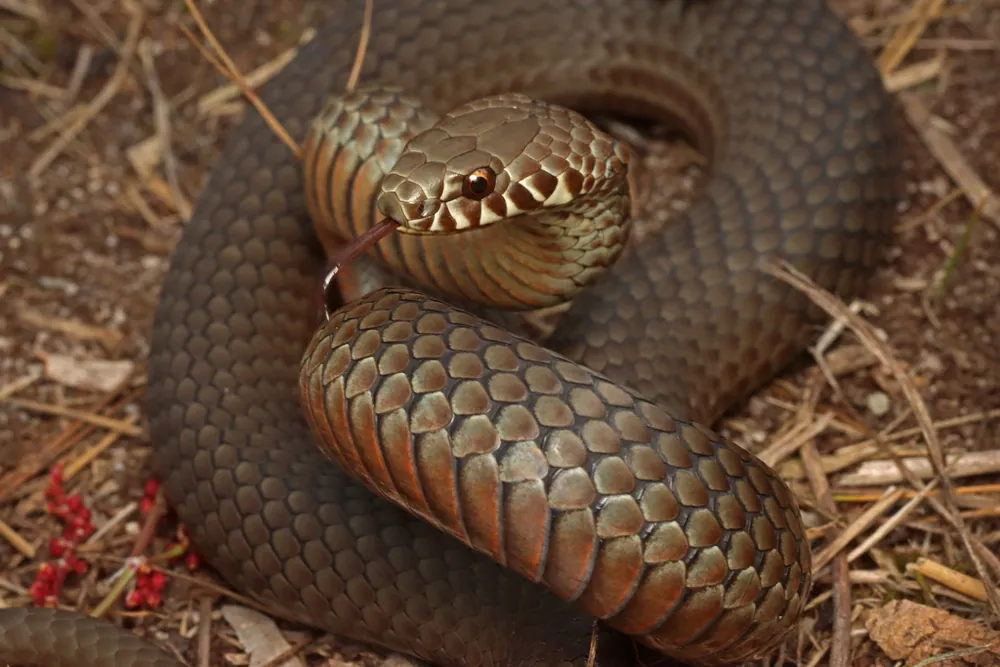
 So erkennst du es
- Dorsal scales are brown to grey, with a darker stripe along the spine.1
- The belly is cream to light grey, with red along the edges that fades to a brown-grey underside.1
- The lip scales are barred with dark colour.1
- Adults average about 80 cm long, with males usually larger than females.1
- Newborns often have paler backsides than adults.1
Oft verwechselt mit: The highland and lowland copperheads are larger, and the pygmy copperhead is the smallest of the Australian copperheads. It is not closely related to the American copperhead, Agkistrodon contortrix.1
Giftkraft
Das Gift kommt beim Beißen durch die Giftzähne oder Zähne heraus.
Was macht sein Gift, wenn es beißt oder sticht?
The venom is strongly neurotoxic, which means it attacks the nerves, and its toxicity is similar to that of the Indian cobra. It is weakly coagulant and strongly anticoagulant, meaning it can both disrupt blood clotting and destroy blood and muscle. Without prompt treatment, a bite can cause possibly irreversible damage to nerve endings.1
Wie gefährlich ist es für Menschen?
Gefahr für Menschen: ErnstEin Biss gehört zum Arzt. Todesfälle sind sehr selten.Bites are considered possibly lethal. The snake is not known for being aggressive and is unlikely to attack unless it is stepped on or purposely provoked.1
 Gute Nachricht: Ärzte haben dafür ein Medikament (Gegengift) oder eine Behandlung.1
Was macht es, wenn es Angst hat?
It is generally unobtrusive and usually hides under leaf litter, old iron and haystacks.1
 Wenn es beißt
- Prompt antivenom treatment is essential, because bites are considered lethal without it. Antivenom developed from tiger snake venom cannot completely neutralise the neurotoxicity of pygmy copperhead venom.1
- Druck-Immobilisation: Wickle eine feste elastische Binde über den Biss und dann über den ganzen Arm oder das ganze Bein, leg eine Schiene an und halte die Person völlig still, bis Hilfe kommt.
- Wasch den Biss nicht ab: Im Krankenhaus kann man das Gift auf der Haut testen, um das richtige Gegengift (Antiserum) auszuwählen.
Ruf immer zuerst deine Notrufnummer an (112, 000, 911). Das sind allgemeine Erste-Hilfe-Hinweise, keine ärztliche Beratung. Erste-Hilfe-Grundlagen
 Bleib sicher
- Fass ein wildes Tier niemals an, fang es nicht und ärgere es nicht, auch kein kleines, und auch nicht, wenn es schlafend aussieht oder tot.
- Halte Abstand. Wenn du einem begegnest, bleib ruhig, geh langsam zurück und lass es seiner Wege gehen.
- Wenn dich eines beißt: Bleib ruhig, halt still, ruf deine Notrufnummer an (112, 000, 911) oder fahr schnell in ein Krankenhaus. Merk dir, wie es aussah, ein Foto hilft.
Es hat es nicht auf dich abgesehen. Es benutzt sein Gift, um Futter zu fangen oder sich zu schützen, und versteckt sich viel lieber. Mehr über Sicherheit
Wo auf der Welt?
Wie groß ist es?
Wie lang ist es?
 so lang wie 2,5 Hauskatzen von Nase bis Schwanz
 so lang wie 7 Bananen hintereinander
 könnte 100 Meter in 56 Sekunden schaffen (der schnellste Mensch braucht 9,6)
Wie groß ist Pygmy copperhead im Vergleich zu DIR?
Nur Rechnen in deinem Browser. Nichts wird gespeichert oder irgendwohin geschickt.
Wie schnell ist es?


Fakten
Sightings on islands near Tasmania are probably the result of snakes stowing away on boats.1
It is the only snake endemic to South Australia.1
It is the smallest of the Australian copperhead snakes.1
Its litter size is about half that of the other Australian copperheads, which is linked to its smaller body size.1
In field research, only about two thirds of surveyed adult females were reproductive, which suggests females do not breed every year.1
Mythen-Check
Mythos: Because it is small and not aggressive, the pygmy copperhead is harmless.
Wahrheit: Its venom is strongly neurotoxic, and its bite is considered possibly lethal without prompt antivenom treatment.1
Woher die Fakten kommen
- Pygmy copperhead (Wikipedia (CC BY-SA 4.0))
- Austrelaps labialis (iNaturalist): Namen und Klassifikation.
- Venom Wiki: die Gefahrenstufe, die typische Größe und die geschätzte Geschwindigkeit sind von uns. So berechnen wir sie: So bewerten wir die Gefahr.
Jeder Fakt auf dieser Seite hat eine Nummer, die auf seine Quelle zeigt. Wenn wir etwas falsch haben: Entschuldigung, wir sind Tierfans, keine Fachzeitschrift. Schreib uns an [email protected] und wir korrigieren es.
 Der Skorpion hat Hunger! Venom Wiki ist ein Ein-Mann-Projekt: kostenlos, ohne Werbung und ohne Tracker. Ein kleines Trinkgeld hilft, es online zu halten.Füttere den Skorpion
Mehr aus derselben Gruppe: Australische Schlangen
 Coastal taipan
 Common death adder
 Eastern brown snake
 Inlandtaipan
 Tigerotter
 Collett's snake
Lebt auch in: Australien & Ozeanien
 Sydney funnel-web spiderVogelspinnen & TrichternetzspinnenTödlich
 Redback spiderSpinnenBraucht einen Arzt
 Brown tree snakeTrugnatternTut nur weh
 Hooded pitohuiAndere passiv giftige TiereTut nur wehNicht anfassen
 PlatypusGiftige SäugetiereTut nur weh
 Northern tree-dwelling funnel-web spiderVogelspinnen & TrichternetzspinnenTödlich