
 Afrika
 Asien
Asien Europa
 Südamerika
 Australien & Ozeanien
 Antarktis
 Pazifischer Ozean
 Atlantischer Ozean
 Indischer Ozean
 Nordpolarmeer
 Mittelmeer
 Rotes Meer
 Karibisches Meer
 Korallenmeer
 Südchinesisches Meer
 Philippinensee
 Andamanensee
 Nordsee
 Timorsee & Arafurasee
 Golf von Bengalen
 Golf von Kalifornien
Stephens' banded snake
 Bisse
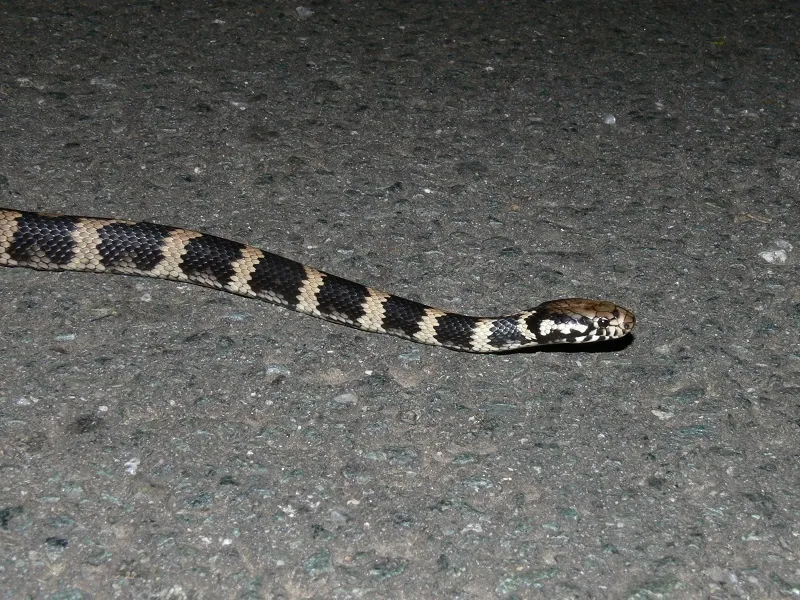
BisseStephens' banded snake is a tree-dwelling snake that lives only on the east coast of Australia. It is highly venomous, and its venom affects the blood, so it is one of the snakes that people should give plenty of space. It spends most of its life high in the trees of forests.1



 So erkennst du es
- Alternating bands of grey or black and dirty-white along the back, with over 40 of each colour from the back of the head to the tip of the tail1
- A flat, mostly dirty-white belly, with occasional grey splotches towards the head and tail1
- A dark brown top of the head, with pale blotches or bars along the lips1
- A slender body with a broadened, arrow-shaped head1
- Mostly active at night, and often found in tree hollows high in the canopy1
Oft verwechselt mit: Its closest relatives are the broad-headed snake, which shares its coastal range, and the pale-headed snake, which lives further inland. All three are tree-dwelling snakes in the same genus.1
Giftkraft
Das Gift kommt beim Beißen durch die Giftzähne oder Zähne heraus.
Was macht sein Gift, wenn es beißt oder sticht?
Its venom is procoagulant, meaning it makes blood clot. It contains prothrombinase, which triggers the production of thrombin in the blood, causing tiny clots throughout the body. Symptoms include nausea, headache, abdominal pain, vomiting, diarrhoea and sweating. If left untreated, the clotting leads to excessive bleeding as blood vessels rupture.1
Wie gefährlich ist es für Menschen?
Gefahr für Menschen: ErnstEin Biss gehört zum Arzt. Todesfälle sind sehr selten.It is described as a ready biter, and its envenoming is potentially fatal. Only one death has been recorded: an elderly man in his 60s in Kalang, New South Wales, whose rescue was delayed by torrential rain and floods.1
 Gute Nachricht: Ärzte haben dafür ein Medikament (Gegengift) oder eine Behandlung.1
Was macht es, wenn es Angst hat?
It is described as nervous and defensive towards other animals, and it is a ready biter when threatened.1
 Wenn es beißt
- Victims have been successfully treated with up to four doses of 3,000 unit tiger snake antivenom. The wounded person must be transported to hospital for medical treatment.1
- Druck-Immobilisation: Wickle eine feste elastische Binde über den Biss und dann über den ganzen Arm oder das ganze Bein, leg eine Schiene an und halte die Person völlig still, bis Hilfe kommt.
- Wasch den Biss nicht ab: Im Krankenhaus kann man das Gift auf der Haut testen, um das richtige Gegengift (Antiserum) auszuwählen.
Ruf immer zuerst deine Notrufnummer an (112, 000, 911). Das sind allgemeine Erste-Hilfe-Hinweise, keine ärztliche Beratung. Erste-Hilfe-Grundlagen
 Bleib sicher
- Fass ein wildes Tier niemals an, fang es nicht und ärgere es nicht, auch kein kleines, und auch nicht, wenn es schlafend aussieht oder tot.
- Halte Abstand. Wenn du einem begegnest, bleib ruhig, geh langsam zurück und lass es seiner Wege gehen.
- Wenn dich eines beißt: Bleib ruhig, halt still, ruf deine Notrufnummer an (112, 000, 911) oder fahr schnell in ein Krankenhaus. Merk dir, wie es aussah, ein Foto hilft.
Es hat es nicht auf dich abgesehen. Es benutzt sein Gift, um Futter zu fangen oder sich zu schützen, und versteckt sich viel lieber. Mehr über Sicherheit
Wo auf der Welt?
Wie groß ist es?
Wie lang ist es?
Wie schwer ist es?
 so lang wie 2,5 Hauskatzen von Nase bis Schwanz
 so lang wie 7 Bananen hintereinander
 könnte 100 Meter in 55 Sekunden schaffen (der schnellste Mensch braucht 9,6)
Wie groß ist Stephens' banded snake im Vergleich zu DIR?
Nur Rechnen in deinem Browser. Nichts wird gespeichert oder irgendwohin geschickt.
Wie schnell ist es?


Fakten
It is one of the few mainly tree-dwelling elapid snakes in Australia.1
A single individual may use up to 30 different trees within its range.1
It hibernates, or brumates, for up to five months through winter inside a tree hollow.1
Males may use home ranges averaging 20.2 hectares, while females average 5.4 hectares.1
It is the largest species in the genus Hoplocephalus, and females are usually larger than males.1
It is slow to mature, with males reaching sexual maturity at three years and females at four years.1
Für Giftexperten
- Wissenschaftlicher Name
- Hoplocephalus stephensii
- Gruppe
- Australische Schlangen
- Familie
- Elapidae2
- Ordnung
- Squamata
- Kontinente
- Australien & Ozeanien
- Babys
- It gives birth to live young, with between one and nine offspring per litter. Females are only pregnant every two years.1
- Wie es ihm in der Natur geht
- Near Threatened (IUCN Red List)1
- Gefahr für Menschen
- 3 / 5: Ernst3
Woher die Fakten kommen
- Stephens's banded snake (Wikipedia (CC BY-SA 4.0))
- Hoplocephalus stephensii (iNaturalist): Namen und Klassifikation.
- Venom Wiki: die Gefahrenstufe, die typische Größe und die geschätzte Geschwindigkeit sind von uns. So berechnen wir sie: So bewerten wir die Gefahr.
Jeder Fakt auf dieser Seite hat eine Nummer, die auf seine Quelle zeigt. Wenn wir etwas falsch haben: Entschuldigung, wir sind Tierfans, keine Fachzeitschrift. Schreib uns an [email protected] und wir korrigieren es.
 Der Skorpion hat Hunger! Venom Wiki ist ein Ein-Mann-Projekt: kostenlos, ohne Werbung und ohne Tracker. Ein kleines Trinkgeld hilft, es online zu halten.Füttere den Skorpion
Mehr aus derselben Gruppe: Australische Schlangen
 Küstentaipan
 Gewöhnliche Todesotter
 Östliche Braunschlange
 Inlandtaipan
 Tigerotter
 Collett's snake
Lebt auch in: Australien & Ozeanien
 Sydney-TrichternetzspinneVogelspinnen & TrichternetzspinnenTödlich
 Redback spiderSpinnenBraucht einen Arzt
 Brown tree snakeTrugnatternTut nur weh
 Hooded pitohuiAndere passiv giftige TiereTut nur wehNicht anfassen
 PlatypusGiftige SäugetiereTut nur weh
 Northern tree-dwelling funnel-web spiderVogelspinnen & TrichternetzspinnenTödlich