
 Afrika
 Asien
Asien Europa
 Südamerika
 Australien & Ozeanien
 Antarktis
 Pazifischer Ozean
 Atlantischer Ozean
 Indischer Ozean
 Nordpolarmeer
 Mittelmeer
 Rotes Meer
 Karibisches Meer
 Korallenmeer
 Südchinesisches Meer
 Philippinensee
 Andamanensee
 Nordsee
 Timorsee & Arafurasee
 Golf von Bengalen
 Golf von Kalifornien
Yellow-faced whip snake
 Bisse
BisseThe yellow-faced whip snake is a thin, fast snake with large eyes that lives across most of Australia. It is venomous, but its venom is mainly used on lizards and frogs, and it is not considered dangerous to people. It is one of the most widespread snakes found only in Australia.1



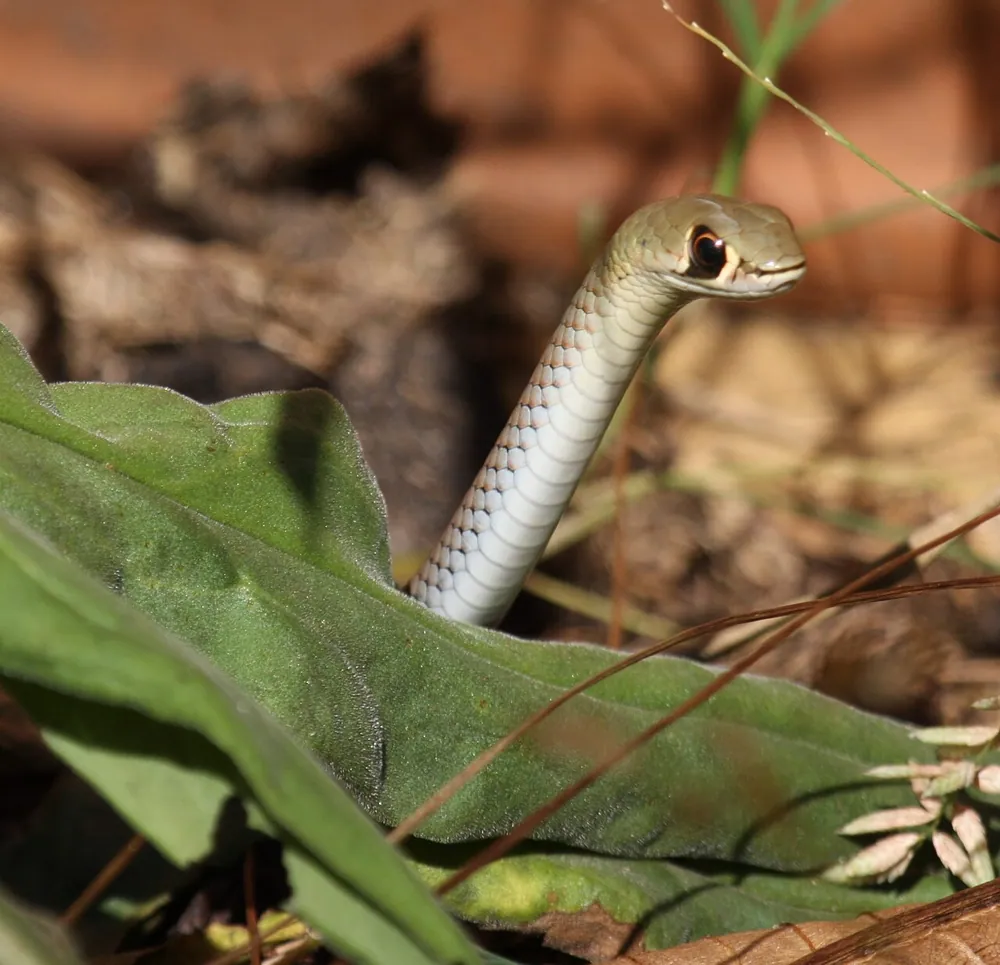
 So erkennst du es
- Has a narrow, yellowish head with a pale ring around each eye1
- A dark marking curves along the upper lip1
- Colour ranges from olive green to grey and brown, often with a red flush along the upper third of the back1
- Has large, prominent eyes, the largest of any Australian snake1
- Young snakes have a white-edged dark line across the snout1
Oft verwechselt mit: It is often confused with the eastern brown snake (Pseudonaja textilis) because the two look similar. Identifying it accurately requires a clear view of the head and counting the dorsal scales at mid-body, which number 15 rows.1
Giftkraft
Das Gift kommt beim Beißen durch die Giftzähne oder Zähne heraus.
Was macht sein Gift, wenn es beißt oder sticht?
The venom is toxic and deadly to other reptiles and amphibians, and it slows and eventually kills the prey. The venom is not considered dangerous to humans. Some bites cause systemic symptoms such as paralysis and bleeding, along with localised pain and swelling that can range from moderate to severe.1
Wie gefährlich ist es für Menschen?
Gefahr für Menschen: SchmerzhaftEs kann richtig wehtun, ist aber fast nie gefährlich.The venom is not considered dangerous to humans, but a bite will be painful. Some bites cause systemic symptoms such as paralysis and bleeding, so medical attention is needed.1
Was macht es, wenn es Angst hat?
It is fast-moving and nervous, and it flees quickly when disturbed.1
 Wenn es beißt
- Medical treatment should be sought after any snake bite.1
- Druck-Immobilisation: Wickle eine feste elastische Binde über den Biss und dann über den ganzen Arm oder das ganze Bein, leg eine Schiene an und halte die Person völlig still, bis Hilfe kommt.
- Wasch den Biss nicht ab: Im Krankenhaus kann man das Gift auf der Haut testen, um das richtige Gegengift (Antiserum) auszuwählen.
Ruf immer zuerst deine Notrufnummer an (112, 000, 911). Das sind allgemeine Erste-Hilfe-Hinweise, keine ärztliche Beratung. Erste-Hilfe-Grundlagen
 Bleib sicher
- Fass ein wildes Tier niemals an, fang es nicht und ärgere es nicht, auch kein kleines, und auch nicht, wenn es schlafend aussieht oder tot.
- Halte Abstand. Wenn du einem begegnest, bleib ruhig, geh langsam zurück und lass es seiner Wege gehen.
- Wenn dich eines beißt: Bleib ruhig, halt still, ruf deine Notrufnummer an (112, 000, 911) oder fahr schnell in ein Krankenhaus. Merk dir, wie es aussah, ein Foto hilft.
Es hat es nicht auf dich abgesehen. Es benutzt sein Gift, um Futter zu fangen oder sich zu schützen, und versteckt sich viel lieber. Mehr über Sicherheit
Wo auf der Welt?
Wie groß ist es?
Wie lang ist es?
 so lang wie 2 Hauskatzen von Nase bis Schwanz
 so lang wie 6 Bananen hintereinander
 könnte 100 Meter in 55 Sekunden schaffen (der schnellste Mensch braucht 9,6)
Wie groß ist Yellow-faced whip snake im Vergleich zu DIR?
Nur Rechnen in deinem Browser. Nichts wird gespeichert oder irgendwohin geschickt.
Wie schnell ist es?


Fakten
It has the largest eyes of any Australian snake, which helps it hunt successfully during the day.1
Snakes often gather in communities, and some communal nests contain 500 to 600 eggs.1
Young snakes often constrict their prey, but adults rarely do so and usually use venom instead.1
Although it is mainly active by day, it also forages at night for nocturnal prey such as geckos and frogs.1
In winter it slows down through brumation and moves mainly to find sun and water.1
Mythen-Check
Mythos: The yellow-faced whip snake is a dangerous snake to people because it is venomous.
Wahrheit: Its venom is deadly to lizards, frogs and other reptiles, but it is not considered dangerous to humans. Its bites are still painful and medical care should be sought.1
Für Giftexperten
- Wissenschaftlicher Name
- Demansia psammophis
- Gruppe
- Australische Schlangen
- Familie
- Elapidae2
- Ordnung
- Squamata
- Kontinente
- Australien & Ozeanien
- Babys
- It lays eggs in clutches of 5 to 6 or 15 to 20, and some communal nests hold 500 to 600 eggs. Hatchlings measure about 17 cm snout to vent.1
- Wie es ihm in der Natur geht
- Least concern (IUCN Red List); near-threatened in Victoria1
- Gefahr für Menschen
- 2 / 5: Schmerzhaft3
Woher die Fakten kommen
- Yellow-faced whipsnake (Wikipedia (CC BY-SA 4.0))
- Demansia psammophis (iNaturalist): Namen und Klassifikation.
- Venom Wiki: die Gefahrenstufe, die typische Größe und die geschätzte Geschwindigkeit sind von uns. So berechnen wir sie: So bewerten wir die Gefahr.
Jeder Fakt auf dieser Seite hat eine Nummer, die auf seine Quelle zeigt. Wenn wir etwas falsch haben: Entschuldigung, wir sind Tierfans, keine Fachzeitschrift. Schreib uns an [email protected] und wir korrigieren es.
 Der Skorpion hat Hunger! Venom Wiki ist ein Ein-Mann-Projekt: kostenlos, ohne Werbung und ohne Tracker. Ein kleines Trinkgeld hilft, es online zu halten.Füttere den Skorpion
Mehr aus derselben Gruppe: Australische Schlangen
 Küstentaipan
 Gewöhnliche Todesotter
 Östliche Braunschlange
 Inlandtaipan
 Tigerotter
 Collett's snake
Lebt auch in: Australien & Ozeanien
 Sydney-TrichternetzspinneVogelspinnen & TrichternetzspinnenTödlich
 Redback spiderSpinnenBraucht einen Arzt
 Brown tree snakeTrugnatternTut nur weh
 Hooded pitohuiAndere passiv giftige TiereTut nur wehNicht anfassen
 PlatypusGiftige SäugetiereTut nur weh
 Northern tree-dwelling funnel-web spiderVogelspinnen & TrichternetzspinnenTödlich