
 África
 Asia
Asia Europa
 Sudamérica
 Australia y Oceanía
 Antártida
 Océano Pacífico
 Océano Atlántico
 Océano Índico
 Océano Ártico
 Mar Mediterráneo
 Mar Rojo
 Mar Caribe
 Mar del Coral
 Mar de China Meridional
 Mar de Filipinas
 Mar de Andamán
 Mar del Norte
 Mar de Timor y de Arafura
 Golfo de Bengala
 Golfo de California
Crown-of-thorns starfish
 Púas venenosas
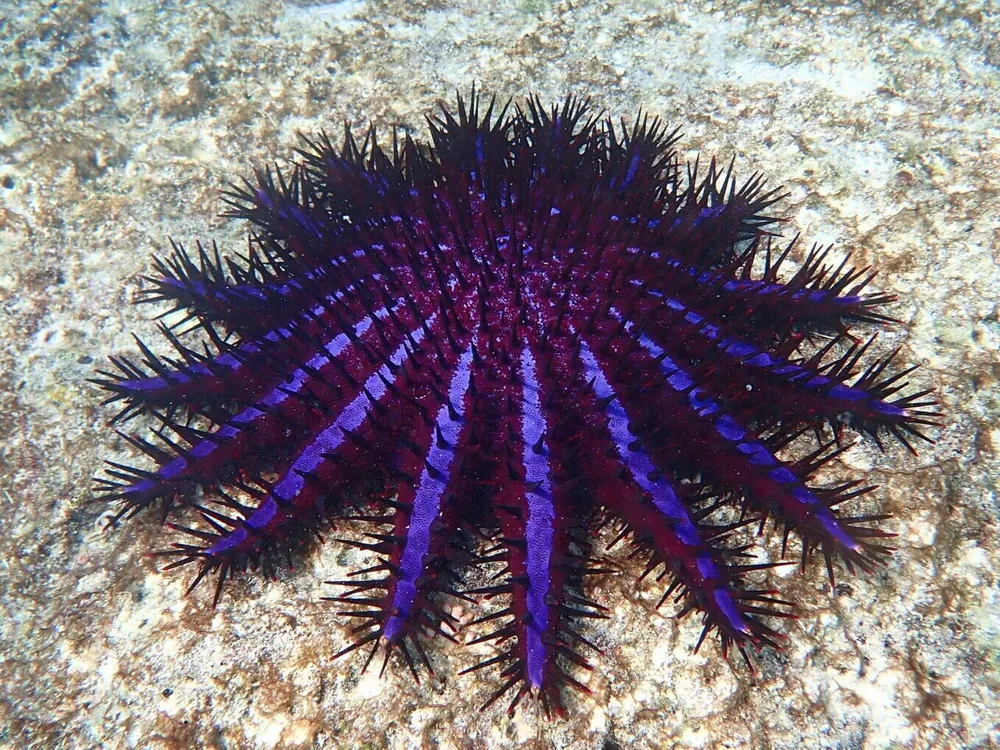
The crown-of-thorns starfish is a large starfish with long, sharp spines that look like a crown of thorns. It lives on coral reefs across the Indo-Pacific, from the Red Sea to the west coast of Central America, and it is most common around Australia. It feeds on hard coral, so it can change the reefs it lives on.1

 Cómo reconocerlo
- Adults are normally 25 to 35 cm across.1
- Up to 21 arms, with long, stiff, very sharp spines that are 4 to 5 cm long on the top and sides of the arms.1
- Colour varies with diet or region: purple, purple-blue, reddish grey or brown with red spine tips, or green with yellow spine tips.1
- The body is flexible and can bend and twist around coral surfaces.1
Se confunde a menudo con: A close relative, Acanthaster brevispinus, lives on soft sea floors at moderate depths rather than on coral reefs. The two are considered sibling species.1
Poder del veneno
Unas púas afiladas llevan el veneno. Pisarlo o agarrarlo duele.
¿Qué hace su veneno?
The spines do not inject venom. When they pierce skin, tissue containing saponins (detergent-like chemicals) is left in the wound. In humans this causes a sharp, stinging pain that can last several hours, persistent bleeding, and nausea and swelling that may last a week or more.1
¿Qué peligro tiene para las personas?
Peligro para las personas: GraveSi sus púas se te clavan, ve al médico. Las muertes son muy raras.The spines can cause sharp pain, long-lasting bleeding, nausea and swelling. Brittle spines can break off and stay in the tissue.1
 Si sus púas se te clavan
- Spines that become embedded in the tissue must be removed surgically.1
- Mete la herida en agua caliente, tan caliente como la persona aguante sin quemarse, y busca ayuda médica para quitar las púas. No las saques tú hurgando.
Llama siempre primero a tu número de emergencias (112, 000, 911). Esto son pautas generales de primeros auxilios, no consejo médico. Primeros auxilios básicos
 Mantente a salvo
- Nunca toques, atrapes ni molestes a un animal salvaje, aunque sea pequeño y aunque parezca dormido o muerto.
- Déjale espacio. Si te encuentras uno, mantén la calma, retrocede despacio y deja que siga su camino.
- Si sus púas se te clavan: mantén la calma, no te muevas, llama a tu número de emergencias (112, 000, 911) o ve rápido a un hospital. Recuerda cómo era, una foto ayuda.
No va a por ti. Usa su veneno para cazar o defenderse, y prefiere mil veces esconderse. Más sobre cómo protegerte
¿En qué parte del mundo?
¿Qué tamaño tiene?
¿Cuánto mide?
 mide como 11 piezas de construcción de juguete en fila
 más lento que un caracol de jardín
¿Qué tamaño tiene Crown-of-thorns starfish comparado contigo?
Solo cálculos en tu navegador. No se guarda ni se envía nada a ningún sitio.
¿Qué velocidad alcanza?

.jpg)
Datos
An individual starfish can consume up to 6 square metres of living coral reef per year.1
When taken out of water, its soft body ruptures and collapses, but its spines can recover their shape if it is put back in the water while still alive.1
Its body contains detergent-like saponins, so keeping starfish in small volumes of water with aeration produces large amounts of foam.1
It is one of the largest starfish in the world.1
It has lost the usual five-fold symmetry of starfish as it grew more arms, although it begins life with five-fold symmetry.1
Cazamitos
Mito: Its spines inject venom like a snake or stinging animal.
Verdad: It has no mechanism for injecting toxin. Its spines pierce skin and leave saponin-containing tissue in the wound.1
Para expertos en veneno
- Nombre científico
- Acanthaster planci
- Grupo
- Erizos, estrellas y gusanos
- Familia
- Acanthasteridae2
- Orden
- Valvatida
- Continentes
- Océano Índico, Océano Pacífico, Mar Rojo, Mar del Coral, Mar de Filipinas, Mar de China Meridional, Mar de Andamán, Mar Arábigo y golfo Pérsico, Mar de Timor y de Arafura, Golfo de Bengala, Los océanos
- Crías
- It releases vast amounts of eggs and sperm (gametes) during mass spawning events in summer, and the eggs contain saponins similar to those in adults.1
- Peligro para las personas
- 3 / 5: Grave3
De dónde salen los datos
- Crown-of-thorns starfish (Wikipedia (CC BY-SA 4.0))
- Acanthaster planci (iNaturalist): nombres y clasificación.
- Venom Wiki: el nivel de peligro, el tamaño típico y la velocidad estimada son nuestros. Mira cómo los calculamos: Cómo valoramos el peligro.
Cada dato de esta página tiene un número que lleva a su fuente. Si nos hemos equivocado en algo, perdón, somos fans de los animales, no una revista científica. Escríbenos a [email protected] y lo arreglamos.
 ¡El escorpión tiene hambre! Venom Wiki es un proyecto de una sola persona: gratis, sin anuncios y sin rastreadores. Una pequeña propina ayuda a mantenerlo en línea.Alimenta al escorpión
Más del mismo grupo: Erizos, estrellas y gusanos
 Flower urchinErizos, estrellas y gusanosPuede matar
 Fire urchinErizos, estrellas y gusanosNecesita médicoNo tocar
 Bearded firewormErizos, estrellas y gusanosSolo dueleNo tocar
 Black long-spined urchinErizos, estrellas y gusanosSolo dueleNo tocar
 BloodwormErizos, estrellas y gusanosSolo duele
 Bobbit wormErizos, estrellas y gusanosSolo duele
También vive en: Océano Índico
 Avispa de marMedusas y picadores marinosMortalNo tocar
 Cono geógrafoCaracoles cono y pulposMortal
 Pulpo de anillos azules mayorCaracoles cono y pulposMortal
 Pulpo de anillos azules del surCaracoles cono y pulposMortal
 Hawksbill sea turtleOtros animales tóxicosPuede matar
 Irukandji jellyfishMedusas y picadores marinosPuede matarNo tocar