
 África
 Asia
Asia Europa
 Sudamérica
 Australia y Oceanía
 Antártida
 Océano Pacífico
 Océano Atlántico
 Océano Índico
 Océano Ártico
 Mar Mediterráneo
 Mar Rojo
 Mar Caribe
 Mar del Coral
 Mar de China Meridional
 Mar de Filipinas
 Mar de Andamán
 Mar del Norte
 Mar de Timor y de Arafura
 Golfo de Bengala
 Golfo de California
Irukandji jellyfish
 Tentáculos urticantes
The Irukandji jellyfish is a tiny box jellyfish with a sting that can cause a serious illness called Irukandji syndrome. It lives in the open water near Australia, and it is hard to spot because it is so small.1



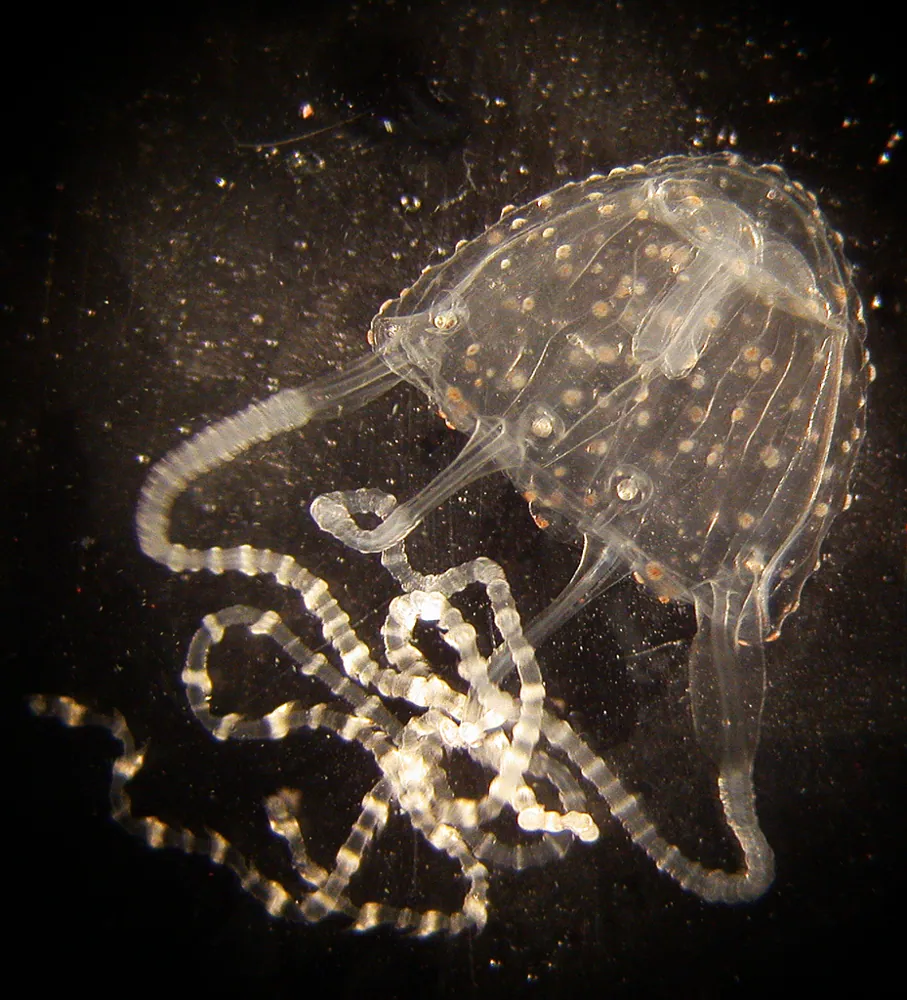
 Cómo reconocerlo
- The bell is square-shaped and very small, about 12 mm high and 30 mm across.1
- It has four long tentacles, one from each corner of the bell.1
- The tentacles range from 5 to 50 cm long.1
- Its small size means it often goes unseen in open water.1
Se confunde a menudo con: The common name Irukandji jellyfish is also used for other Irukandji jellyfish, such as Malo kingi. The name alone does not tell them apart.1
Poder del veneno
Miles de células urticantes diminutas se disparan cuando algo las toca.
¿Qué hace su veneno?
This jellyfish is extremely venomous. Its venom comes from stinging cells called nematocysts in its tentacles and bell, and it changes as the jellyfish matures. A sting can cause Irukandji syndrome, with muscle aches, back pain, nausea, headaches, chest and stomach pains, sweating, high blood pressure and difficulty breathing.1
¿Qué peligro tiene para las personas?
Peligro para las personas: Muy peligrosoPuede matar a una persona que no recibe tratamiento.Irukandji syndrome can be severe, and the symptoms are described in detail in medical accounts. Most reported incidents have been in Australia during the warm summer season. Because the jellyfish is so small, people often do not see it before they are stung.1
 Si pica
- In hospital, patients are given intravenous morphine, hydromorphone or fentanyl for pain. Pethidine is avoided because of its toxic metabolite norpethidine.1
- Sal del agua y quita los tentáculos que queden (con guantes o un trapo).
- Para las cubomedusas tropicales: echa vinagre sobre las picaduras al menos 30 segundos, pide ayuda y prepárate para hacer RCP. Para fragatas portuguesas y la mayoría de las demás: aclara con agua de mar y luego agua caliente para el dolor.
Llama siempre primero a tu número de emergencias (112, 000, 911). Esto son pautas generales de primeros auxilios, no consejo médico. Primeros auxilios básicos
 Mantente a salvo
- Nunca toques, atrapes ni molestes a un animal salvaje, aunque sea pequeño y aunque parezca dormido o muerto.
- Déjale espacio. Si te encuentras uno, mantén la calma, retrocede despacio y deja que siga su camino.
- Si te pica: mantén la calma, no te muevas, llama a tu número de emergencias (112, 000, 911) o ve rápido a un hospital. Recuerda cómo era, una foto ayuda.
No va a por ti. Usa su veneno para cazar o defenderse, y prefiere mil veces esconderse. Más sobre cómo protegerte
¿En qué parte del mundo?
¿Qué tamaño tiene?
¿Cuánto mide?
 más corto que tu dedo meñique
 podría nadar el largo de una piscina grande (50 m) en 36 segundos
¿Qué tamaño tiene Irukandji jellyfish comparado contigo?
Solo cálculos en tu navegador. No se guarda ni se envía nada a ningún sitio.
¿Qué velocidad alcanza?
Datos
Jack Barnes of Cairns, Australia, discovered the species. During an exploration aimed at finding the cause of Irukandji syndrome, he allowed himself, a lifeguard and his 9-year-old son to be stung.1
Irukandji syndrome, which this jellyfish can cause, was first identified after a group of swimmers were stung in open water near North Queensland, Australia.1
Its venom changes in composition as the jellyfish grows, matching its change in prey from invertebrates to fish.1
Its life cycle alternates between a young form that attaches to a reef or rock and an adult form that swims freely in the water.1
This jellyfish is a type of box jellyfish, a group known for potent venom.1
Para expertos en veneno
- Nombre científico
- Carukia barnesi
- Grupo
- Medusas y picadores marinos
- Familia
- Carukiidae2
- Orden
- Carybdeida
- Continentes
- Océano Índico, Océano Pacífico, Mar del Coral, Mar de Timor y de Arafura, Los océanos
- Crías
- Young jellyfish begin as a swimming planula larva, which settles on a reef or rock and grows into a polyp. The polyp later forms a colony that develops into an adult medusa.1
- Peligro para las personas
- 4 / 5: Muy peligroso3
De dónde salen los datos
- Carukia barnesi (Wikipedia (CC BY-SA 4.0))
- Carukia barnesi (iNaturalist): nombres y clasificación.
- Venom Wiki: el nivel de peligro, el tamaño típico y la velocidad estimada son nuestros. Mira cómo los calculamos: Cómo valoramos el peligro.
Cada dato de esta página tiene un número que lleva a su fuente. Si nos hemos equivocado en algo, perdón, somos fans de los animales, no una revista científica. Escríbenos a [email protected] y lo arreglamos.
 ¡El escorpión tiene hambre! Venom Wiki es un proyecto de una sola persona: gratis, sin anuncios y sin rastreadores. Una pequeña propina ayuda a mantenerlo en línea.Alimenta al escorpión
Más del mismo grupo: Medusas y picadores marinos
 Avispa de marMedusas y picadores marinosMortalNo tocar
 Portuguese man o' warMedusas y picadores marinosNecesita médicoNo tocar
 Lion's mane jellyfishMedusas y picadores marinosSolo dueleNo tocar
 Moon jellyfishMedusas y picadores marinosInofensivo
 Common kingslayerMedusas y picadores marinosPuede matarNo tocar
 Hell's fire anemoneMedusas y picadores marinosNecesita médicoNo tocar
También vive en: Océano Índico
 Cono geógrafoCaracoles cono y pulposMortal
 Pulpo de anillos azules mayorCaracoles cono y pulposMortal
 Pulpo de anillos azules del surCaracoles cono y pulposMortal
 Hawksbill sea turtleOtros animales tóxicosPuede matar
 Reef stonefishPeces venenososPuede matarNo tocar
 Crown-of-thorns starfishErizos, estrellas y gusanosNecesita médicoNo tocar