
 África
 Asia
Asia Europa
 Sudamérica
 Australia y Oceanía
 Antártida
 Océano Pacífico
 Océano Atlántico
 Océano Índico
 Océano Ártico
 Mar Mediterráneo
 Mar Rojo
 Mar Caribe
 Mar del Coral
 Mar de China Meridional
 Mar de Filipinas
 Mar de Andamán
 Mar del Norte
 Mar de Timor y de Arafura
 Golfo de Bengala
 Golfo de California
Lion's mane jellyfish
 Tentáculos urticantes
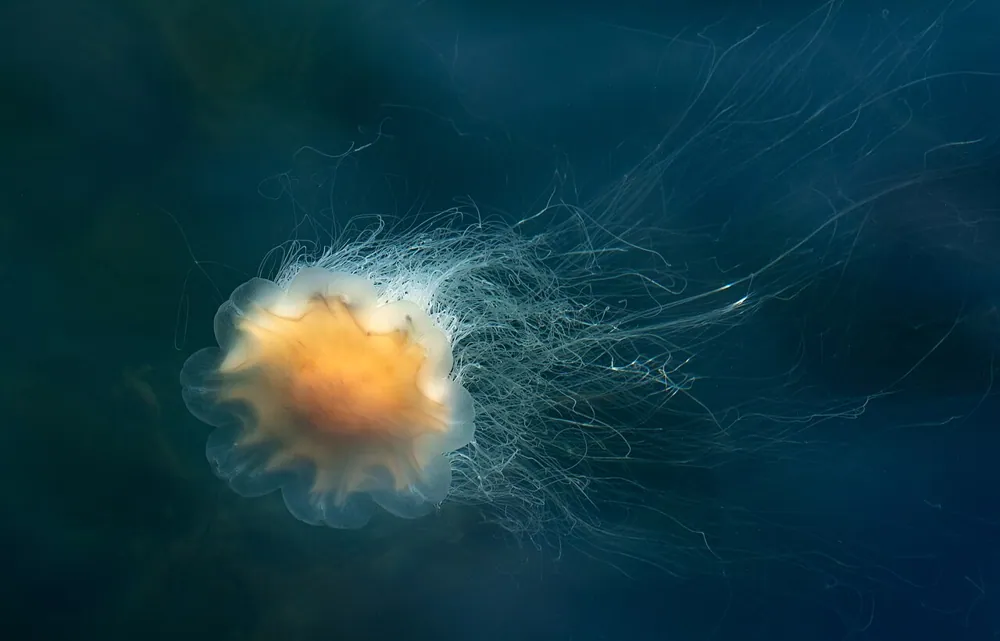
The lion's mane jellyfish is one of the largest jellyfish known, and its bell can be over 2 m across in the far north. It lives in cold northern seas, including the English Channel, the North Sea and the Irish Sea. Its long, trailing stinging tentacles can wash up on beaches in late summer and autumn.1



 Cómo reconocerlo
- Bell is divided into eight lobes, giving it the look of an eight-point star1
- Young ones are light orange or tan, darkening to red and purple as they grow1
- Long, thin, trailing tentacles, with many more tentacles around the mouth1
- Bell is often about 50 cm across in lower latitudes, and much larger in the far north1
- Usually found alone, rarely in groups1
Se confunde a menudo con: The blue jellyfish (Cyanea lamarckii) is sometimes found in the same waters. It is blue rather than red, and smaller, with a bell of about 10 to 20 cm across.1
Poder del veneno
Miles de células urticantes diminutas se disparan cuando algo las toca.
¿Qué hace su veneno?
Its tentacles carry stinging cells, called nematocysts, which inject a sting when touched. The sting is very painful and feels like intense itching or burning, and it can cause temporary pain and redness where the skin was touched. Stings across large parts of the body can cause whole-body (systemic) effects, and medical attention is recommended in that case.1
¿Qué peligro tiene para las personas?
Peligro para las personas: DolorosoPuede doler de verdad, pero casi nunca es grave.Stings are not known to be fatal in healthy people, and there is normally no real danger, though people with special allergies may be at risk. Rare severe stings in deep water can cause panic, which may lead to drowning. In July 2010, about 150 beachgoers were stung by the remains of one broken-up jellyfish on a beach in New Hampshire, US.1
 Si pica
- Vinegar can be used to deactivate the stinging cells. If you have touched a large number of tentacles, get medical attention after exposure.1
- Sal del agua y quita los tentáculos que queden (con guantes o un trapo).
- Para las cubomedusas tropicales: echa vinagre sobre las picaduras al menos 30 segundos, pide ayuda y prepárate para hacer RCP. Para fragatas portuguesas y la mayoría de las demás: aclara con agua de mar y luego agua caliente para el dolor.
Llama siempre primero a tu número de emergencias (112, 000, 911). Esto son pautas generales de primeros auxilios, no consejo médico. Primeros auxilios básicos
 Mantente a salvo
- Nunca toques, atrapes ni molestes a un animal salvaje, aunque sea pequeño y aunque parezca dormido o muerto.
- Déjale espacio. Si te encuentras uno, mantén la calma, retrocede despacio y deja que siga su camino.
- Si te pica: mantén la calma, no te muevas, llama a tu número de emergencias (112, 000, 911) o ve rápido a un hospital. Recuerda cómo era, una foto ayuda.
No va a por ti. Usa su veneno para cazar o defenderse, y prefiere mil veces esconderse. Más sobre cómo protegerte
¿En qué parte del mundo?
¿Qué tamaño tiene?
¿Cuánto mide?
 mide como 4 gatos domésticos de la nariz a la cola
 mide como 12 plátanos puestos en fila
 podría nadar el largo de una piscina grande (50 m) en 140 segundos
¿Qué tamaño tiene Lion's mane jellyfish comparado contigo?
Solo cálculos en tu navegador. No se guarda ni se envía nada a ningún sitio.
¿Qué velocidad alcanza?

Datos
The longest recorded tentacles were 36.6 m long, longer than a blue whale.1
Its tentacles can still sting for up to 25 days after they have detached from the jellyfish.1
Each of the eight lobes of its bell has about 70 to 150 tentacles, and it has around 1,200 tentacles near its mouth.1
The leatherback sea turtle feeds almost exclusively on lion's mane jellyfish in large numbers during summer around Eastern Canada.1
Unlike most jellyfish that drift in groups, the lion's mane is completely solitary.1
Cazamitos
Mito: The lion's mane jellyfish is the longest animal in the world.
Verdad: This claim was made on a TV show, but it was corrected. A bootlace worm reported in 1864 was said to be over 55 m long, and that report is doubted because bootlace worms can stretch well beyond their natural length. If that report is wrong, the lion's mane would be the longest animal.1
Para expertos en veneno
- Nombre científico
- Cyanea capillata
- Grupo
- Medusas y picadores marinos
- Familia
- Cyaneidae2
- Orden
- Semaeostomeae
- Continentes
- Océano Ártico, Océano Atlántico, Océano Pacífico, Mar del Norte, Los océanos
- Crías
- The female carries fertilised eggs in a tentacle, and they grow into larvae that settle on a hard surface and become polyps, which then produce young jellyfish called ephyrae.1
- Esperanza de vida
- unos 1 años1
- Peligro para las personas
- 2 / 5: Doloroso3
De dónde salen los datos
- Lion's mane jellyfish (Wikipedia (CC BY-SA 4.0))
- Cyanea capillata (iNaturalist): nombres y clasificación.
- Venom Wiki: el nivel de peligro, el tamaño típico y la velocidad estimada son nuestros. Mira cómo los calculamos: Cómo valoramos el peligro.
Cada dato de esta página tiene un número que lleva a su fuente. Si nos hemos equivocado en algo, perdón, somos fans de los animales, no una revista científica. Escríbenos a [email protected] y lo arreglamos.
 ¡El escorpión tiene hambre! Venom Wiki es un proyecto de una sola persona: gratis, sin anuncios y sin rastreadores. Una pequeña propina ayuda a mantenerlo en línea.Alimenta al escorpión
Más del mismo grupo: Medusas y picadores marinos
 Avispa de marMedusas y picadores marinosMortalNo tocar
 Irukandji jellyfishMedusas y picadores marinosPuede matarNo tocar
 Portuguese man o' warMedusas y picadores marinosNecesita médicoNo tocar
 Moon jellyfishMedusas y picadores marinosInofensivo
 Common kingslayerMedusas y picadores marinosPuede matarNo tocar
 Hell's fire anemoneMedusas y picadores marinosNecesita médicoNo tocar
 Greenland shark
 Spiny dogfish
 Bootlace worm