
 África
 Asia
Asia Europa
 Sudamérica
 Australia y Oceanía
 Antártida
 Océano Pacífico
 Océano Atlántico
 Océano Índico
 Océano Ártico
 Mar Mediterráneo
 Mar Rojo
 Mar Caribe
 Mar del Coral
 Mar de China Meridional
 Mar de Filipinas
 Mar de Andamán
 Mar del Norte
 Mar de Timor y de Arafura
 Golfo de Bengala
 Golfo de California
Portuguese man o' war
 Tentáculos urticantes
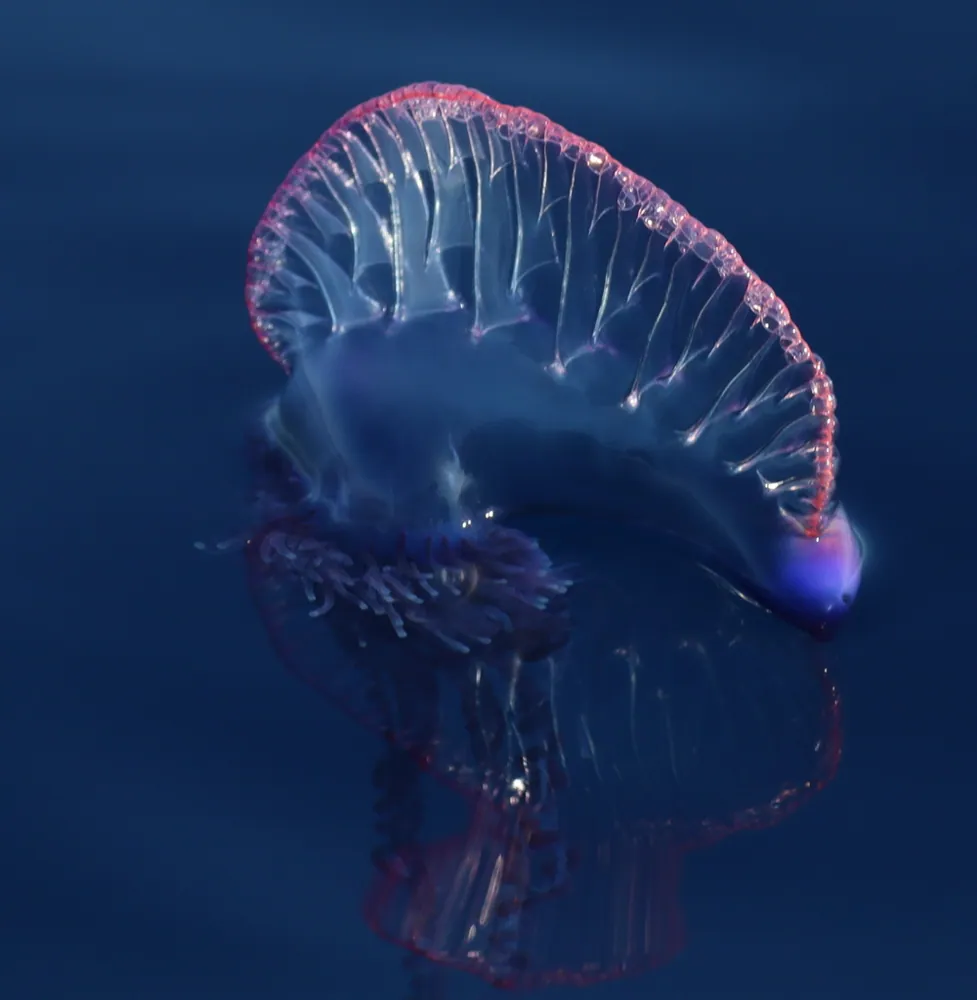
The Portuguese man o' war looks like a jellyfish, but it is actually a colony of many tiny linked animals that work together as one. It drifts on the surface of the Atlantic, Indian and Pacific oceans, and its long tentacles sting prey. Its sting is painful to people, and in some cases it can kill them.1



 Cómo reconocerlo
- A gas-filled bladder called the pneumatophore floats on the surface and acts as a sail.1
- Long tentacles, which can reach over 30 m, hang below the surface.1
- The float can be up to 30 cm long, 13 cm wide and 15 cm tall.1
- Groups can be large, sometimes over 1,000 animals.1
- The sail may be left- or right-handed, depending on the way the wind catches it.1
Se confunde a menudo con: It superficially resembles a jellyfish, but it is a siphonophore, a colonial animal made of many smaller units called zooids.1
Poder del veneno
Miles de células urticantes diminutas se disparan cuando algo las toca.
¿Qué hace su veneno?
Its tentacles carry nematocysts, tiny coiled, thread-like stingers that inject venom on contact. The venom can paralyse small fish and other prey. The sting is powerful enough to kill fish, crustaceans and, in some cases, humans.1
¿Qué peligro tiene para las personas?
Peligro para las personas: GraveUna picadura necesita médico. Las muertes son muy raras.Its stings are painful and it is well known to beachgoers. In some cases the sting can kill humans. Large groups can also reduce fish populations and damage fishing supplies.1
¿Qué hace cuando se asusta?
When attacked at the surface, it can deflate its pneumatophore and temporarily submerge.1
 Si pica
- Sal del agua y quita los tentáculos que queden (con guantes o un trapo).
- Para las cubomedusas tropicales: echa vinagre sobre las picaduras al menos 30 segundos, pide ayuda y prepárate para hacer RCP. Para fragatas portuguesas y la mayoría de las demás: aclara con agua de mar y luego agua caliente para el dolor.
Llama siempre primero a tu número de emergencias (112, 000, 911). Esto son pautas generales de primeros auxilios, no consejo médico. Primeros auxilios básicos
 Mantente a salvo
- Nunca toques, atrapes ni molestes a un animal salvaje, aunque sea pequeño y aunque parezca dormido o muerto.
- Déjale espacio. Si te encuentras uno, mantén la calma, retrocede despacio y deja que siga su camino.
- Si te pica: mantén la calma, no te muevas, llama a tu número de emergencias (112, 000, 911) o ve rápido a un hospital. Recuerda cómo era, una foto ayuda.
No va a por ti. Usa su veneno para cazar o defenderse, y prefiere mil veces esconderse. Más sobre cómo protegerte
¿En qué parte del mundo?
¿Qué tamaño tiene?
¿Cuánto mide?
 mide como 5 piezas de construcción de juguete en fila
 podría nadar el largo de una piscina grande (50 m) en 180 segundos
¿Qué tamaño tiene Portuguese man o' war comparado contigo?
Solo cálculos en tu navegador. No se guarda ni se envía nada a ningún sitio.
¿Qué velocidad alcanza?

Datos
It is not a single animal. It is a colony of zooids, all genetically identical, that work together like organs in one body.1
The blanket octopus is immune to its venom and uses broken tentacles as weapons.1
Its float can produce carbon monoxide, which makes up as much as 13% of the gas inside it.1
The loggerhead sea turtle eats it regularly, because its thick skin protects it from the stings.1
The man-of-war fish can live among its tentacles and feeds on them, while avoiding being stung.1
Cazamitos
Mito: It is a jellyfish.
Verdad: It only looks like a jellyfish. It is a siphonophore, a colony of many linked zooids.1
Para expertos en veneno
- Nombre científico
- Physalia physalis
- Grupo
- Medusas y picadores marinos
- Familia
- Physaliidae2
- Orden
- Siphonophorae
- Continentes
- Océano Atlántico, Océano Pacífico, Océano Índico, Mar Mediterráneo, Mar Caribe, Golfo de México, Los océanos
- Crías
- Each colony is either male or female, and eggs or sperm are released into the water, where a fertilised egg develops into a planula (a free-swimming larva) that grows into a new colony.1
- Peligro para las personas
- 3 / 5: Grave3
De dónde salen los datos
- Portuguese man o' war (Wikipedia (CC BY-SA 4.0))
- Physalia physalis (iNaturalist): nombres y clasificación.
- Venom Wiki: el nivel de peligro, el tamaño típico y la velocidad estimada son nuestros. Mira cómo los calculamos: Cómo valoramos el peligro.
Cada dato de esta página tiene un número que lleva a su fuente. Si nos hemos equivocado en algo, perdón, somos fans de los animales, no una revista científica. Escríbenos a [email protected] y lo arreglamos.
 ¡El escorpión tiene hambre! Venom Wiki es un proyecto de una sola persona: gratis, sin anuncios y sin rastreadores. Una pequeña propina ayuda a mantenerlo en línea.Alimenta al escorpión
Más del mismo grupo: Medusas y picadores marinos
 Avispa de marMedusas y picadores marinosMortalNo tocar
 Irukandji jellyfishMedusas y picadores marinosPuede matarNo tocar
 Lion's mane jellyfishMedusas y picadores marinosSolo dueleNo tocar
 Moon jellyfishMedusas y picadores marinosInofensivo
 Common kingslayerMedusas y picadores marinosPuede matarNo tocar
 Hell's fire anemoneMedusas y picadores marinosNecesita médicoNo tocar
 Hawksbill sea turtle
 Blue sea dragon
 Greenland shark
 Common octopus
 Common stingray
 Greater weever