
 África
 Asia
Asia Europa
 Sudamérica
 Australia y Oceanía
 Antártida
 Océano Pacífico
 Océano Atlántico
 Océano Índico
 Océano Ártico
 Mar Mediterráneo
 Mar Rojo
 Mar Caribe
 Mar del Coral
 Mar de China Meridional
 Mar de Filipinas
 Mar de Andamán
 Mar del Norte
 Mar de Timor y de Arafura
 Golfo de Bengala
 Golfo de California
Panamanian golden frog
 Veneno en la piel
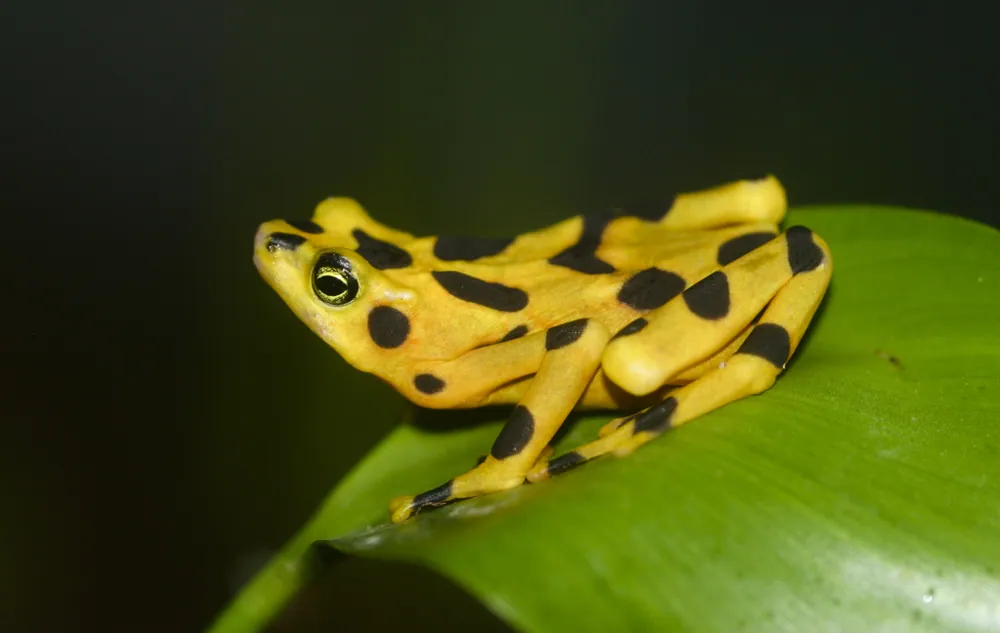
The Panamanian golden frog is a bright yellow-gold toad that lives only in Panama. It sits on the mountain streams and cloud forests of the west-central part of the country. It is a national symbol, and it is also one of the most endangered amphibians in the world.1

 Cómo reconocerlo
Poder tóxico
Su piel es venenosa. Es peligroso tocarlo, lamerlo o comerlo.
¿Qué hace su toxina?
It is poisonous rather than venomous, because its toxins work on contact with the skin and are not injected. The toxin is water-soluble and affects the nerve cells of anyone who touches it. Large doses can be fatal within 20 to 30 minutes, after convulsions that stop breathing and blood circulation.1
¿Qué peligro tiene para las personas?
Peligro para las personas: GraveSi alguien lo toca o se lo come, hay que ir al médico. Las muertes son muy raras.Its toxin affects the nerve cells of anyone who comes into contact with it, and large doses can be fatal. Because it is critically endangered, the frog should be left alone in the wild.1
¿Qué hace cuando se asusta?
When a predator approaches, it waves and lifts its foot to show its bright colours, which warn of its toxicity. If the predator keeps coming, the waving and calls increase in speed and volume.1
 Si alguien lo tocó o se lo comió
- Si alguien tocó uno: lávale bien las manos y que no se toque los ojos ni la boca. Si un niño o una mascota lo lamió o se lo comió: llama al centro de toxicología o a emergencias.
Llama siempre primero a tu número de emergencias (112, 000, 911). Esto son pautas generales de primeros auxilios, no consejo médico. Primeros auxilios básicos
 Mantente a salvo
- Nunca toques, atrapes ni molestes a un animal salvaje, aunque sea pequeño y aunque parezca dormido o muerto.
- Déjale espacio. Si te encuentras uno, mantén la calma, retrocede despacio y deja que siga su camino.
- Si lo tocaste o te lo comiste: no te frotes los ojos ni la boca, lávate las manos y busca ayuda médica.
No va a por ti. Su veneno solo está ahí para que nadie se lo coma. Más sobre cómo protegerte
¿En qué parte del mundo?
¿Qué tamaño tiene?
¿Cuánto mide?
¿Cuánto pesa?

 mide como 2 piezas de construcción de juguete en fila
 tan ligero que no lo notarías en la mano
 podría recorrer 100 metros en 90 segundos (el humano más rápido necesita 9,6)
¿Qué tamaño tiene Panamanian golden frog comparado contigo?
Solo cálculos en tu navegador. No se guarda ni se envía nada a ningún sitio.
¿Qué velocidad alcanza?


Datos
It is able to communicate by waving its feet, a bit like semaphore, as well as by sound.1
It is an 'earless' frog with no eardrums, yet it can still hear sounds and work out where they come from.1
Its toxins are powerful enough that some predators avoid it, though a few snakes can cope with its poison.1
Tadpoles have black and gold colouring, which helps protect them from the sun.1
It was filmed in the wild for the last time in 2006 for the BBC series Life in Cold Blood.1
Cazamitos
Mito: It is a frog.
Verdad: Despite its common name, it is a true toad, a member of the family Bufonidae.1
Para expertos en veneno
- Nombre científico
- Atelopus zeteki
- Grupo
- Ranas venenosas, sapos y tritones
- Familia
- Bufonidae2
- Orden
- Anura
- Continentes
- Norteamérica
- Crías
- Eggs are laid in shallow streams and hatch after 2 to 10 days. The tadpoles then take 6 to 7 months to grow.1
- Esperanza de vida
- unos 12 años1
- Cómo le va en la naturaleza
- Critically Endangered (IUCN). It may have been extinct in the wild since 2007.1
- Peligro para las personas
- 3 / 5: Grave3
De dónde salen los datos
- Panamanian golden frog (Wikipedia (CC BY-SA 4.0))
- Atelopus zeteki (iNaturalist): nombres y clasificación.
- Venom Wiki: el nivel de peligro, el tamaño típico y la velocidad estimada son nuestros. Mira cómo los calculamos: Cómo valoramos el peligro.
Cada dato de esta página tiene un número que lleva a su fuente. Si nos hemos equivocado en algo, perdón, somos fans de los animales, no una revista científica. Escríbenos a [email protected] y lo arreglamos.
 ¡El escorpión tiene hambre! Venom Wiki es un proyecto de una sola persona: gratis, sin anuncios y sin rastreadores. Una pequeña propina ayuda a mantenerlo en línea.Alimenta al escorpión
Más del mismo grupo: Ranas venenosas, sapos y tritones
 Cane toadRanas venenosas, sapos y tritonesNecesita médicoNo tocar
 Strawberry poison-dart frogRanas venenosas, sapos y tritonesSolo dueleNo tocar
 California newtRanas venenosas, sapos y tritonesPuede matarNo tocar
 Rough-skinned newtRanas venenosas, sapos y tritonesPuede matarNo tocar
 Colorado River toadRanas venenosas, sapos y tritonesNecesita médicoNo tocar
 Eastern newtRanas venenosas, sapos y tritonesSolo dueleNo tocar
 Terciopelo
 Eastern coral snake
 Eastern diamondback rattlesnake
 Eyelash viper
 Timber rattlesnake
 Western diamondback rattlesnake