
 África
 Asia
Asia Europa
 Sudamérica
 Australia y Oceanía
 Antártida
 Océano Pacífico
 Océano Atlántico
 Océano Índico
 Océano Ártico
 Mar Mediterráneo
 Mar Rojo
 Mar Caribe
 Mar del Coral
 Mar de China Meridional
 Mar de Filipinas
 Mar de Andamán
 Mar del Norte
 Mar de Timor y de Arafura
 Golfo de Bengala
 Golfo de California
Pelagic stingray
 Picaduras
The pelagic stingray is a ray that lives in the open ocean rather than on the sea floor, which sets it apart from almost all other stingrays. It is found in warm waters around much of the world. It can give a severe sting with its tail spine, so it matters most to people who work on fishing boats.1



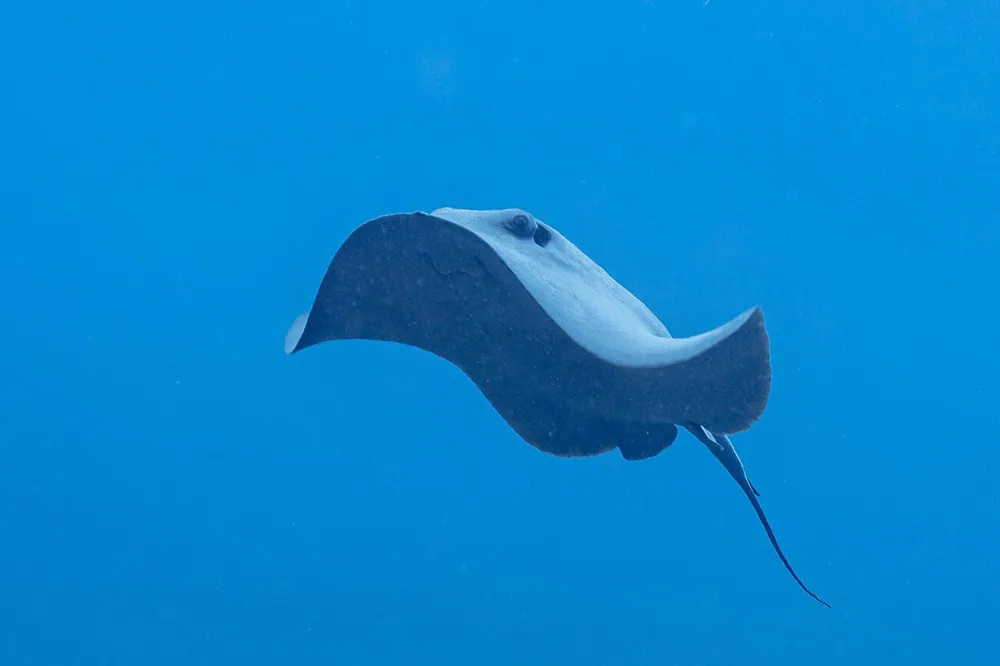
 Cómo reconocerlo
- The pectoral fin disc is a thick, wedge-shaped wing that is about one-third wider than it is long.1
- It is a plain dark purple to blue-green above, with a slightly lighter shade below.1
- The tail is whip-like, up to twice as long as the disc, with an extremely long, serrated spine about a third to halfway along it.1
- Young rays are smooth-skinned, and small prickles and thorns appear with age.1
Poder del veneno
El veneno sale por un aguijón.
¿Qué hace su veneno?
The venom is on the tail spine and is quite potent, which is why other fishes avoid it.1
¿Qué peligro tiene para las personas?
Peligro para las personas: GraveUna picadura necesita médico. Las muertes son muy raras.It is rarely encountered except by fishery workers. Its tail spine can inflict a severe wound that can be fatal.1
¿Qué hace cuando se asusta?
When captured and handled, it releases a thick black mucus that covers its body, and its tail spine delivers venom.1
 Si pica
- Mete la herida en agua caliente, tan caliente como la persona aguante sin quemarse (pruébala con tu propia mano), de 30 a 90 minutos. Busca ayuda médica, sobre todo con peces piedra y rayas.
Llama siempre primero a tu número de emergencias (112, 000, 911). Esto son pautas generales de primeros auxilios, no consejo médico. Primeros auxilios básicos
 Mantente a salvo
- Nunca toques, atrapes ni molestes a un animal salvaje, aunque sea pequeño y aunque parezca dormido o muerto.
- Déjale espacio. Si te encuentras uno, mantén la calma, retrocede despacio y deja que siga su camino.
- Si te pica: mantén la calma, no te muevas, llama a tu número de emergencias (112, 000, 911) o ve rápido a un hospital. Recuerda cómo era, una foto ayuda.
No va a por ti. Usa su veneno para cazar o defenderse, y prefiere mil veces esconderse. Más sobre cómo protegerte
¿En qué parte del mundo?
¿Qué tamaño tiene?
¿Cuánto mide?
¿Cuánto pesa?

 mide como 2,5 gatos domésticos de la nariz a la cola
 mide como 7 plátanos puestos en fila
 podría nadar el largo de una piscina grande (50 m) en 8,6 segundos
¿Qué tamaño tiene Pelagic stingray comparado contigo?
Solo cálculos en tu navegador. No se guarda ni se envía nada a ningún sitio.
¿Qué velocidad alcanza?

,_Cabo_de_Palos,_Espa%C3%B1a,_2022-07-16,_DD_68.jpg)
Datos
It is the only stingray that almost exclusively lives in the open ocean rather than on the sea floor.1
Instead of rippling the edges of its disc like other stingrays, it swims by flapping its pectoral fins, similar to eagle rays.1
Both sexes have pointed teeth, which is unusual among stingrays. Only the teeth of adult males are longer and sharper.1
Females can store sperm inside their bodies for more than a year, waiting for good conditions before their young develop.1
A captive female reached 94 cm across and 49 kg, the largest individual on record from a rearing experiment.1
Oceanic whitetip sharks, great white sharks and toothed whales prey on it.1
Para expertos en veneno
- Nombre científico
- Pteroplatytrygon violacea
- Grupo
- Peces venenosos
- Familia
- Dasyatidae2
- Orden
- Myliobatiformes
- Continentes
- Océano Atlántico, Océano Pacífico, Océano Índico, Mar Mediterráneo, Mar Caribe, Los océanos
- Crías
- It gives birth to live young. Females may bear two litters of 4 to 13 pups per year after a gestation of 2 to 4 months.1
- Cómo le va en la naturaleza
- Least Concern1
- Peligro para las personas
- 3 / 5: Grave3
De dónde salen los datos
- Pelagic stingray (Wikipedia (CC BY-SA 4.0))
- Pteroplatytrygon violacea (iNaturalist): nombres y clasificación.
- Venom Wiki: el nivel de peligro, el tamaño típico y la velocidad estimada son nuestros. Mira cómo los calculamos: Cómo valoramos el peligro.
Cada dato de esta página tiene un número que lleva a su fuente. Si nos hemos equivocado en algo, perdón, somos fans de los animales, no una revista científica. Escríbenos a [email protected] y lo arreglamos.
 ¡El escorpión tiene hambre! Venom Wiki es un proyecto de una sola persona: gratis, sin anuncios y sin rastreadores. Una pequeña propina ayuda a mantenerlo en línea.Alimenta al escorpión
Más del mismo grupo: Peces venenosos
 Reef stonefishPeces venenososPuede matarNo tocar
 Red lionfishPeces venenososNecesita médicoNo tocar
 Estuarine stonefishPeces venenososPuede matarNo tocar
 Short-tail stingrayPeces venenososPuede matar
 Striped eel catfishPeces venenososPuede matarNo tocar
 Bluespotted ribbontail rayPeces venenososNecesita médico
También vive en: Océano Atlántico
 Hawksbill sea turtleOtros animales tóxicosPuede matar
 Portuguese man o' warMedusas y picadores marinosNecesita médicoNo tocar
 Blue sea dragonCaracoles cono y pulposSolo duele
 Greenland sharkOtros animales tóxicosSolo duele
 Lion's mane jellyfishMedusas y picadores marinosSolo dueleNo tocar
 Common octopusCaracoles cono y pulposInofensivo