
 África
 Asia
Asia Europa
 Sudamérica
 Australia y Oceanía
 Antártida
 Océano Pacífico
 Océano Atlántico
 Océano Índico
 Océano Ártico
 Mar Mediterráneo
 Mar Rojo
 Mar Caribe
 Mar del Coral
 Mar de China Meridional
 Mar de Filipinas
 Mar de Andamán
 Mar del Norte
 Mar de Timor y de Arafura
 Golfo de Bengala
 Golfo de California
Port Jackson shark
 Púas venenosas
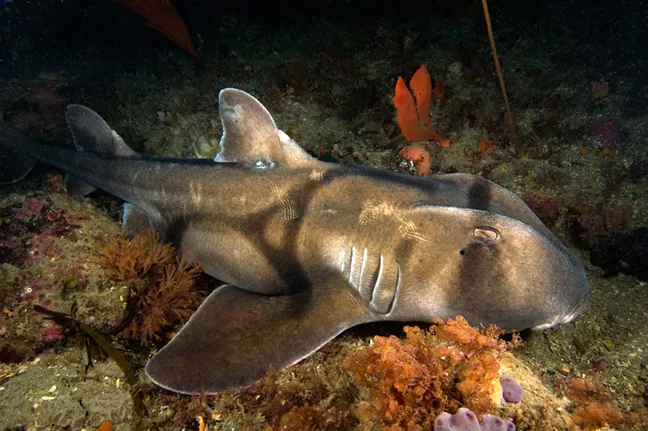
The Port Jackson shark is a bottom-dwelling shark that lives in the cool coastal waters of southern Australia. It is active mostly at night, when it hunts shellfish, sea urchins and fish. It is harmless to people, though its spines have a reputation that is not confirmed.1



 Cómo reconocerlo
- Grey-brown body with dark brown, harness-like bands, including one that runs across the eyes.1
- Large, blunt, flat head with raised ridges above the eyes.1
- A spine at the front edge of each of its two dorsal fins, which are nearly equal in size.1
- Front teeth are small and pointed, while back teeth are flat and blunt.1
- Adults can grow up to 1.65 metres long.1
Poder del veneno
Unas púas afiladas llevan el veneno. Pisarlo o agarrarlo duele.
¿Qué peligro tiene para las personas?
Peligro para las personas: LeveComo una picadura de abeja o menos. Prácticamente inofensivo para las personas.The shark poses no danger to humans. In October 2011, a man was bitten at Elwood Beach near Melbourne, but the bite did not pierce the skin and he was able to swim away while the shark was still attached to his calf.1
 Si sus púas se te clavan
- Mete la herida en agua caliente, tan caliente como la persona aguante sin quemarse (pruébala con tu propia mano), de 30 a 90 minutos. Busca ayuda médica, sobre todo con peces piedra y rayas.
Llama siempre primero a tu número de emergencias (112, 000, 911). Esto son pautas generales de primeros auxilios, no consejo médico. Primeros auxilios básicos
 Mantente a salvo
- Nunca toques, atrapes ni molestes a un animal salvaje, aunque sea pequeño y aunque parezca dormido o muerto.
- Déjale espacio. Si te encuentras uno, mantén la calma, retrocede despacio y deja que siga su camino.
- Si sus púas se te clavan: mantén la calma, no te muevas, llama a tu número de emergencias (112, 000, 911) o ve rápido a un hospital. Recuerda cómo era, una foto ayuda.
No va a por ti. Usa su veneno para cazar o defenderse, y prefiere mil veces esconderse. Más sobre cómo protegerte
¿En qué parte del mundo?
¿Qué tamaño tiene?
¿Cuánto mide?
 mide como 3 gatos domésticos de la nariz a la cola
 mide como 9 plátanos puestos en fila
 podría nadar el largo de una piscina grande (50 m) en 8,2 segundos
¿Qué tamaño tiene Port Jackson shark comparado contigo?
Solo cálculos en tu navegador. No se guarda ni se envía nada a ningún sitio.
¿Qué velocidad alcanza?


Datos
It can turn its stomach inside out and spit out unwanted contents.1
It can breathe while lying still on the bottom. It pumps water in through its first gill slit and out through the others, so it does not need to swim with its mouth open.1
Juveniles have individual personalities. Some are bolder than others when exploring new places, and they respond differently to stress.1
Juveniles can learn to link bubbles, lights or sounds with food, and they can learn by watching other sharks.1
Adults are often seen resting together in caves, but juveniles do not seem to be social.1
Each year it migrates south in summer and returns north to breed in winter.1
Cazamitos
Mito: Port Jackson sharks are dangerous to people.
Verdad: The shark poses no danger to humans. Its spines are rumoured to be venomous, but this has not been confirmed.1
Para expertos en veneno
- Nombre científico
- Heterodontus portusjacksoni
- Grupo
- Peces venenosos
- Familia
- Heterodontidae2
- Orden
- Heterodontiformes
- Continentes
- Océano Índico, Océano Antártico, Antártida, Los océanos
- Crías
- It lays eggs rather than giving birth to live young. From late August to mid-November, the female lays pairs of eggs every 8 to 17 days, up to eight pairs in total, and the eggs take 10 to 11 months to hatch.1
- Cómo le va en la naturaleza
- Least Concern (IUCN Red List)1
- Peligro para las personas
- 1 / 5: Leve3
De dónde salen los datos
- Port Jackson shark (Wikipedia (CC BY-SA 4.0))
- Heterodontus portusjacksoni (iNaturalist): nombres y clasificación.
- Venom Wiki: el nivel de peligro, el tamaño típico y la velocidad estimada son nuestros. Mira cómo los calculamos: Cómo valoramos el peligro.
Cada dato de esta página tiene un número que lleva a su fuente. Si nos hemos equivocado en algo, perdón, somos fans de los animales, no una revista científica. Escríbenos a [email protected] y lo arreglamos.
 ¡El escorpión tiene hambre! Venom Wiki es un proyecto de una sola persona: gratis, sin anuncios y sin rastreadores. Una pequeña propina ayuda a mantenerlo en línea.Alimenta al escorpión
Más del mismo grupo: Peces venenosos
 Reef stonefishPeces venenososPuede matarNo tocar
 Red lionfishPeces venenososNecesita médicoNo tocar
 Estuarine stonefishPeces venenososPuede matarNo tocar
 Short-tail stingrayPeces venenososPuede matar
 Striped eel catfishPeces venenososPuede matarNo tocar
 Bluespotted ribbontail rayPeces venenososNecesita médico
También vive en: Océano Índico
 Avispa de marMedusas y picadores marinosMortalNo tocar
 Cono geógrafoCaracoles cono y pulposMortal
 Pulpo de anillos azules mayorCaracoles cono y pulposMortal
 Pulpo de anillos azules del surCaracoles cono y pulposMortal
 Hawksbill sea turtleOtros animales tóxicosPuede matar
 Irukandji jellyfishMedusas y picadores marinosPuede matarNo tocar