
 África
 Asia
Asia Europa
 Sudamérica
 Australia y Oceanía
 Antártida
 Océano Pacífico
 Océano Atlántico
 Océano Índico
 Océano Ártico
 Mar Mediterráneo
 Mar Rojo
 Mar Caribe
 Mar del Coral
 Mar de China Meridional
 Mar de Filipinas
 Mar de Andamán
 Mar del Norte
 Mar de Timor y de Arafura
 Golfo de Bengala
 Golfo de California
Valentin's sharpnose puffer
 Tóxico si se come
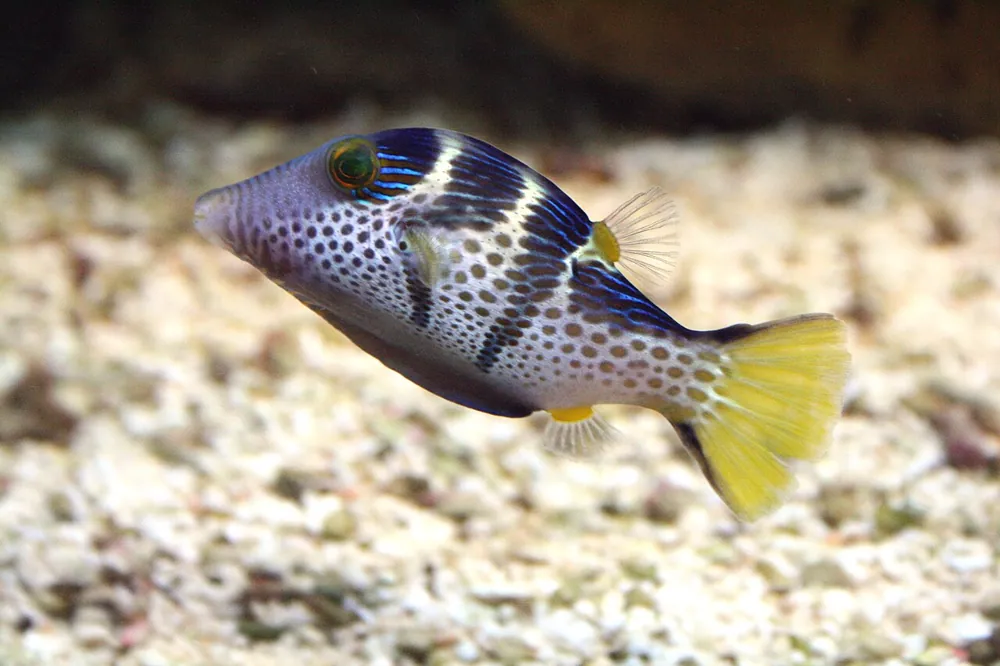
Valentin's sharpnose puffer is a small reef fish with four black stripes across its back. It lives in warm seas across the Indian Ocean, the Red Sea and parts of the Pacific. It is special because its skin holds one of the most potent natural poisons known, which keeps most predators away.1



 Cómo reconocerlo
- Four distinct black stripes, called saddles, run across its back.1
- The head is blue-grey.1
- The main body is white, speckled with blue-grey spots.1
- The tail and fins show hints of yellow, and a rainbow streak sits behind the eyes.1
Se confunde a menudo con: The filefish Paraluteres prionurus has similar colours and sometimes swims in schools with this puffer. It mimics the puffer's appearance for protection, but it is not toxic.1
Poder tóxico
Solo es dañino si algo se lo come.
¿Qué hace su toxina?
Its skin and other tissues contain tetrodotoxin, a neurotoxin, which attacks the nerves. It is one of the most potent naturally occurring toxins and is lethal to many species of fish. This makes the fish unpalatable to predators.1
¿Qué peligro tiene para las personas?
Peligro para las personas: GraveSi alguien se lo come, hay que ir al médico. Las muertes son muy raras.It is highly poisonous to eat.1
¿Qué hace cuando se asusta?
It gulps water to puff its body up to three or four times its normal volume, and its toxic skin deters predators.1
 Si alguien lo tocó o se lo comió
- Si alguien se lo comió o tiene síntomas después de comerlo: llama enseguida a tu número de emergencias o al centro de toxicología.
Llama siempre primero a tu número de emergencias (112, 000, 911). Esto son pautas generales de primeros auxilios, no consejo médico. Primeros auxilios básicos
 Mantente a salvo
- Nunca toques, atrapes ni molestes a un animal salvaje, aunque sea pequeño y aunque parezca dormido o muerto.
- Déjale espacio. Si te encuentras uno, mantén la calma, retrocede despacio y deja que siga su camino.
- Si lo tocaste o te lo comiste: no te frotes los ojos ni la boca, lávate las manos y busca ayuda médica.
No va a por ti. Su veneno solo está ahí para que nadie se lo coma. Más sobre cómo protegerte
¿En qué parte del mundo?
¿Qué tamaño tiene?
¿Cuánto mide?
 mide como 3 piezas de construcción de juguete en fila
 podría nadar el largo de una piscina grande (50 m) en 45 segundos
¿Qué tamaño tiene Valentin's sharpnose puffer comparado contigo?
Solo cálculos en tu navegador. No se guarda ni se envía nada a ningún sitio.
¿Qué velocidad alcanza?
Datos
Its tetrodotoxin is one of the most potent naturally occurring toxins, and it is lethal to many fish.1
A non-toxic filefish, Paraluteres prionurus, has evolved to look like this puffer, which helps it avoid predators.1
Its eggs are unpalatable, so predatory fish rarely eat them, and any swallowed eggs are quickly passed out again. This means the parents need not guard them.1
Juveniles of the grouper Plectropomus laevis also mimic its colours.1
Its eggs, at 0.68 to 0.72 mm across, are among the smallest in the puffer family Tetraodontidae.1
Cazamitos
Mito: Pufferfish hold their breath while they puff up.
Verdad: A 2014 study found that oxygen consumption actually increases while the fish is inflated. Oxygen intake through the gills is almost five times higher than normal.1
Para expertos en veneno
- Nombre científico
- Canthigaster valentini
- Grupo
- Otros animales tóxicos
- Familia
- Tetraodontidae2
- Orden
- Tetraodontiformes
- Continentes
- Océano Pacífico, Océano Índico, Mar Rojo, Mar del Coral, Mar de Filipinas, Mar de China Meridional, Mar de Timor y de Arafura, Los océanos
- Crías
- Females lay anywhere between fifteen and over 800 eggs at a time, every four to ten days depending on the season.1
- Peligro para las personas
- 3 / 5: Grave3
De dónde salen los datos
- Valentin's sharpnose puffer (Wikipedia (CC BY-SA 4.0))
- Canthigaster valentini (iNaturalist): nombres y clasificación.
- Venom Wiki: el nivel de peligro, el tamaño típico y la velocidad estimada son nuestros. Mira cómo los calculamos: Cómo valoramos el peligro.
Cada dato de esta página tiene un número que lleva a su fuente. Si nos hemos equivocado en algo, perdón, somos fans de los animales, no una revista científica. Escríbenos a [email protected] y lo arreglamos.
 ¡El escorpión tiene hambre! Venom Wiki es un proyecto de una sola persona: gratis, sin anuncios y sin rastreadores. Una pequeña propina ayuda a mantenerlo en línea.Alimenta al escorpión
Más del mismo grupo: Otros animales tóxicos
 Pez globo tigre
 Hawksbill sea turtle
 Greenland shark
 Silver-cheeked toadfish
 Blackspotted puffer
 White-spotted puffer
También vive en: Océano Pacífico
 Avispa de marMedusas y picadores marinosMortalNo tocar
 Cono geógrafoCaracoles cono y pulposMortal
 Pulpo de anillos azules mayorCaracoles cono y pulposMortal
 Pulpo de anillos azules del surCaracoles cono y pulposMortal
 Irukandji jellyfishMedusas y picadores marinosPuede matarNo tocar
 Reef stonefishPeces venenososPuede matarNo tocar