
 África
 Asia
Asia Europa
 Sudamérica
 Australia y Oceanía
 Antártida
 Océano Pacífico
 Océano Atlántico
 Océano Índico
 Océano Ártico
 Mar Mediterráneo
 Mar Rojo
 Mar Caribe
 Mar del Coral
 Mar de China Meridional
 Mar de Filipinas
 Mar de Andamán
 Mar del Norte
 Mar de Timor y de Arafura
 Golfo de Bengala
 Golfo de California
Yellow stingray
 Picaduras
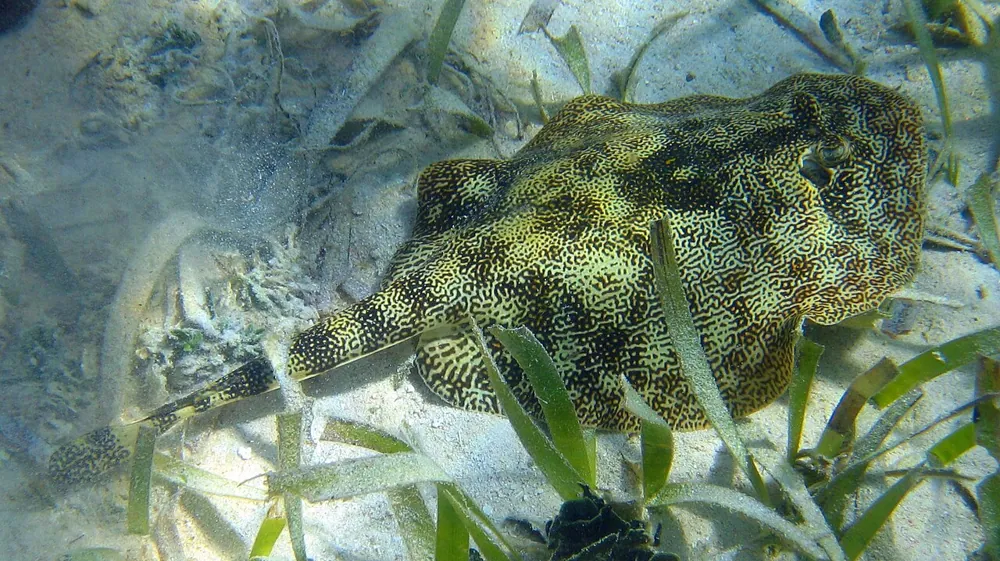
The yellow stingray is a small ray that lives on the sandy, muddy or seagrass bottoms of shallow coastal waters in the western Atlantic, the Gulf of Mexico and the Caribbean. It spends much of the day buried under sand or lying still. It can sting with a venomous spine on its tail, but it usually ignores divers unless it is stepped on or provoked.1



 Cómo reconocerlo
- Nearly round pectoral fin disc with a short tail and a small, leaf-shaped tail fin.1
- Pattern of spots and blotches, either light on dark or dark on light, which varies a lot between individuals.1
- Can quickly change the tone and contrast of its colour to match its surroundings.1
- Underside is yellowish, greenish or brownish white, with small darker spots near the edge of the disc and the tail.1
- A serrated spine sits about halfway along the tail.1
Poder del veneno
El veneno sale por un aguijón.
¿Qué hace su veneno?
The tail spine is coated in potent venom. The wound it causes is extremely painful, but it is seldom life-threatening.1
¿Qué peligro tiene para las personas?
Peligro para las personas: DolorosoPuede doler de verdad, pero casi nunca es grave.It is not aggressive towards people. It injures people only when it is stepped on or otherwise provoked, and the resulting wound is very painful but seldom life-threatening.1
¿Qué hace cuando se asusta?
When threatened it mostly stays still, buried under sediment or lying in vegetation, and if stepped on or provoked it defends itself with its tail spine.1
 Si pica
- Mete la herida en agua caliente, tan caliente como la persona aguante sin quemarse (pruébala con tu propia mano), de 30 a 90 minutos. Busca ayuda médica, sobre todo con peces piedra y rayas.
Llama siempre primero a tu número de emergencias (112, 000, 911). Esto son pautas generales de primeros auxilios, no consejo médico. Primeros auxilios básicos
 Mantente a salvo
- Nunca toques, atrapes ni molestes a un animal salvaje, aunque sea pequeño y aunque parezca dormido o muerto.
- Déjale espacio. Si te encuentras uno, mantén la calma, retrocede despacio y deja que siga su camino.
- Si te pica: mantén la calma, no te muevas, llama a tu número de emergencias (112, 000, 911) o ve rápido a un hospital. Recuerda cómo era, una foto ayuda.
No va a por ti. Usa su veneno para cazar o defenderse, y prefiere mil veces esconderse. Más sobre cómo protegerte
¿En qué parte del mundo?
¿Qué tamaño tiene?
¿Cuánto mide?
 mide como 4 plátanos puestos en fila
 podría nadar el largo de una piscina grande (50 m) en 13 segundos
¿Qué tamaño tiene Yellow stingray comparado contigo?
Solo cálculos en tu navegador. No se guarda ni se envía nada a ningún sitio.
¿Qué velocidad alcanza?


Datos
It glows green when lit by blue or ultraviolet light, a effect called biofluorescence that may help it communicate and camouflage itself.1
It can raise the front of its disc to form a shaded 'cave' that draws in small creatures looking for shelter.1
Off Jamaica, up to one yellow stingray per square metre gathers under mangrove roosts used by cattle egrets, possibly because bird droppings feed the small animals that attract the rays.1
Its eyes give it a 360° view of its surroundings, and each eye has a covering that controls how much light enters.1
It can live for 15 to 25 years.1
Cazamitos
Mito: Stingrays attack people in the water.
Verdad: Yellow stingrays generally pay little attention to divers and can be approached closely. They only sting when they are stepped on or otherwise provoked.1
Para expertos en veneno
- Nombre científico
- Urobatis jamaicensis
- Grupo
- Peces venenosos
- Familia
- Urotrygonidae2
- Orden
- Myliobatiformes
- Continentes
- Océano Atlántico, Mar Caribe, Golfo de México, Los océanos
- Crías
- It gives birth to live young, with litters of up to seven. Females have two litters a year in seagrass beds after a gestation period of 5–6 months.1
- Esperanza de vida
- unos 25 años1
- Cómo le va en la naturaleza
- Least Concern1
- Peligro para las personas
- 2 / 5: Doloroso3
De dónde salen los datos
- Yellow stingray (Wikipedia (CC BY-SA 4.0))
- Urobatis jamaicensis (iNaturalist): nombres y clasificación.
- Venom Wiki: el nivel de peligro, el tamaño típico y la velocidad estimada son nuestros. Mira cómo los calculamos: Cómo valoramos el peligro.
Cada dato de esta página tiene un número que lleva a su fuente. Si nos hemos equivocado en algo, perdón, somos fans de los animales, no una revista científica. Escríbenos a [email protected] y lo arreglamos.
 ¡El escorpión tiene hambre! Venom Wiki es un proyecto de una sola persona: gratis, sin anuncios y sin rastreadores. Una pequeña propina ayuda a mantenerlo en línea.Alimenta al escorpión
Más del mismo grupo: Peces venenosos
 Reef stonefishPeces venenososPuede matarNo tocar
 Red lionfishPeces venenososNecesita médicoNo tocar
 Estuarine stonefishPeces venenososPuede matarNo tocar
 Short-tail stingrayPeces venenososPuede matar
 Striped eel catfishPeces venenososPuede matarNo tocar
 Bluespotted ribbontail rayPeces venenososNecesita médico
También vive en: Océano Atlántico
 Hawksbill sea turtleOtros animales tóxicosPuede matar
 Portuguese man o' warMedusas y picadores marinosNecesita médicoNo tocar
 Blue sea dragonCaracoles cono y pulposSolo duele
 Greenland sharkOtros animales tóxicosSolo duele
 Lion's mane jellyfishMedusas y picadores marinosSolo dueleNo tocar
 Common octopusCaracoles cono y pulposInofensivo