
 Afrika
 Asia
Asia Europa
 Hego Amerika
 Australia eta Ozeania
 Antartika
 Ozeano Barea
 Ozeano Atlantikoa
 Ozeano Indikoa
 Ozeano Artikoa
 Mediterraneo itsasoa
 Itsaso Gorria
 Karibe itsasoa
 Koralen itsasoa
 Hego Txinako itsasoa
 Filipinetako itsasoa
 Andaman itsasoa
 Ipar itsasoa
 Timor eta Arafura itsasoak
 Bengalako golkoa
 Kaliforniako golkoa
Goliath birdeater
 Koska
KoskaThe Goliath birdeater is a huge tarantula and the largest spider in the world by mass and body length. It lives in the rainforests of northern South America, including the Amazon. Although it can look frightening, its venom is mild and it rarely bites people.1



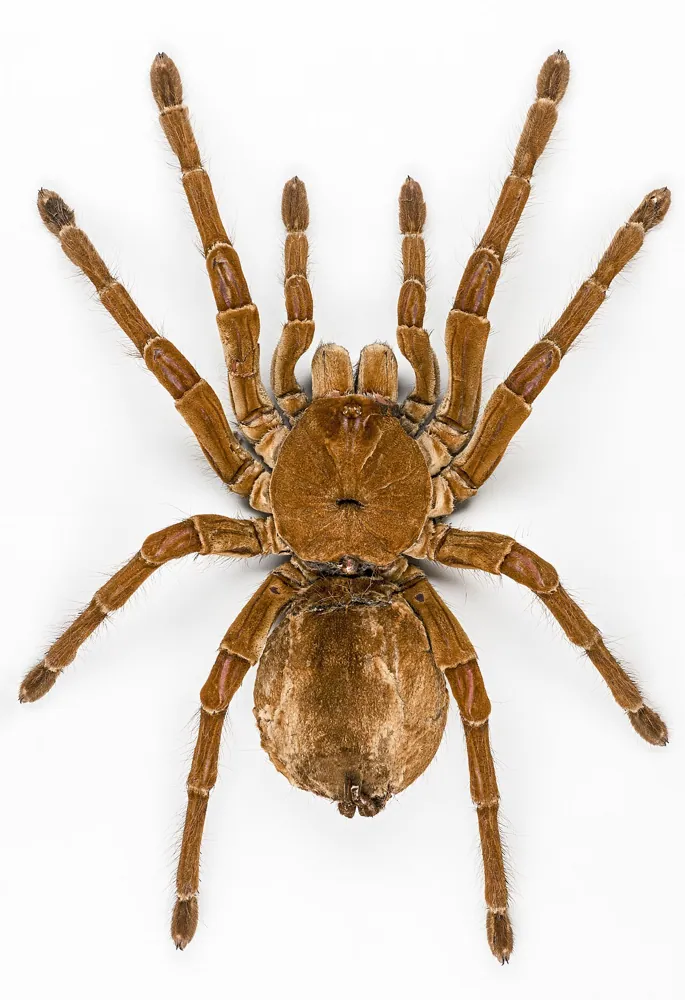
 Nola ezagutu
Pozoi-ahalmena
Pozoia letaginetatik edo hortzetatik ateratzen da kosk egiten duenean.
Zer egiten du bere pozoiak?
Like all tarantulas, it has fangs and venom, but its venom is relatively harmless. Its effects are comparable to those of a wasp sting. Some bites are 'dry bites', meaning no venom is injected.1
Zein arriskutsua da pertsonentzat?
Arriskua pertsonentzat: MingarriaBenetan min handia eman dezake, baina ia inoiz ez da larria.Tarantulas generally bite people only in self-defence. Its venom is comparable to a wasp sting. Its urticating hairs, which it releases when threatened, are a severe irritant to skin and mucous membranes.1
Zer egiten du beldurtzen denean?
When threatened, it rubs its setae together to make a hissing sound, and rubs its abdomen with its hind legs to release irritating hairs.1
 Kosk egiten badu
- Garbitu koska eta hoztu. Lortu mediku-laguntza mina handia bada edo pertsona gaizki sentitzen bada.
Deitu beti lehenik zure larrialdi-zenbakira (112, 000, 911). Lehen sorospenei buruzko orientabide orokorra da hau, ez mediku-aholkua. Lehen sorospenen oinarriak
 Egon seguru
- Ez ukitu, ez harrapatu eta ez zirikatu inoiz animalia basati bat, txikia izan arren, eta lo edo hilda dagoela badirudi ere.
- Utzi tartea. Bat aurkitzen baduzu, egon lasai, egin atzera poliki eta utzi bere bidetik joaten.
- Batek kosk egiten badizu: egon lasai, egon geldi, deitu zure larrialdi-zenbakira (112, 000, 911) edo joan ospitalera azkar. Gogoratu nolakoa zen, argazki batek laguntzen du.
Ez dabil zure atzetik. Pozoia janaria harrapatzeko edo bere burua babesteko erabiltzen du, eta askoz nahiago du ezkutatu. Seguru egoteari buruz gehiago
Munduko zein tokitan?
Zein handia da?
Zein luzea da?
Zein astuna da?

 4 eraikuntza-bloke ilaran jarrita bezain luzea
 100 metro 150 segundotan egin litzake (gizakirik azkarrenak 9,6 behar ditu)
Zein handia da Goliath birdeater ZUREKIN alderatuta?
Matematika hutsa zure nabigatzailean. Ez da ezer gordetzen, ezta inora bidaltzen ere.
Zein azkarra da?


Datuak
It is the largest spider in the world by mass and body length, and is second only to the giant huntsman spider by leg span.1
Its fangs measure 2 to 4 cm, large enough to break human skin.1
It is an edible spider. In northeastern South America, the hairs are singed off, and the spider is roasted in banana leaves.1
Its flavour has been described as 'shrimp-like'.1
Its body length is far greater than that of Mongolarachne, the largest known prehistoric spider, which measured 2.46 cm.1
Females rarely eat males during mating, unlike some other spider species.1
Mito-hauslea
Mitoa: The Goliath birdeater eats lots of birds.
Egia: Despite its name, it rarely preys on birds. Its diet is mostly other large arthropods, worms and amphibians.1
Datuak nondik datozen
- Goliath birdeater (Wikipedia (CC BY-SA 4.0))
- Theraphosa blondi (iNaturalist): izenak eta sailkapena.
- Venom Wiki: arrisku-maila, ohiko tamaina eta abiadura-kalkulua geureak dira. Ikusi nola kalkulatzen ditugun: Nola baloratzen dugun arriskua.
Orrialde honetako datu bakoitzak zenbaki bat du, bere iturrira eramaten zaituena. Zerbait gaizki badugu, barkatu, animalien zaleak gara, ez zientzia-aldizkari bat. Esaiguzu [email protected] helbidean eta konponduko dugu.
 Eskorpioia gose da! Venom Wiki pertsona bakar baten proiektua da: doakoa, iragarkirik eta jarraitzailerik gabe. Eskupeko txiki batek sarean mantentzen laguntzen du.Elikatu eskorpioia
Talde bereko gehiago: Tarantulak eta inbutu-sareko armiarmak
 Brazilian salmon pink birdeaterTarantulak eta inbutu-sareko armiarmakKaltegabea
 Chilean rose tarantulaTarantulak eta inbutu-sareko armiarmakKaltegabea
 Greenbottle blue tarantulaTarantulak eta inbutu-sareko armiarmakKaltegabea
 Pinktoe tarantulaTarantulak eta inbutu-sareko armiarmakKaltegabea
 Brazilian funnel-web spiderTarantulak eta inbutu-sareko armiarmakMedikua behar du
 Burgundy goliath birdeaterTarantulak eta inbutu-sareko armiarmakMin ematen du, besterik ez
 Golden poison frog
 Terciopelo
 Brazilian wandering spider
 Eyelash viper
 Golden lancehead
 South American bushmaster