
 Afrika
 Asia
Asia Europa
 Hego Amerika
 Australia eta Ozeania
 Antartika
 Ozeano Barea
 Ozeano Atlantikoa
 Ozeano Indikoa
 Ozeano Artikoa
 Mediterraneo itsasoa
 Itsaso Gorria
 Karibe itsasoa
 Koralen itsasoa
 Hego Txinako itsasoa
 Filipinetako itsasoa
 Andaman itsasoa
 Ipar itsasoa
 Timor eta Arafura itsasoak
 Bengalako golkoa
 Kaliforniako golkoa
Terciopelo
 Koska
KoskaThe terciopelo is a large pit viper, one of the biggest vipers in the world. It lives from north-east Mexico through Central America to northern South America. It is important to know because it causes more envenomated snakebites than any other snake in its range.1



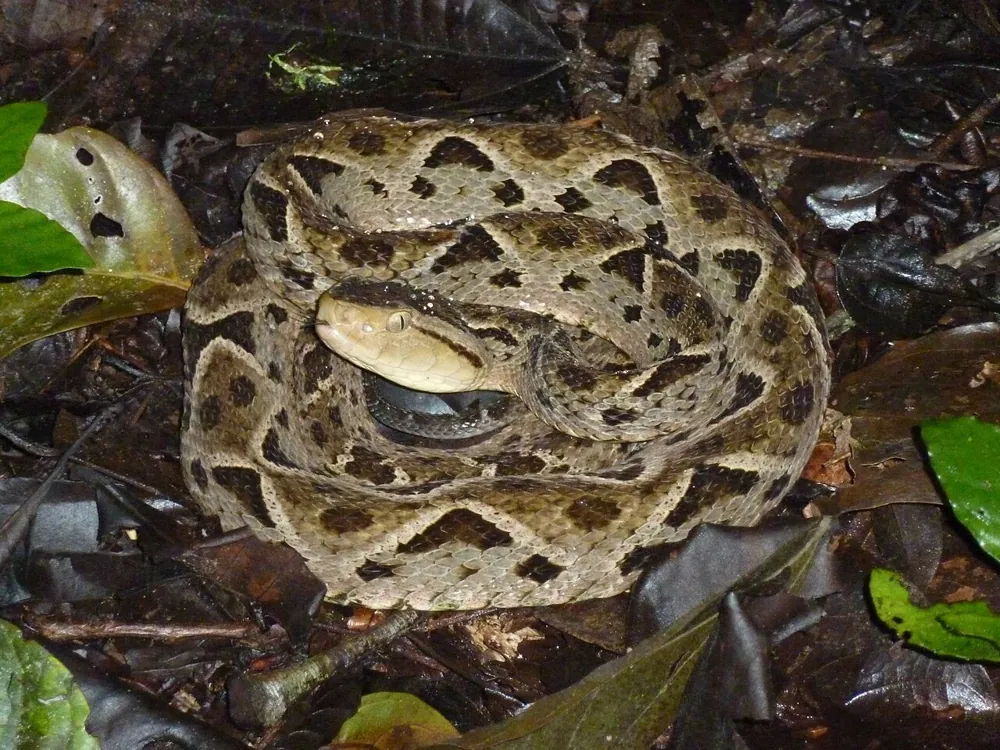
 Nola ezagutu
- Broad, flattened head that is clearly set apart from the neck1
- Light to dark brown, olive, grey or nearly black body1
- Often a yellowish zig-zag line on each side of the body1
- Dark triangles with pale edges along the sides of the body1
- Pale yellow, cream or whitish grey underside with dark blotches1
Askotan honekin nahasten da: Bothrops atrox is similar in colour, but it usually has yellow or rust-like tones and rectangular or trapezoidal blotches. The terciopelo is often more uniformly brown or grey, with the zig-zag pattern on its sides.1
Pozoi-ahalmena
Pozoia letaginetatik edo hortzetatik ateratzen da kosk egiten duenean.
Zein arriskutsua da pertsonentzat?
Arriskua pertsonentzat: HilgarriaMunduko animaliarik arriskutsuenetako bat.It is considered one of the most dangerous snakes in its range because it is large, has big fangs and a potent venom, and lives close to people. It is responsible for the most envenomated snakebites within its range. Bites usually happen only when the snake is cornered, pursued or threatened.1
Zer egiten du beldurtzen denean?
When cornered or threatened, it may perform an S-shaped coiled display and can be very defensive, sometimes suddenly reversing direction to attack.1
 Kosk egiten badu
- Eutsi pertsona geldi eta lasai, eduki koska jasotako gorputz-adarra bihotzaren mailan, kendu eraztunak eta gauza estuak, eta joan ospitalera azkar.
Deitu beti lehenik zure larrialdi-zenbakira (112, 000, 911). Lehen sorospenei buruzko orientabide orokorra da hau, ez mediku-aholkua. Lehen sorospenen oinarriak
 Egon seguru
- Ez ukitu, ez harrapatu eta ez zirikatu inoiz animalia basati bat, txikia izan arren, eta lo edo hilda dagoela badirudi ere.
- Utzi tartea. Bat aurkitzen baduzu, egon lasai, egin atzera poliki eta utzi bere bidetik joaten.
- Batek kosk egiten badizu: egon lasai, egon geldi, deitu zure larrialdi-zenbakira (112, 000, 911) edo joan ospitalera azkar. Gogoratu nolakoa zen, argazki batek laguntzen du.
Ez dabil zure atzetik. Pozoia janaria harrapatzeko edo bere burua babesteko erabiltzen du, eta askoz nahiago du ezkutatu. Seguru egoteari buruz gehiago
Munduko zein tokitan?
Zein handia da?
Zein luzea da?
Zein astuna da?
 2,5 txakur muturretik buztanera jarrita bezain luzea
 14 banana bata bestearen atzetik jarrita bezain luzea
 etxeko katu bat bezain astuna, gutxi gorabehera
 100 metro 86 segundotan egin litzake (gizakirik azkarrenak 9,6 behar ditu)
Zein handia da Terciopelo ZUREKIN alderatuta?
Matematika hutsa zure nabigatzailean. Ez da ezer gordetzen, ezta inora bidaltzen ere.
Zein azkarra da?


Datuak
Juveniles can lure prey by waving brightly coloured tail tips. Only males have bright tail tips, though both sexes show this behaviour.1
It is one of the largest vipers in the world, and it is often called 'the ultimate pit-viper' by herpetologists.1
Females are much bigger than males. The two sexes are born the same size, but females grow much faster from about 7 to 12 months of age.1
Its home range is small for a pit viper, averaging between about 3.7 and 6 hectares.1
Mito-hauslea
Mitoa: Fer-de-lance is the name of one single snake species.
Egia: The name fer-de-lance has been used informally for several Bothrops species, including this one. Herpetologists now prefer the name terciopelo for Bothrops asper.1
Datuak nondik datozen
- Bothrops asper (Wikipedia (CC BY-SA 4.0))
- Bothrops asper (iNaturalist): izenak eta sailkapena.
- Venom Wiki: arrisku-maila, ohiko tamaina eta abiadura-kalkulua geureak dira. Ikusi nola kalkulatzen ditugun: Nola baloratzen dugun arriskua.
Orrialde honetako datu bakoitzak zenbaki bat du, bere iturrira eramaten zaituena. Zerbait gaizki badugu, barkatu, animalien zaleak gara, ez zientzia-aldizkari bat. Esaiguzu [email protected] helbidean eta konponduko dugu.
 Eskorpioia gose da! Venom Wiki pertsona bakar baten proiektua da: doakoa, iragarkirik eta jarraitzailerik gabe. Eskupeko txiki batek sarean mantentzen laguntzen du.Elikatu eskorpioia
 Eyelash viper
 Golden lancehead
 South American bushmaster
 Cottonmouth
 Eastern copperhead
 Common lancehead
 Eastern coral snake
 Eastern diamondback rattlesnake
 Timber rattlesnake
 Western diamondback rattlesnake
 Arizona bark scorpion
 Brown recluse