
 Afrika
 Asia
Asia Europa
 Hego Amerika
 Australia eta Ozeania
 Antartika
 Ozeano Barea
 Ozeano Atlantikoa
 Ozeano Indikoa
 Ozeano Artikoa
 Mediterraneo itsasoa
 Itsaso Gorria
 Karibe itsasoa
 Koralen itsasoa
 Hego Txinako itsasoa
 Filipinetako itsasoa
 Andaman itsasoa
 Ipar itsasoa
 Timor eta Arafura itsasoak
 Bengalako golkoa
 Kaliforniako golkoa
South American bushmaster
 Koska
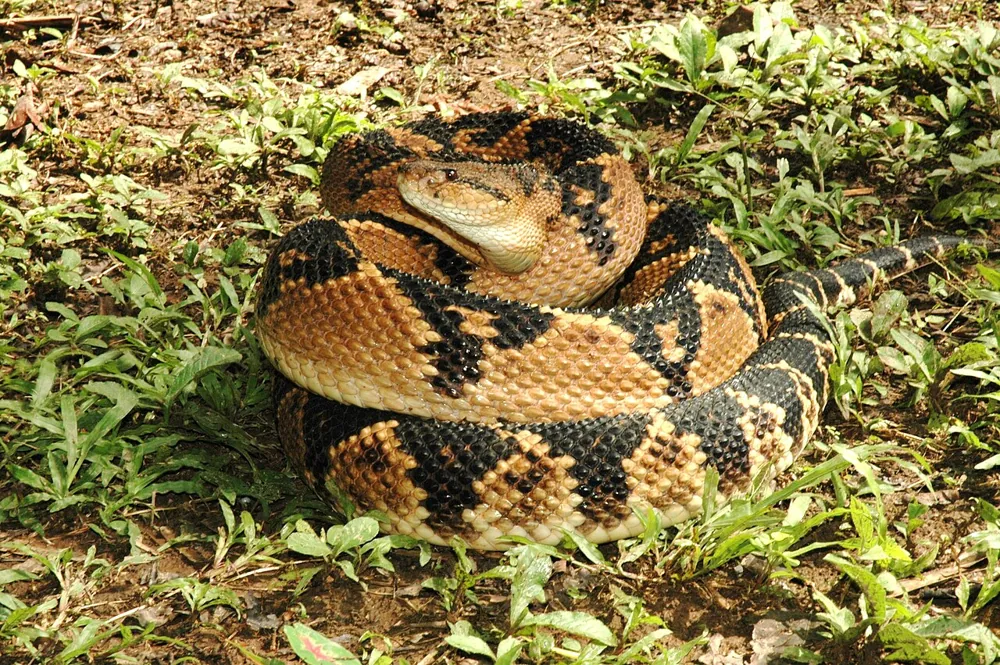
KoskaThe South American bushmaster is one of the longest vipers in the world, and it is the longest venomous snake in the Western Hemisphere. It lives in the equatorial forests east of the Andes and on the island of Trinidad. Its bite is dangerous, so it is important to know what it looks like.1



 Nola ezagutu
- Its ground colour is yellowish, reddish or grey-brown.1
- Dark brown or black blotches run along the body, forming inverted triangles on the sides.1
- Adults are usually 2 to 2.5 m long, and 3 m is not unusual.1
- The head is broad and clearly separate from the narrow neck.1
- The tail is short and ends in a spine. When alarmed it vibrates the tail, which makes a loud rustling in undergrowth.1
Askotan honekin nahasten da: It is similar in appearance to rattlesnakes. It has no rattle, so its tail vibration sounds like rustling leaves rather than a rattle.1
Pozoi-ahalmena
Pozoia letaginetatik edo hortzetatik ateratzen da kosk egiten duenean.
Zer egiten du bere pozoiak?
Its venom breaks down tissue, stops blood from clotting, and can cause bleeding. It also has effects on the nerves. At the bite there is pain, swelling, bruising, blisters and skin death. Whole-body effects include low blood pressure, dizziness, vision problems, a slow heartbeat, vomiting, diarrhoea and kidney failure.1
Zein arriskutsua da pertsonentzat?
Arriskua pertsonentzat: Oso arriskutsuaTratamendurik jasotzen ez duen pertsona bat hil dezake.Its bites are often fatal. Lab tests show its venom is weak, but the mortality rate of bite victims is high. In reported cases, a 7-year-old boy in Brazil died about 15 minutes after being bitten, and a 5-year-old child in Mato Grosso went into shock about 30 minutes after a bite and died within 90 minutes.1
Zer egiten du beldurtzen denean?
When threatened it vibrates its tail, which makes a loud rustling sound in the undergrowth.1
 Kosk egiten badu
- Eutsi pertsona geldi eta lasai, eduki koska jasotako gorputz-adarra bihotzaren mailan, kendu eraztunak eta gauza estuak, eta joan ospitalera azkar.
Deitu beti lehenik zure larrialdi-zenbakira (112, 000, 911). Lehen sorospenei buruzko orientabide orokorra da hau, ez mediku-aholkua. Lehen sorospenen oinarriak
 Egon seguru
- Ez ukitu, ez harrapatu eta ez zirikatu inoiz animalia basati bat, txikia izan arren, eta lo edo hilda dagoela badirudi ere.
- Utzi tartea. Bat aurkitzen baduzu, egon lasai, egin atzera poliki eta utzi bere bidetik joaten.
- Batek kosk egiten badizu: egon lasai, egon geldi, deitu zure larrialdi-zenbakira (112, 000, 911) edo joan ospitalera azkar. Gogoratu nolakoa zen, argazki batek laguntzen du.
Ez dabil zure atzetik. Pozoia janaria harrapatzeko edo bere burua babesteko erabiltzen du, eta askoz nahiago du ezkutatu. Seguru egoteari buruz gehiago
Munduko zein tokitan?
Zein handia da?
Zein luzea da?
Zein astuna da?
 4 txakur muturretik buztanera jarrita bezain luzea
 20 banana bata bestearen atzetik jarrita bezain luzea
 etxeko katu bat bezain astuna, gutxi gorabehera
 100 metro 71 segundotan egin litzake (gizakirik azkarrenak 9,6 behar ditu)
Zein handia da South American bushmaster ZUREKIN alderatuta?
Matematika hutsa zure nabigatzailean. Ez da ezer gordetzen, ezta inora bidaltzen ere.
Zein azkarra da?


Datuak
It is the longest viper in the world.1
It is the third longest venomous snake in the world, after the king cobra and the black mamba.1
Stress also lowers its venom yield. One specimen's yield fell from 233 mg to 64 mg while it was kept in captivity.1
Its name Lachesis comes from one of the three Fates of Greek mythology, who was said to decide how long a person would live.1
It rarely lives long in captivity, because stress makes it unwell.1
Mito-hauslea
Mitoa: Its venom is weak, so its bite is not very serious.
Egia: Lab tests show low toxicity, but bite victims die at a high rate, so the bite is very dangerous.1
Datuak nondik datozen
- Lachesis muta (Wikipedia (CC BY-SA 4.0))
- Lachesis muta (iNaturalist): izenak eta sailkapena.
- Venom Wiki: arrisku-maila, ohiko tamaina eta abiadura-kalkulua geureak dira. Ikusi nola kalkulatzen ditugun: Nola baloratzen dugun arriskua.
Orrialde honetako datu bakoitzak zenbaki bat du, bere iturrira eramaten zaituena. Zerbait gaizki badugu, barkatu, animalien zaleak gara, ez zientzia-aldizkari bat. Esaiguzu [email protected] helbidean eta konponduko dugu.
 Eskorpioia gose da! Venom Wiki pertsona bakar baten proiektua da: doakoa, iragarkirik eta jarraitzailerik gabe. Eskupeko txiki batek sarean mantentzen laguntzen du.Elikatu eskorpioia
Talde bereko gehiago: Sugegorri zulodunak
 Terciopelo
 Eyelash viper
 Golden lancehead
 Common lancehead
 Jararaca
 Jararacussu
Hemen ere bizi da: Hego Amerika
 Golden poison frogIgel toxikoak, apoak eta uhandreakHilgarriaEz ukitu
 Brazilian wandering spiderArmiarmakHil dezake
 Cane toadIgel toxikoak, apoak eta uhandreakMedikua behar duEz ukitu
 Peruvian giant centipedeEhunzangoakMedikua behar du
 Bullet antInurriakMin ematen du, besterik ez
 Common vampire batUgaztun pozoitsuakMin ematen du, besterik ez