
 Afrika
 Asia
Asia Europa
 Hego Amerika
 Australia eta Ozeania
 Antartika
 Ozeano Barea
 Ozeano Atlantikoa
 Ozeano Indikoa
 Ozeano Artikoa
 Mediterraneo itsasoa
 Itsaso Gorria
 Karibe itsasoa
 Koralen itsasoa
 Hego Txinako itsasoa
 Filipinetako itsasoa
 Andaman itsasoa
 Ipar itsasoa
 Timor eta Arafura itsasoak
 Bengalako golkoa
 Kaliforniako golkoa
Pantropical huntsman spider
 Koska
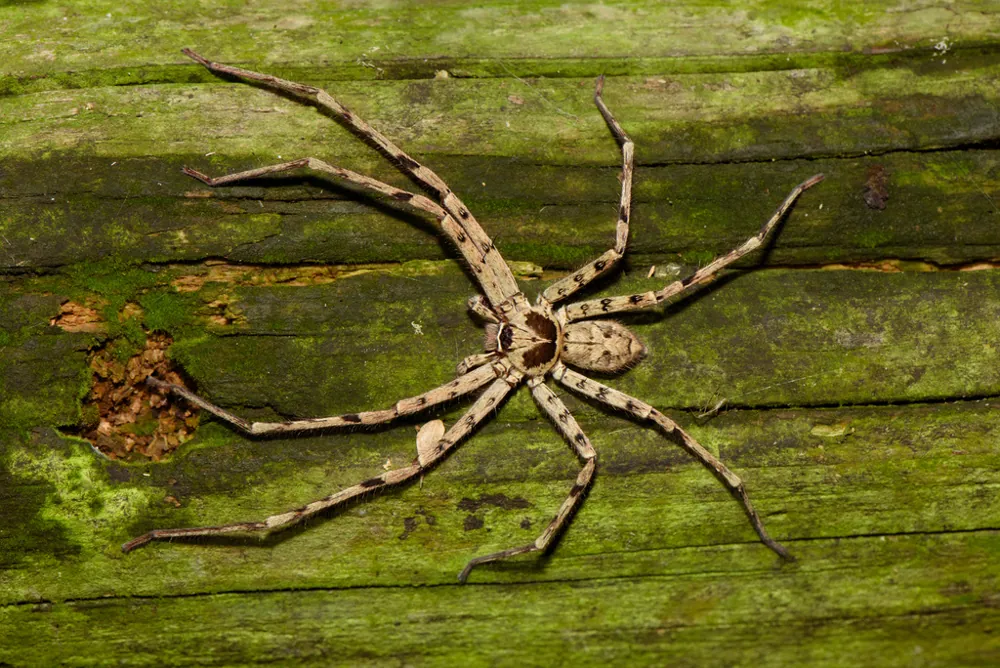
KoskaHeteropoda venatoria is a large, flat spider that hunts its prey instead of catching it in a web. It lives in tropical regions around the world and is often found in houses, barns and sheds. Its bite is painful, but it is not considered dangerous.1


 Nola ezagutu
- Adults have a flat, brown body about 2.2 to 2.8 cm long.1
- Leg span is about 7 to 10 cm.1
- The area just in front of the eyes is cream or yellowish.1
- A wide band behind the eyes is usually tan in females and cream in males.1
- The body is not very hairy, but the legs have hairs (setae), each marked with a black dot.1
Askotan honekin nahasten da: In Bermuda, where most are found indoors, it is often called a house spider, which may be confused with the southern house spider. It is sometimes called a wolf spider, which should not be confused with the true wolf spiders of the family Lycosidae.1
Pozoi-ahalmena
Pozoia letaginetatik edo hortzetatik ateratzen da kosk egiten duenean.
Zer egiten du bere pozoiak?
Its venom contains the toxin HpTX2, which is a potassium channel blocker. The venom is strong enough to cause a painful bite.1
Zein arriskutsua da pertsonentzat?
Arriskua pertsonentzat: ArinaErle-ziztada bat bezala edo gutxiago. Ia kaltegabea pertsonentzat.The spider is not considered dangerous to people, but its bite is painful.1
 Kosk egiten badu
- Garbitu koska eta jarri izotz-poltsa bat gainean minerako. Lortu mediku-laguntza mina handia bada, zabaltzen bada edo pertsona gaizki sentitzen bada.
Deitu beti lehenik zure larrialdi-zenbakira (112, 000, 911). Lehen sorospenei buruzko orientabide orokorra da hau, ez mediku-aholkua. Lehen sorospenen oinarriak
 Egon seguru
- Ez ukitu, ez harrapatu eta ez zirikatu inoiz animalia basati bat, txikia izan arren, eta lo edo hilda dagoela badirudi ere.
- Utzi tartea. Bat aurkitzen baduzu, egon lasai, egin atzera poliki eta utzi bere bidetik joaten.
- Batek kosk egiten badizu: egon lasai, egon geldi, deitu zure larrialdi-zenbakira (112, 000, 911) edo joan ospitalera azkar. Gogoratu nolakoa zen, argazki batek laguntzen du.
Ez dabil zure atzetik. Pozoia janaria harrapatzeko edo bere burua babesteko erabiltzen du, eta askoz nahiago du ezkutatu. Seguru egoteari buruz gehiago
Munduko zein tokitan?
Zein handia da?
Zein luzea da?
 klip bat bezain luzea, gutxi gorabehera
 100 metro 200 segundotan egin litzake (gizakirik azkarrenak 9,6 behar ditu)
Zein handia da Pantropical huntsman spider ZUREKIN alderatuta?
Matematika hutsa zure nabigatzailean. Ez da ezer gordetzen, ezta inora bidaltzen ere.
Zein azkarra da?


Datuak
It has been known to prey on scorpions and bats, as well as insects.1
During courtship, the male makes a faint buzz or hum by vibrating its abdomen while keeping its feet firmly planted.1
It does not spin webs. It hunts its prey directly.1
Females carry their egg sacs under the body until the young are ready to emerge.1
In one small laboratory sample, males lived an average of 465 days and females an average of 580 days.1
Pozoi-adituentzat
- Izen zientifikoa
- Heteropoda venatoria
- Taldea
- Armiarmak
- Familia
- Sparassidae2
- Ordena
- Araneae
- Kontinenteak
- Asia
- Kumeak
- Females carry an egg sac up to about 2.5 cm wide tucked under the body with their pedipalps. Each sac usually holds over 100 eggs, and larger sacs hold over 400. The young moult for the first time while still inside the sac.1
- Arriskua pertsonentzat
- 1 / 5: Arina3
Datuak nondik datozen
- Heteropoda venatoria (Wikipedia (CC BY-SA 4.0))
- Heteropoda venatoria (iNaturalist): izenak eta sailkapena.
- Venom Wiki: arrisku-maila, ohiko tamaina eta abiadura-kalkulua geureak dira. Ikusi nola kalkulatzen ditugun: Nola baloratzen dugun arriskua.
Orrialde honetako datu bakoitzak zenbaki bat du, bere iturrira eramaten zaituena. Zerbait gaizki badugu, barkatu, animalien zaleak gara, ez zientzia-aldizkari bat. Esaiguzu [email protected] helbidean eta konponduko dugu.
 Eskorpioia gose da! Venom Wiki pertsona bakar baten proiektua da: doakoa, iragarkirik eta jarraitzailerik gabe. Eskupeko txiki batek sarean mantentzen laguntzen du.Elikatu eskorpioia
 Mediterranean black widow
 Diving bell spider
 European yellow sac spider
 Daddy long-legs spider
 Giant huntsman spider
 Hobo spider
 Deathstalker
 Indian cobra
 Indian saw-scaled viper
 King cobra
 Puff adder
 Russell's viper