
 Afrika
 Asia
Asia Europa
 Hego Amerika
 Australia eta Ozeania
 Antartika
 Ozeano Barea
 Ozeano Atlantikoa
 Ozeano Indikoa
 Ozeano Artikoa
 Mediterraneo itsasoa
 Itsaso Gorria
 Karibe itsasoa
 Koralen itsasoa
 Hego Txinako itsasoa
 Filipinetako itsasoa
 Andaman itsasoa
 Ipar itsasoa
 Timor eta Arafura itsasoak
 Bengalako golkoa
 Kaliforniako golkoa
Socotra Island blue baboon spider
 Koska
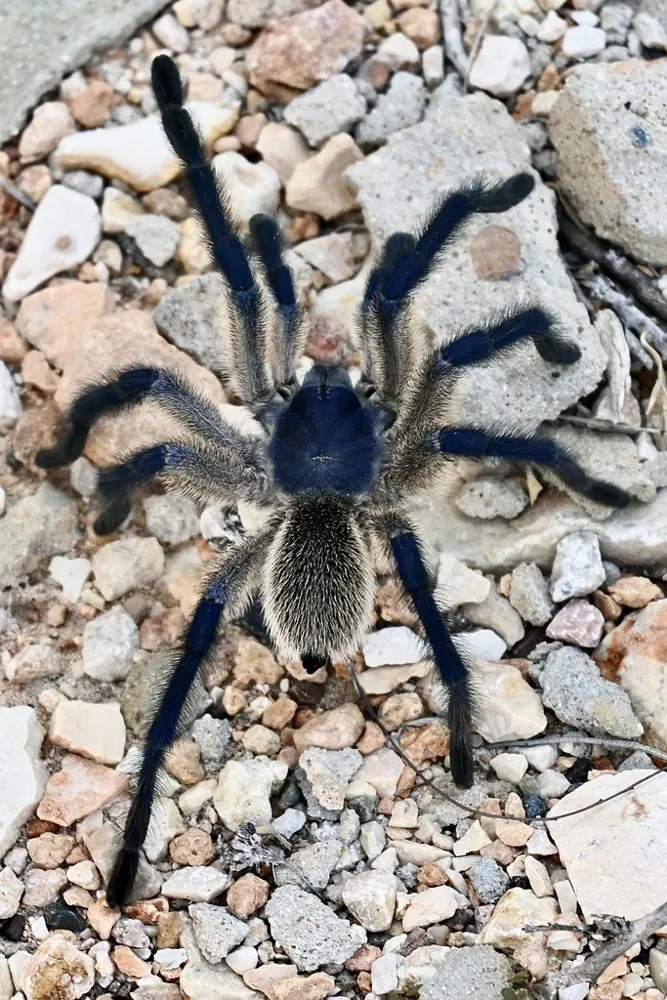
KoskaThe Socotra Island blue baboon tarantula is a large, vivid blue spider that lives on the ground. It is found only on Socotra Island, which is part of Yemen, and it is known for its unusual group behaviour, where mother spiders guard their young. Its venom has not been studied enough to know how strong it is.1
 Nola ezagutu
Pozoi-ahalmena
Pozoia letaginetatik edo hortzetatik ateratzen da kosk egiten duenean.
Zer egiten du bere pozoiak?
The potency of its venom is not known. Some people believe it can kill a dromedary (a one-humped camel), but this is most likely not the case.1
Zein arriskutsua da pertsonentzat?
Arriskua pertsonentzat: MingarriaBenetan min handia eman dezake, baina ia inoiz ez da larria.How strong its venom is has not been established. When provoked, especially when a mother is protecting an egg sac, it will deliver a fast strike and bite.1
Zer egiten du beldurtzen denean?
When threatened, it rears up on its hind legs and bares its chelicerae (fang-bearing mouthparts) in a characteristic threat pose. Further provocation leads to a fast strike and bite.1
 Kosk egiten badu
- Garbitu koska eta hoztu. Lortu mediku-laguntza mina handia bada edo pertsona gaizki sentitzen bada.
Deitu beti lehenik zure larrialdi-zenbakira (112, 000, 911). Lehen sorospenei buruzko orientabide orokorra da hau, ez mediku-aholkua. Lehen sorospenen oinarriak
 Egon seguru
- Ez ukitu, ez harrapatu eta ez zirikatu inoiz animalia basati bat, txikia izan arren, eta lo edo hilda dagoela badirudi ere.
- Utzi tartea. Bat aurkitzen baduzu, egon lasai, egin atzera poliki eta utzi bere bidetik joaten.
- Batek kosk egiten badizu: egon lasai, egon geldi, deitu zure larrialdi-zenbakira (112, 000, 911) edo joan ospitalera azkar. Gogoratu nolakoa zen, argazki batek laguntzen du.
Ez dabil zure atzetik. Pozoia janaria harrapatzeko edo bere burua babesteko erabiltzen du, eta askoz nahiago du ezkutatu. Seguru egoteari buruz gehiago
Munduko zein tokitan?
Zein handia da?
Zein luzea da?
 4 eraikuntza-bloke ilaran jarrita bezain luzea
 100 metro 220 segundotan egin litzake (gizakirik azkarrenak 9,6 behar ditu)
Zein handia da Socotra Island blue baboon spider ZUREKIN alderatuta?
Matematika hutsa zure nabigatzailean. Ez da ezer gordetzen, ezta inora bidaltzen ere.
Zein azkarra da?


Datuak
Its vivid blue colour is the striking feature of the adult, although red and amber forms have been seen very rarely.1
This tarantula is communal: mother spiders care for their young and will attack predators that get too close to their egg sac.1
In captivity, several males and females of different ages can live together without attacking one another, as long as they have enough food and proper care.1
Females live for about 10 to 14 years, while males tend to live for only about 3 to 4 years.1
Because it is an Old World tarantula, it does not have urticating hairs, the irritating hairs that some New World tarantulas flick at attackers.1
Mito-hauslea
Mitoa: It can kill a dromedary (one-humped camel).
Egia: Some people believe this, but it is most likely not the case. Its venom potency is not known.1
Pozoi-adituentzat
Datuak nondik datozen
- Monocentropus balfouri (Wikipedia (CC BY-SA 4.0))
- Monocentropus balfouri (iNaturalist): izenak eta sailkapena.
- Venom Wiki: arrisku-maila, ohiko tamaina eta abiadura-kalkulua geureak dira. Ikusi nola kalkulatzen ditugun: Nola baloratzen dugun arriskua.
Orrialde honetako datu bakoitzak zenbaki bat du, bere iturrira eramaten zaituena. Zerbait gaizki badugu, barkatu, animalien zaleak gara, ez zientzia-aldizkari bat. Esaiguzu [email protected] helbidean eta konponduko dugu.
 Eskorpioia gose da! Venom Wiki pertsona bakar baten proiektua da: doakoa, iragarkirik eta jarraitzailerik gabe. Eskupeko txiki batek sarean mantentzen laguntzen du.Elikatu eskorpioia
Talde bereko gehiago: Tarantulak eta inbutu-sareko armiarmak
 Gooty sapphire tarantulaTarantulak eta inbutu-sareko armiarmakMedikua behar du
 Indian ornamental tarantulaTarantulak eta inbutu-sareko armiarmakMedikua behar du
 Cobalt blue tarantulaTarantulak eta inbutu-sareko armiarmakMin ematen du, besterik ez
 Chinese bird spiderTarantulak eta inbutu-sareko armiarmakMedikua behar du
 Chinese black earth tiger tarantulaTarantulak eta inbutu-sareko armiarmakMedikua behar du
 Fringed ornamental tarantulaTarantulak eta inbutu-sareko armiarmakMedikua behar du
 Deathstalker
 Indian cobra
 Indian saw-scaled viper
 King cobra
 Puff adder
 Russell's viper