
 Afrika
 Asia
Asia Europa
 Hego Amerika
 Australia eta Ozeania
 Antartika
 Ozeano Barea
 Ozeano Atlantikoa
 Ozeano Indikoa
 Ozeano Artikoa
 Mediterraneo itsasoa
 Itsaso Gorria
 Karibe itsasoa
 Koralen itsasoa
 Hego Txinako itsasoa
 Filipinetako itsasoa
 Andaman itsasoa
 Ipar itsasoa
 Timor eta Arafura itsasoak
 Bengalako golkoa
 Kaliforniako golkoa
Cane toad
 Pozoia azalean
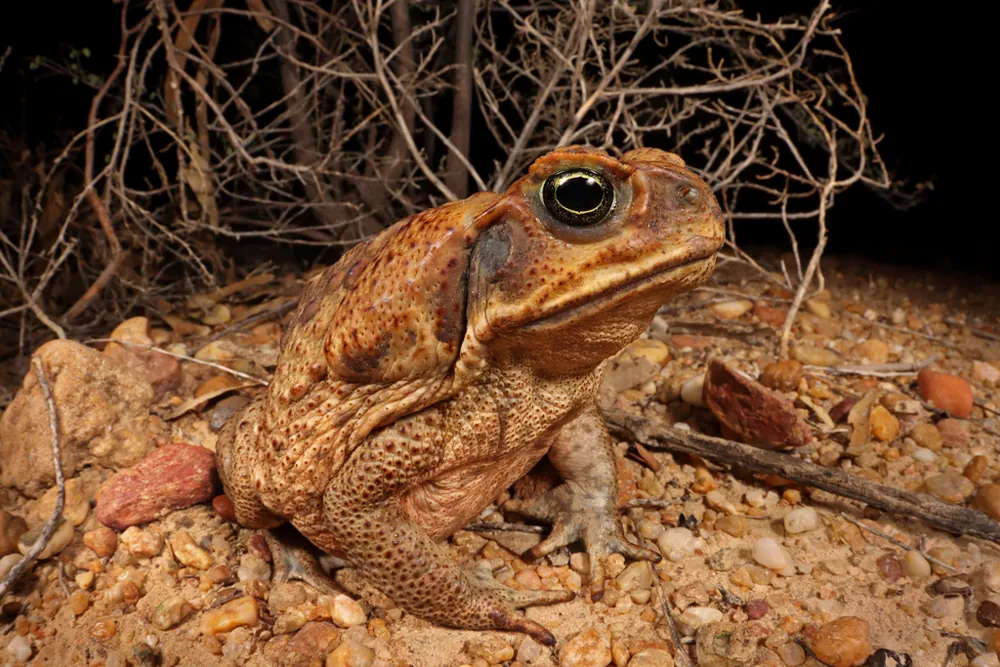
The cane toad is a large toad that is very poisonous to many animals. It is native to South and mainland Central America, but people have moved it to islands in Oceania and the Caribbean and to northern Australia. It matters because it spreads quickly and harms native wildlife and pets.1
 Nola ezagutu
- Very large, with adults usually 10 to 15 cm long1
- Dry, warty skin with distinct ridges above the eyes that run down the snout1
- A large parotoid gland (a swollen gland) behind each eye1
- Grey, yellowish, red-brown or olive-brown skin, often with patterns1
- Horizontal pupils and golden irises1
Askotan honekin nahasten da: In Australia, adults can be confused with large native frogs, but these lack the large parotoid glands and the ridge between the nostril and eye. The giant burrowing frog has vertical pupils and silver-grey irises, while the cane toad has horizontal pupils and golden irises. In the United States, the southern toad has two bulbs in front of the parotoid glands.1
Pozoi-indarra
Bere azala toxikoa da. Arriskutsua da ukitzea, miazkatzea edo jatea.
Zer egiten du bere toxinak?
The toad's glands secrete a milky-white fluid called bufotoxin when it is threatened. Components of bufotoxin are toxic to many animals. In dogs, signs of poisoning include excessive drooling, extremely red gums, head-shaking, crying and loss of coordination.1
Zein arriskutsua da pertsonentzat?
Arriskua pertsonentzat: LarriaNorbaitek ukitzen edo jaten badu, joan medikuarengana. Heriotzak oso arraroak dira.The toxic skin can kill many wild and domestic animals. Dogs are especially at risk from licking or biting the toad. Human deaths have also been recorded after people ate cane toads.1
Zer egiten du beldurtzen denean?
When threatened, it releases bufotoxin from its glands.1
 Norbaitek ukitu edo jan badu
- Norbaitek bat ukitu badu: garbitu eskuak ondo eta ez ukitu begiak edo ahoa. Haur edo maskota batek bat miazkatu edo jan badu: deitu zure intoxikazio-zentrora edo larrialdi-zenbakira.
Deitu beti lehenik zure larrialdi-zenbakira (112, 000, 911). Lehen sorospenei buruzko orientabide orokorra da hau, ez mediku-aholkua. Lehen sorospenen oinarriak
 Egon seguru
- Ez ukitu, ez harrapatu eta ez zirikatu inoiz animalia basati bat, txikia izan arren, eta lo edo hilda dagoela badirudi ere.
- Utzi tartea. Bat aurkitzen baduzu, egon lasai, egin atzera poliki eta utzi bere bidetik joaten.
- Ukitu edo jan baduzu: ez igurtzi begiak edo ahoa, garbitu eskuak eta lortu mediku-laguntza.
Ez dabil zure atzetik. Pozoia ezerk jan ez dezan baino ez du. Seguru egoteari buruz gehiago
Munduko zein tokitan?
Zein handia da?
Zein luzea da?
 8 eraikuntza-bloke ilaran jarrita bezain luzea
 100 metro 180 segundotan egin litzake (gizakirik azkarrenak 9,6 behar ditu)
Zein handia da Cane toad ZUREKIN alderatuta?
Matematika hutsa zure nabigatzailean. Ez da ezer gordetzen, ezta inora bidaltzen ere.
Zein azkarra da?


Datuak
Young toads lose the toxicity they had as eggs and tadpoles, and they only develop their poison glands later. Only an estimated 0.5% of cane toads reach adulthood.1
In Australia, tadpoles have evolved to be more likely to eat their siblings than tadpoles in South America.1
A female can lay thousands of eggs in one spawn, in strings up to 20 metres long.1
In the wild, cane toads can live 10 to 15 years, and one captive toad was reported to have lived 35 years.1
The cane toad is considered the largest species in the Bufonidae, the toad family.1
Cane toads eat both living and dead matter, which is unusual among frogs and toads.1
Mito-hauslea
Mitoa: The name 'marine toad' suggests that cane toads live in the sea.
Egia: Cane toads do not live in the sea. The name came from a mistaken belief by an early naturalist.1
Pozoi-adituentzat
- Izen zientifikoa
- Rhinella marina
- Taldea
- Igel toxikoak, apoak eta uhandreak
- Familia
- Bufonidae2
- Ordena
- Anura
- Kontinenteak
- Ipar Amerika, Hego Amerika
- Kumeak
- A female lays 8,000 to 25,000 eggs at once, in long jelly strings that can stretch up to 20 metres.1
- Bizi-iraupena
- 15 urte inguru1
- Arriskua pertsonentzat
- 3 / 5: Larria3
Datuak nondik datozen
- Cane toad (Wikipedia (CC BY-SA 4.0))
- Rhinella marina (iNaturalist): izenak eta sailkapena.
- Venom Wiki: arrisku-maila, ohiko tamaina eta abiadura-kalkulua geureak dira. Ikusi nola kalkulatzen ditugun: Nola baloratzen dugun arriskua.
Orrialde honetako datu bakoitzak zenbaki bat du, bere iturrira eramaten zaituena. Zerbait gaizki badugu, barkatu, animalien zaleak gara, ez zientzia-aldizkari bat. Esaiguzu [email protected] helbidean eta konponduko dugu.
 Eskorpioia gose da! Venom Wiki pertsona bakar baten proiektua da: doakoa, iragarkirik eta jarraitzailerik gabe. Eskupeko txiki batek sarean mantentzen laguntzen du.Elikatu eskorpioia
Talde bereko gehiago: Igel toxikoak, apoak eta uhandreak
 Golden poison frogIgel toxikoak, apoak eta uhandreakHilgarriaEz ukitu
 Dyeing poison dart frogIgel toxikoak, apoak eta uhandreakMin ematen du, besterik ezEz ukitu
 Strawberry poison-dart frogIgel toxikoak, apoak eta uhandreakMin ematen du, besterik ezEz ukitu
 Black-legged poison frogIgel toxikoak, apoak eta uhandreakHil dezakeEz ukitu
 California newtIgel toxikoak, apoak eta uhandreakHil dezakeEz ukitu
 Rough-skinned newtIgel toxikoak, apoak eta uhandreakHil dezakeEz ukitu
 Terciopelo
 Eastern coral snake
 Eastern diamondback rattlesnake
 Eyelash viper
 Timber rattlesnake
 Western diamondback rattlesnake