
 Afirik
 Aazi
Aazi Orop
Orop Amerik Sud
 Ostarali e Oseyani
 Antarktik
 Geeci Pasifik
 Geeci Atlantik
 Geeci Enndo
 Geeci Arktik
 Geeci Mediteraane
 Geeci Boɗeewi
 Geeci Karayib
 Geeci Korayl
 Geeci Siin Sud
 Geeci Filipiin
 Geeci Andaman
 Geeci Nord
 Geeci Timor e Arafura
 Gulf Bengal
 Gulf Kaliforni
Guinea paper wasp
 Jukkugol
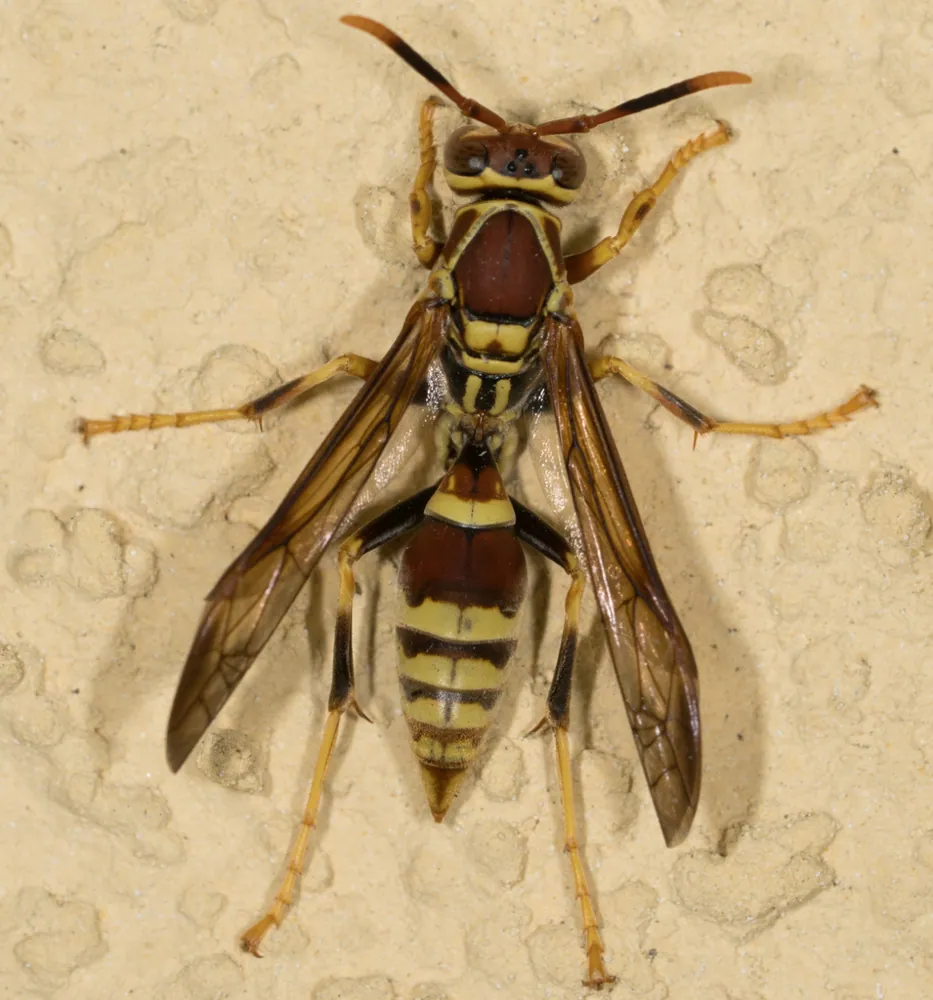
The Guinea paper wasp is a social wasp that builds small, open nests in colonies of up to about one hundred individuals. It lives in parts of North America, including the eastern United States, Ontario in Canada, and Mexico. Its colonies are often found near buildings and other man-made structures.1
 Hono anndirtee ngal
- Typical form: mostly yellow markings on the back of the thorax and the propodeum (the rear part of the thorax), and wings that are purple-tinged rather than yellow.1
- Variable form: red-brown body with dark, almost black, markings on the middle of the antennae, the bases of the abdominal segments and the wings, and pale ivory-white markings spread across the body.1
- Antennae banded with red, black and yellow, unlike most paper wasps, which have only one antenna colour.1
- Females have forewings of 13.0 to 16.5 mm; males have forewings of 12.0 to 15.0 mm.1
- Males have bulging eyes and slender antennae.1
No jiibondiree e: The typical form is often confused with Polistes fuscatus, Polistes crinitus and Polistes minor.1
Doole tooke ŋatgol
Tooke no yaltira jukkere.
Hono musiiba mum heewiri e yimɓe?
Musiiba e yimɓe: MuusɗoNo waawi muusugol sanne, kono ko ɓadii kala tuma ɗum wonataa musiiba mawɗo. Si no jukka
- Ittu jukkere ñaaki nden e ɓorgol (gratter), ɓuuɓnu nokku on.
- Si neɗɗo on no caɗɗa foofagol, yeeso walla daande mum no ufi, walla no yi'a o no ɓadii majjugol hakkille, ɗum ko musiiba allergie: noddu nimero ballal, huutoro stylo adrénaline mum (auto-injecteur) si o no jogii.
Adii fow noddu nimero ballal (112, 000, 911). Ɗum ko anndinal ballal adiingal, wanaa saaraangal doktoro. Ko adii nder ballal adiingal
 Reen hoore maa
- Wota a meem, wota a nanngu, wota a jalnu kullal ladde haa abada, hay si ko tokooso, hay si no yi'ee no ɗaanii walla maayii.
- Accu ngal nokku. Si a fotti e ngal, deeƴu, ruttu ɓaawo seeɗa seeɗa, accu ngal yaha laawol mum.
- Si gooto e majji jukkii ma: deeƴu, wota a dillu, noddu nimero ballal (112, 000, 911) walla yahu lopitaan law. Jogo e hakkille no ngal nanndi, natal no walla.
Ngal faalaaka gaañugol ma. Ngal no huutora tooke mum ngam nanngugol ñaamdu walla reenugol hoore mum, ngal ɓuri yiɗugol suuɗaade. Ko ɓeydi fii reenugol hoore maa
Hoto nder aduna?
Hono mawniri?
Hono juutiri?
 ɓuri hoɓɓere maa tokoosere rabbiɗugol
 no waawi diwugol taccugol nokku bal fow nder segonde 15
Hono Guinea paper wasp mawniri, si fooɗondiraama e AN?
Ko limoore tun nder navigateur maa. Alaa ko danndetee walla ko neldetee ka nokku woo.
Hono yaawiri?


Humpito
Queens survive cold better than workers. In one test at 5 °C over 15 days, 76% of queens survived compared with 17% of workers, partly because they build up sugars that act as antifreeze and a layer of body fat.1
When a queen dies, the oldest female worker becomes the new queen, because the colony ranks its members by age.1
Whether a wasp becomes a worker or a queen is set by the temperature it experiences as an immature wasp.1
Nests are small, usually with fewer than one hundred individuals, so the queen is often the most active wasp in the nest and directly controls the nest's activity.1
Out of six wasp species studied, this was the only one that nested in artificial sites.1
Ɗo humpitooji ɗin iwri
- Polistes exclamans (Wikipedia (CC BY-SA 4.0))
- Polistes exclamans (iNaturalist): inɗe e ŋoordingol (classification).
- Venom Wiki: tolno musiiba, mawnugol aadaajo e miijo yaawugol ko amen. Ndaar no min ƴeewtirta ɗum: Hono min tolnirta musiiba.
Kala humpito nder ngoo hello no jogii limoore hollirnde iwdi mum. Si min juumii, yaafo, min ko yiɗɓe kulle, wanaa jaaynde ganndal. Haalan min e [email protected], min feewnitan.
 Yaare nden no weelaa! Venom Wiki ko golle neɗɗo gooto: ko yoɓetaake, alaa piiblisite, alaa reweteeɓe. Kopporde tokooso no walla heddingol ɗum e enternet.Ñaamnu yaare nden
Ko ɓeydi e fedde wootere: Ñaaki, ɗuggi e ɗuggi mawɗi
 Tarantula hawkÑaaki, ɗuggi e ɗuggi mawɗiNo muusi tun
 Executioner waspÑaaki, ɗuggi e ɗuggi mawɗiNo sokli doktoro
 Warrior waspÑaaki, ɗuggi e ɗuggi mawɗiNo sokli doktoro
 Bald-faced hornetÑaaki, ɗuggi e ɗuggi mawɗiNo muusi tun
 Cow killer velvet antÑaaki, ɗuggi e ɗuggi mawɗiNo muusi tun
 Eastern cicada killerÑaaki, ɗuggi e ɗuggi mawɗiAlaa musiiba
 Terciopelo
 Eastern coral snake
 Eastern diamondback rattlesnake
 Eyelash viper
 Timber rattlesnake
 Western diamondback rattlesnake