
 Afirik
 Aazi
Aazi Orop
Orop Amerik Sud
 Ostarali e Oseyani
 Antarktik
 Geeci Pasifik
 Geeci Atlantik
 Geeci Enndo
 Geeci Arktik
 Geeci Mediteraane
 Geeci Boɗeewi
 Geeci Karayib
 Geeci Korayl
 Geeci Siin Sud
 Geeci Filipiin
 Geeci Andaman
 Geeci Nord
 Geeci Timor e Arafura
 Gulf Bengal
 Gulf Kaliforni
Harlequin poison frog
 Tooke nder nguru mumNo ñaama: ƁuuɓuuliTookeejo ɓanndu, wanaa naatnoowo tooke
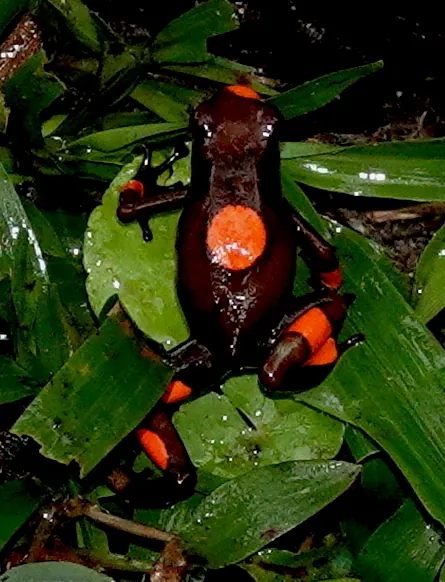
The harlequin poison frog is a small, brightly marked frog that lives on the forest floor of western Colombia. Its skin carries strong toxins, so it is one of the poison dart frogs that should never be handled. It is now critically endangered because its rainforest home is being destroyed.1

 Hono anndirtee ngal
- Background colour ranges from light to dark brown.1
- Usually has a vivid, bright spot on its back.1
- Small, with an average snout-to-vent length of about 3.3 cm.1
- Active on the forest floor, feeding on the ground after sunrise and hiding under leaf litter or on fallen logs by 16:00.1
No jiibondiree e: Some frogs that were once classed as this species were separated into new species in 2018: Oophaga anchicayensis, Oophaga andresi and Oophaga solanensis.1
Doole tooke
Nguru mum ko tooke. No musiiba meemugol ngal, meemugol ngal e ɗemngal walla ñaamugol ngal.
Ko honɗun tooke ɓanndu mum waɗata?
The frog produces histrionicotoxins, which are cardiotoxins, meaning they affect the heart. These compounds act as potent blockers of nicotinic acetylcholine receptors, the sites that receive nerve signals at muscle and nerve junctions. They also affect sodium and potassium channels, though much less strongly.1
Hono musiiba mum heewiri e yimɓe?
Musiiba e yimɓe: Musiiba mawɗoSi neɗɗo meemii walla ñaamii ngal, yahu ka doktoro. Maayde no famɗi sanne.The frog's toxins can be dangerous. Wild-caught frogs may be toxic and dangerous to handle, and they often have a much higher fatality rate in captivity.1
 Si neɗɗo meemii walla ñaamii ngal
- Si neɗɗo meemii gooto e majji: loot juuɗe ɗen no moƴƴi, wota meem gite walla hunuko. Si paykun walla kullal suudu meemii gooto e ɗemngal walla ñaamii gooto: noddu centre antipoison walla nimero ballal.
Adii fow noddu nimero ballal (112, 000, 911). Ɗum ko anndinal ballal adiingal, wanaa saaraangal doktoro. Ko adii nder ballal adiingal
 Reen hoore maa
- Wota a meem, wota a nanngu, wota a jalnu kullal ladde haa abada, hay si ko tokooso, hay si no yi'ee no ɗaanii walla maayii.
- Accu ngal nokku. Si a fotti e ngal, deeƴu, ruttu ɓaawo seeɗa seeɗa, accu ngal yaha laawol mum.
- Si a meemii walla a ñaamii ngal: wota a moomtu gite maa walla hunuko maa, loot juuɗe maa, heɓu ballal doktoro.
Ngal faalaaka gaañugol ma. Tooke mum woodi tun ngam wota huunde ñaam ngal. Ko ɓeydi fii reenugol hoore maa
Hoto nder aduna?
Hono mawniri?
Hono juutiri?
 juuti no ñippirde kayitaaje
 no waawi taccugol meeteruuji 100 nder segonde 97 (neɗɗo ɓurɗo yaawugol sokli 9,6)
Hono Harlequin poison frog mawniri, si fooɗondiraama e AN?
Ko limoore tun nder navigateur maa. Alaa ko danndetee walla ko neldetee ka nokku woo.
Hono yaawiri?


Humpito
The tadpoles cannot feed on their own. They are obligate egg-feeders and will starve without the unfertilised eggs their mother provides.1
A parent carries the tadpoles to tiny water pools, often found in the axil of a bromeliad plant, where they develop.1
Histrionicotoxins are hard to make in a lab. Synthesising them has been the subject of many different attempts.1
Harlequin poison frogs are among the most difficult poison dart frogs to raise in captivity.1
Adults are active on the ground during the day and retreat to refuge by mid-afternoon.1
Ngam ganduɓe tooke
- Innde ganndal
- Oophaga histrionica
- Fedde
- Paaɓe tooke, krapooji e tritonuuji
- Ɓesngu
- Dendrobatidae2
- Ordre
- Anura
- Leyɗe mawɗe
- Amerik Sud
- Ɓiɓɓe tokosɓe
- The female lays eggs among leaf litter. A parent carries the newly hatched tadpoles to a small water pool, often in a bromeliad, and the mother later lays unfertilised eggs for the tadpoles to eat.1
- Hono ngal woniri nder ladde
- Critically Endangered1
- Musiiba e yimɓe
- 3 / 5: Musiiba mawɗo3
Ɗo humpitooji ɗin iwri
- Harlequin poison frog (Wikipedia (CC BY-SA 4.0))
- Oophaga histrionica (iNaturalist): inɗe e ŋoordingol (classification).
- Venom Wiki: tolno musiiba, mawnugol aadaajo e miijo yaawugol ko amen. Ndaar no min ƴeewtirta ɗum: Hono min tolnirta musiiba.
Kala humpito nder ngoo hello no jogii limoore hollirnde iwdi mum. Si min juumii, yaafo, min ko yiɗɓe kulle, wanaa jaaynde ganndal. Haalan min e [email protected], min feewnitan.
 Yaare nden no weelaa! Venom Wiki ko golle neɗɗo gooto: ko yoɓetaake, alaa piiblisite, alaa reweteeɓe. Kopporde tokooso no walla heddingol ɗum e enternet.Ñaamnu yaare nden
Ko ɓeydi e fedde wootere: Paaɓe tooke, krapooji e tritonuuji
 Faaɓru tooke kaŋŋePaaɓe tooke, krapooji e tritonuujiWaroowoWota a meem
 Cane toadPaaɓe tooke, krapooji e tritonuujiNo sokli doktoroWota a meem
 Dyeing poison dart frogPaaɓe tooke, krapooji e tritonuujiNo muusi tunWota a meem
 Black-legged poison frogPaaɓe tooke, krapooji e tritonuujiNo waawi warugolWota a meem
 Bruno's casque-headed frogPaaɓe tooke, krapooji e tritonuujiNo sokli doktoroWota a meem
 Giant leaf frogPaaɓe tooke, krapooji e tritonuujiNo muusi tunWota a meem
 Terciopelo
 Brazilian wandering spider
 Eyelash viper
 Golden lancehead
 South American bushmaster
 Peruvian giant centipede