
 Afirik
 Aazi
Aazi Orop
Orop Amerik Sud
 Ostarali e Oseyani
 Antarktik
 Geeci Pasifik
 Geeci Atlantik
 Geeci Enndo
 Geeci Arktik
 Geeci Mediteraane
 Geeci Boɗeewi
 Geeci Karayib
 Geeci Korayl
 Geeci Siin Sud
 Geeci Filipiin
 Geeci Andaman
 Geeci Nord
 Geeci Timor e Arafura
 Gulf Bengal
 Gulf Kaliforni
Irukandji jellyfish
 Tiimbe jukkooje
The Irukandji jellyfish is a tiny box jellyfish with a sting that can cause a serious illness called Irukandji syndrome. It lives in the open water near Australia, and it is hard to spot because it is so small.1



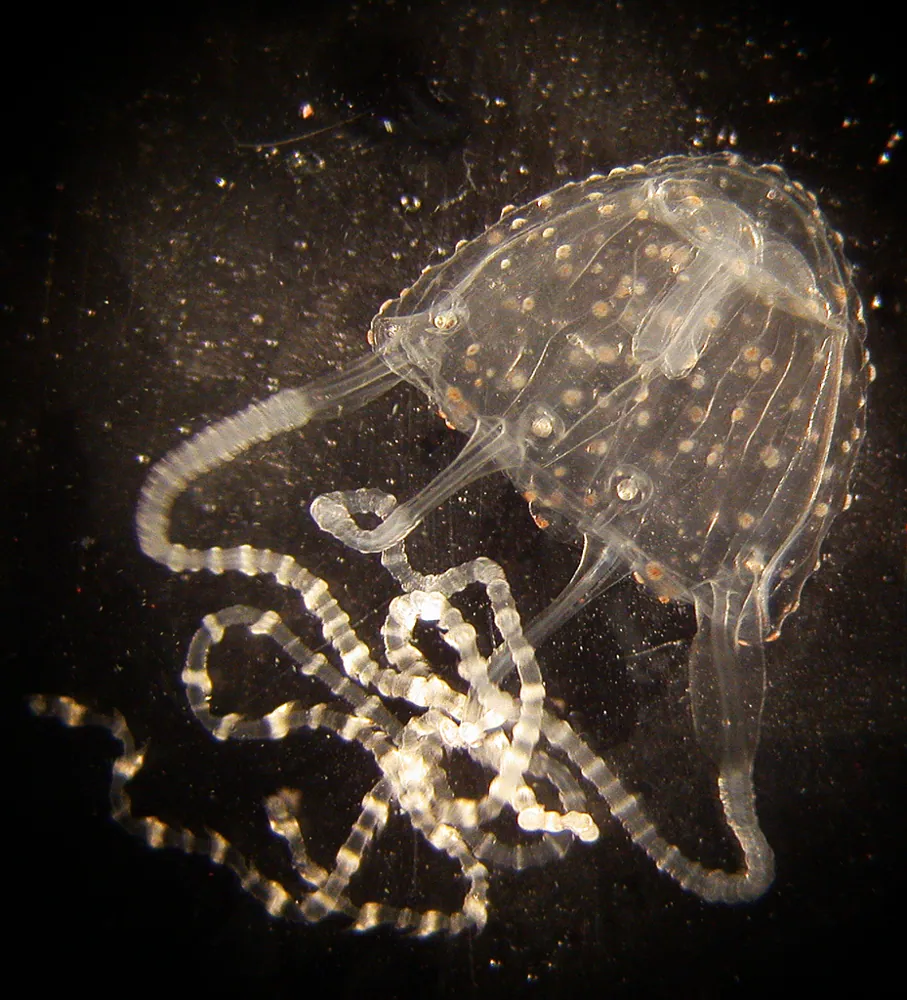
 Hono anndirtee ngal
- The bell is square-shaped and very small, about 12 mm high and 30 mm across.1
- It has four long tentacles, one from each corner of the bell.1
- The tentacles range from 5 to 50 cm long.1
- Its small size means it often goes unseen in open water.1
No jiibondiree e: The common name Irukandji jellyfish is also used for other Irukandji jellyfish, such as Malo kingi. The name alone does not tell them apart.1
Doole tooke ŋatgol
Ceeli jukkooji tokosɗi ujunaaje no tuha tuma huunde meemi ɗi.
Ko honɗun tooke mum waɗata (ŋatgol walla jukkugol)?
This jellyfish is extremely venomous. Its venom comes from stinging cells called nematocysts in its tentacles and bell, and it changes as the jellyfish matures. A sting can cause Irukandji syndrome, with muscle aches, back pain, nausea, headaches, chest and stomach pains, sweating, high blood pressure and difficulty breathing.1
Hono musiiba mum heewiri e yimɓe?
Musiiba e yimɓe: Musiiba sanneNo waawi warugol neɗɗo mo safraaka.Irukandji syndrome can be severe, and the symptoms are described in detail in medical accounts. Most reported incidents have been in Australia during the warm summer season. Because the jellyfish is so small, people often do not see it before they are stung.1
 Si no jukka
- In hospital, patients are given intravenous morphine, hydromorphone or fentanyl for pain. Pethidine is avoided because of its toxic metabolite norpethidine.1
- Yaltin neɗɗo on e ndiyam, ittu kala tiimbe meduusi (e gaŋteeji walla taƴre conci).
- Ngam meduusi kaaɗe tulnde: wuju winegara e nokkuuje jukkaaɗe, ko famɗi fow segonde 30, noddu ballal, hebulo waɗugol réanimation (RCP). Ngam bluebottles e ko heewi e goɗɗe: loot e ndiyam geeci, refti ndiyam guleeɗam ngam muusu.
Adii fow noddu nimero ballal (112, 000, 911). Ɗum ko anndinal ballal adiingal, wanaa saaraangal doktoro. Ko adii nder ballal adiingal
 Reen hoore maa
- Wota a meem, wota a nanngu, wota a jalnu kullal ladde haa abada, hay si ko tokooso, hay si no yi'ee no ɗaanii walla maayii.
- Accu ngal nokku. Si a fotti e ngal, deeƴu, ruttu ɓaawo seeɗa seeɗa, accu ngal yaha laawol mum.
- Si gooto e majji jukkii ma: deeƴu, wota a dillu, noddu nimero ballal (112, 000, 911) walla yahu lopitaan law. Jogo e hakkille no ngal nanndi, natal no walla.
Ngal faalaaka gaañugol ma. Ngal no huutora tooke mum ngam nanngugol ñaamdu walla reenugol hoore mum, ngal ɓuri yiɗugol suuɗaade. Ko ɓeydi fii reenugol hoore maa
Hoto nder aduna?
Hono mawniri?
Hono juutiri?
 ɓuri hoɓɓere maa tokoosere rabbiɗugol
 no waawi yoowugol juutde pisin mawɗo (50 m) nder segonde 36
Hono Irukandji jellyfish mawniri, si fooɗondiraama e AN?
Ko limoore tun nder navigateur maa. Alaa ko danndetee walla ko neldetee ka nokku woo.
Hono yaawiri?
Humpito
Jack Barnes of Cairns, Australia, discovered the species. During an exploration aimed at finding the cause of Irukandji syndrome, he allowed himself, a lifeguard and his 9-year-old son to be stung.1
Irukandji syndrome, which this jellyfish can cause, was first identified after a group of swimmers were stung in open water near North Queensland, Australia.1
Its venom changes in composition as the jellyfish grows, matching its change in prey from invertebrates to fish.1
Its life cycle alternates between a young form that attaches to a reef or rock and an adult form that swims freely in the water.1
This jellyfish is a type of box jellyfish, a group known for potent venom.1
Ngam ganduɓe tooke
- Innde ganndal
- Carukia barnesi
- Fedde
- Meduusiiji e kulle geeci jukkooje
- Ɓesngu
- Carukiidae2
- Ordre
- Carybdeida
- Leyɗe mawɗe
- Geeci Enndo, Geeci Pasifik, Geeci Korayl, Geeci Timor e Arafura, Oseyanuuji
- Ɓiɓɓe tokosɓe
- Young jellyfish begin as a swimming planula larva, which settles on a reef or rock and grows into a polyp. The polyp later forms a colony that develops into an adult medusa.1
- Musiiba e yimɓe
- 4 / 5: Musiiba sanne3
Ɗo humpitooji ɗin iwri
- Carukia barnesi (Wikipedia (CC BY-SA 4.0))
- Carukia barnesi (iNaturalist): inɗe e ŋoordingol (classification).
- Venom Wiki: tolno musiiba, mawnugol aadaajo e miijo yaawugol ko amen. Ndaar no min ƴeewtirta ɗum: Hono min tolnirta musiiba.
Kala humpito nder ngoo hello no jogii limoore hollirnde iwdi mum. Si min juumii, yaafo, min ko yiɗɓe kulle, wanaa jaaynde ganndal. Haalan min e [email protected], min feewnitan.
 Yaare nden no weelaa! Venom Wiki ko golle neɗɗo gooto: ko yoɓetaake, alaa piiblisite, alaa reweteeɓe. Kopporde tokooso no walla heddingol ɗum e enternet.Ñaamnu yaare nden
Ko ɓeydi e fedde wootere: Meduusiiji e kulle geeci jukkooje
 Meduusi kaaɗe OstaraliMeduusiiji e kulle geeci jukkoojeWaroowoWota a meem
 Portuguese man o' warMeduusiiji e kulle geeci jukkoojeNo sokli doktoroWota a meem
 Lion's mane jellyfishMeduusiiji e kulle geeci jukkoojeNo muusi tunWota a meem
 Moon jellyfishMeduusiiji e kulle geeci jukkoojeAlaa musiiba
 Common kingslayerMeduusiiji e kulle geeci jukkoojeNo waawi warugolWota a meem
 Hell's fire anemoneMeduusiiji e kulle geeci jukkoojeNo sokli doktoroWota a meem
No hoɗi kadi nder: Geeci Enndo
 Kokiyaasi kone jeografiKokiyaasi kone e pulpuujiWaroowo
 Pulpu mawɗo koode bulaajeKokiyaasi kone e pulpuujiWaroowo
 Pulpu koode bulaaje sudKokiyaasi kone e pulpuujiWaroowo
 Hawksbill sea turtleKulle goɗɗe tookeeje ɓannduNo waawi warugol
 Reef stonefishLiƴƴi tookeNo waawi warugolWota a meem
 Crown-of-thorns starfishUrsenuuji, koode geeci e ngilɗiNo sokli doktoroWota a meem