
 Afirik
 Aazi
Aazi Orop
Orop Amerik Sud
 Ostarali e Oseyani
 Antarktik
 Geeci Pasifik
 Geeci Atlantik
 Geeci Enndo
 Geeci Arktik
 Geeci Mediteraane
 Geeci Boɗeewi
 Geeci Karayib
 Geeci Korayl
 Geeci Siin Sud
 Geeci Filipiin
 Geeci Andaman
 Geeci Nord
 Geeci Timor e Arafura
 Gulf Bengal
 Gulf Kaliforni
Large velvet ant
 Jukkugol
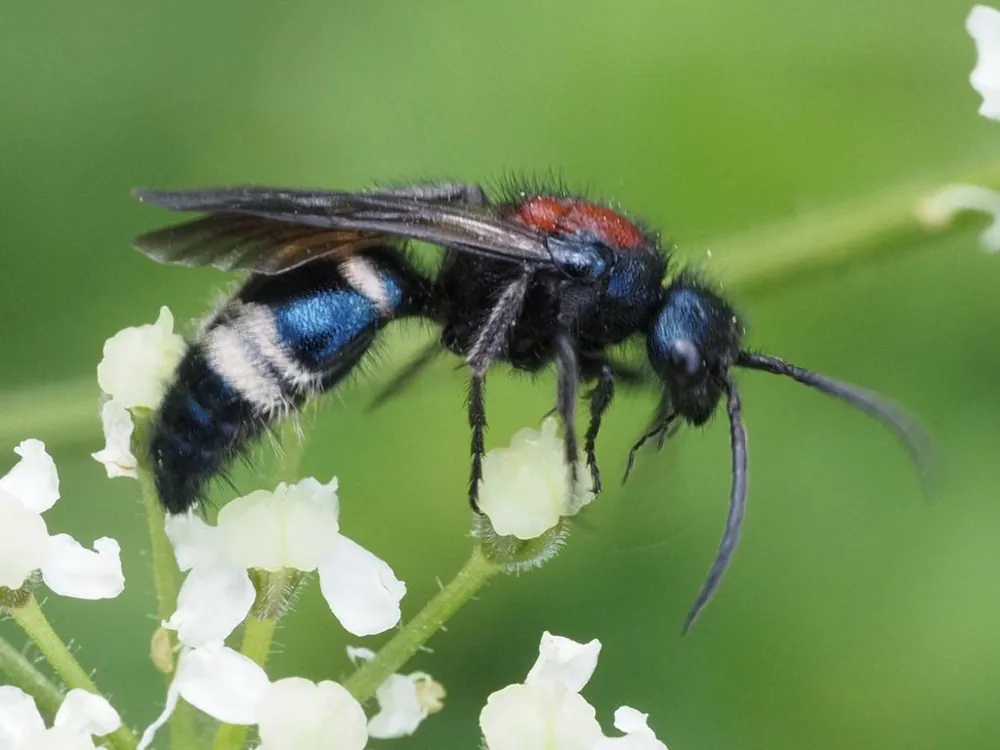
The large velvet ant is not really an ant. It is a wasp, and the females have no wings and look like fuzzy ants. It lives in parts of Europe, Asia and North Africa, in heaths, moors, grasslands and woodland. Its sting is painful, but it is not aggressive.1


 Hono anndirtee ngal
- Males are dark red on the tip of the mandibles (jaws) and on the thorax.1
- The first and second segments of the abdomen have bands of long silver bristles.1
- The tip of the abdomen and much of the body are covered in long black bristles.1
- Females have a red mesonotum (the upper middle part of the thorax) and silver-spotted flanks along the abdomen.1
- Some males are completely black, and colour varies between individuals.1
Doole tooke ŋatgol
Tooke no yaltira jukkere.
Ko honɗun tooke mum waɗata (ŋatgol walla jukkugol)?
The sting is painful. Its venom is much less toxic than the venom of a honeybee.1
Hono musiiba mum heewiri e yimɓe?
Musiiba e yimɓe: MuusɗoNo waawi muusugol sanne, kono ko ɓadii kala tuma ɗum wonataa musiiba mawɗo.The wasp is not aggressive and only stings people when handled. Its sting is painful but less toxic than a honeybee's.1
Ko honɗun ngal waɗata si ngal hulii?
When threatened, it stridulates by rubbing a raised structure called the plectrum over ridges on its abdomen, which makes a sound.1
 Si no jukka
- Ittu jukkere ñaaki nden e ɓorgol (gratter), ɓuuɓnu nokku on.
- Si neɗɗo on no caɗɗa foofagol, yeeso walla daande mum no ufi, walla no yi'a o no ɓadii majjugol hakkille, ɗum ko musiiba allergie: noddu nimero ballal, huutoro stylo adrénaline mum (auto-injecteur) si o no jogii.
Adii fow noddu nimero ballal (112, 000, 911). Ɗum ko anndinal ballal adiingal, wanaa saaraangal doktoro. Ko adii nder ballal adiingal
 Reen hoore maa
- Wota a meem, wota a nanngu, wota a jalnu kullal ladde haa abada, hay si ko tokooso, hay si no yi'ee no ɗaanii walla maayii.
- Accu ngal nokku. Si a fotti e ngal, deeƴu, ruttu ɓaawo seeɗa seeɗa, accu ngal yaha laawol mum.
- Si gooto e majji jukkii ma: deeƴu, wota a dillu, noddu nimero ballal (112, 000, 911) walla yahu lopitaan law. Jogo e hakkille no ngal nanndi, natal no walla.
Ngal faalaaka gaañugol ma. Ngal no huutora tooke mum ngam nanngugol ñaamdu walla reenugol hoore mum, ngal ɓuri yiɗugol suuɗaade. Ko ɓeydi fii reenugol hoore maa
Hoto nder aduna?
Hono mawniri?
Hono juutiri?
 tokooso no feewi haa no waawi joodagol e dow hoore hoɓɓere maa
Hono Large velvet ant mawniri, si fooɗondiraama e AN?
Ko limoore tun nder navigateur maa. Alaa ko danndetee walla ko neldetee ka nokku woo.
Hono yaawiri?


Humpito
Their thick, armoured skin is so strong that related species in North America have been reported to escape from the mouths of lizards and frogs.1
Females can sneak into the nests of paper wasps and steal their food stores, possibly because they can disguise their scent so the paper wasps cannot detect them.1
The size of the adult wasp depends partly on the size of its host: wasps raised in honeybees are smaller than those raised in bumblebees.1
Females are wingless, but males have wings.1
Males die soon after emerging in autumn, while females hibernate over winter, sometimes in the host nest or at the roots of low plants.1
Bonnoowo fenaandeeji
Fenaande: The nickname "cow killer" means the sting can kill cows.
Goonga: The nickname is inappropriate. Its sting is painful, but its venom is much less toxic than a honeybee's, and it is not aggressive.1
Ɗo humpitooji ɗin iwri
- Mutilla europaea (Wikipedia (CC BY-SA 4.0))
- Mutilla europaea (iNaturalist): inɗe e ŋoordingol (classification).
- Venom Wiki: tolno musiiba, mawnugol aadaajo e miijo yaawugol ko amen. Ndaar no min ƴeewtirta ɗum: Hono min tolnirta musiiba.
Kala humpito nder ngoo hello no jogii limoore hollirnde iwdi mum. Si min juumii, yaafo, min ko yiɗɓe kulle, wanaa jaaynde ganndal. Haalan min e [email protected], min feewnitan.
 Yaare nden no weelaa! Venom Wiki ko golle neɗɗo gooto: ko yoɓetaake, alaa piiblisite, alaa reweteeɓe. Kopporde tokooso no walla heddingol ɗum e enternet.Ñaamnu yaare nden
Ko ɓeydi e fedde wootere: Ñaaki, ɗuggi e ɗuggi mawɗi
 Asian giant hornetÑaaki, ɗuggi e ɗuggi mawɗiNo waawi warugol
 Common waspÑaaki, ɗuggi e ɗuggi mawɗiNo muusi tun
 European hornetÑaaki, ɗuggi e ɗuggi mawɗiNo muusi tun
 Western honey beeÑaaki, ɗuggi e ɗuggi mawɗiNo muusi tun
 Giant honey beeÑaaki, ɗuggi e ɗuggi mawɗiNo sokli doktoro
 Asian hornetÑaaki, ɗuggi e ɗuggi mawɗiNo muusi tun
No hoɗi kadi nder: Orop
 Common European adderWipeeri e adderNo sokli doktoro
 Spanish flyKulle goɗɗe tookeeje ɓannduNo sokli doktoroWota a meem
 Fire salamanderPaaɓe tooke, krapooji e tritonuujiNo muusi tunWota a meem
 Blunt-nosed viperWipeeri e adderNo waawi warugol
 Nose-horned viperWipeeri e adderNo waawi warugol
 Ottoman viperWipeeri e adderNo waawi warugol