
 Afirik
 Aazi
Aazi Orop
Orop Amerik Sud
 Ostarali e Oseyani
 Antarktik
 Geeci Pasifik
 Geeci Atlantik
 Geeci Enndo
 Geeci Arktik
 Geeci Mediteraane
 Geeci Boɗeewi
 Geeci Karayib
 Geeci Korayl
 Geeci Siin Sud
 Geeci Filipiin
 Geeci Andaman
 Geeci Nord
 Geeci Timor e Arafura
 Gulf Bengal
 Gulf Kaliforni
Trinidad chevron tarantula
 Ŋatgol
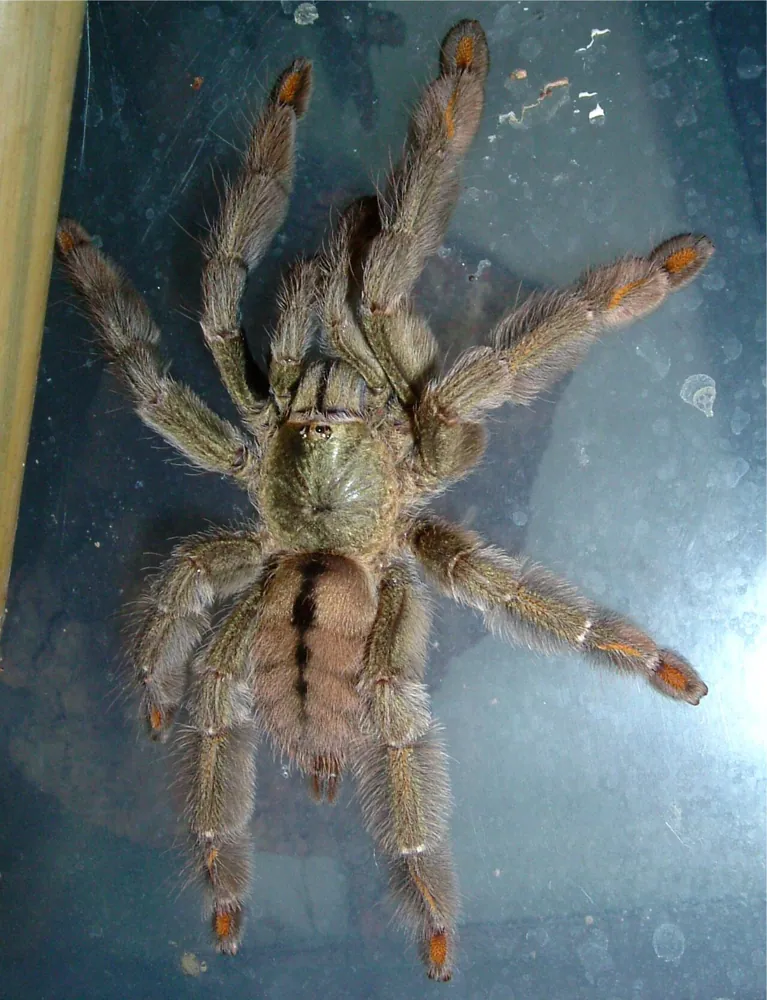
The Trinidad chevron tarantula is a large hairy spider that lives only on the island of Trinidad. It spends much of its life in tree bark and crevices, and it is also a popular pet in many countries because it is easy to breed in captivity.1

 Hono anndirtee ngal
- Females have dark, chevron-shaped (V-shaped) markings on the abdomen.1
- Females are green, tan or brown, with orange markings on the legs.1
- Males are a more uniform grey or brown, with long legs in proportion to their body.1
- Males keep orange markings on the latter part of their legs.1
- Spiderlings are mostly dark, with pale orange bands on the legs that look like leg warmers. These bands fade as the spider grows.1
No jiibondiree e: The female's orange leg markings are similar to those of P. irminia, another species in the same genus.1
Doole tooke ŋatgol
Tooke no yaltira ñiiƴe mum tuma ngal ŋatata.
Ko honɗun tooke mum waɗata (ŋatgol walla jukkugol)?
The venom has been studied for possible medical uses, including pain relief and the management of glioma, breast cancer and stroke. It is also of interest for managing cartilage damage in rheumatoid arthritis. The main active compound studied is psalmotoxin.1
Hono musiiba mum heewiri e yimɓe?
Musiiba e yimɓe: MuusɗoNo waawi muusugol sanne, kono ko ɓadii kala tuma ɗum wonataa musiiba mawɗo. Si no ŋata
- Loot nokku ŋataaɗo on, ɓuuɓnu. Heɓu ballal doktoro si muusu ngu no tiiɗi walla neɗɗo on no yi'a o selliraali.
Adii fow noddu nimero ballal (112, 000, 911). Ɗum ko anndinal ballal adiingal, wanaa saaraangal doktoro. Ko adii nder ballal adiingal
 Reen hoore maa
- Wota a meem, wota a nanngu, wota a jalnu kullal ladde haa abada, hay si ko tokooso, hay si no yi'ee no ɗaanii walla maayii.
- Accu ngal nokku. Si a fotti e ngal, deeƴu, ruttu ɓaawo seeɗa seeɗa, accu ngal yaha laawol mum.
- Si gooto e majji ŋatii ma: deeƴu, wota a dillu, noddu nimero ballal (112, 000, 911) walla yahu lopitaan law. Jogo e hakkille no ngal nanndi, natal no walla.
Ngal faalaaka gaañugol ma. Ngal no huutora tooke mum ngam nanngugol ñaamdu walla reenugol hoore mum, ngal ɓuri yiɗugol suuɗaade. Ko ɓeydi fii reenugol hoore maa
Hoto nder aduna?
Hono mawniri?
Hono juutiri?
 juuti no kaaɗe mahirɗe 5 e diisa gooto
 no waawi taccugol meeteruuji 100 nder segonde 200 (neɗɗo ɓurɗo yaawugol sokli 9,6)
Hono Trinidad chevron tarantula mawniri, si fooɗondiraama e AN?
Ko limoore tun nder navigateur maa. Alaa ko danndetee walla ko neldetee ka nokku woo.
Hono yaawiri?


Humpito
The venom is being studied for possible uses in medicine, including pain relief and treatments for some cancers and stroke.1
Spiderlings have pale orange bands on their legs that look like leg warmers. These fade as they grow.1
Males have a much shorter lifespan than females. Their life ends soon after they mature and reproduce.1
P. cambridgei has stridulatory setae (called lyra) on its maxillae. This trait was once seen only in Asian and African species.1
Ɗo humpitooji ɗin iwri
- Psalmopoeus cambridgei (Wikipedia (CC BY-SA 4.0))
- Psalmopoeus cambridgei (iNaturalist): inɗe e ŋoordingol (classification).
- Venom Wiki: tolno musiiba, mawnugol aadaajo e miijo yaawugol ko amen. Ndaar no min ƴeewtirta ɗum: Hono min tolnirta musiiba.
Kala humpito nder ngoo hello no jogii limoore hollirnde iwdi mum. Si min juumii, yaafo, min ko yiɗɓe kulle, wanaa jaaynde ganndal. Haalan min e [email protected], min feewnitan.
 Yaare nden no weelaa! Venom Wiki ko golle neɗɗo gooto: ko yoɓetaake, alaa piiblisite, alaa reweteeɓe. Kopporde tokooso no walla heddingol ɗum e enternet.Ñaamnu yaare nden
Ko ɓeydi e fedde wootere: Taranteeli e funnel-web
 Mexican redknee tarantulaTaranteeli e funnel-webAlaa musiiba
 Arizona blond tarantulaTaranteeli e funnel-webAlaa musiiba
 Ravine trapdoor spiderTaranteeli e funnel-webAlaa musiiba
 Antilles pinktoe tarantulaTaranteeli e funnel-webAlaa musiiba
 California trapdoor spiderTaranteeli e funnel-webAlaa musiiba
 Costa Rican zebra tarantulaTaranteeli e funnel-webAlaa musiiba
 Terciopelo
 Eastern coral snake
 Eastern diamondback rattlesnake
 Eyelash viper
 Timber rattlesnake
 Western diamondback rattlesnake