
 Afirik
 Asiya
Asiya Turai
Turai Amerik Worgo
 Australiya e Oseaniya
 Antarktika
 Baharu Pasifik
 Baharu Atlantik
 Baharu Indiya
 Baharu Arktik
 Baharu Mediterane
 Baharu Boɗeeru
 Baharu Karibiya
 Baharu Koral
 Baharu Ciina Worgo
 Baharu Filipin
 Baharu Andaman
 Baharu Rewo
 Baharu Timor e Arafura
 Baharu Bengal
 Baharu Kaliforniya
Asian common toad
 Tooke nder nguru mumIna ñaama: TeewuTooke memde walla ñaamde, wonaa tooke ŋatol walla fiɗol
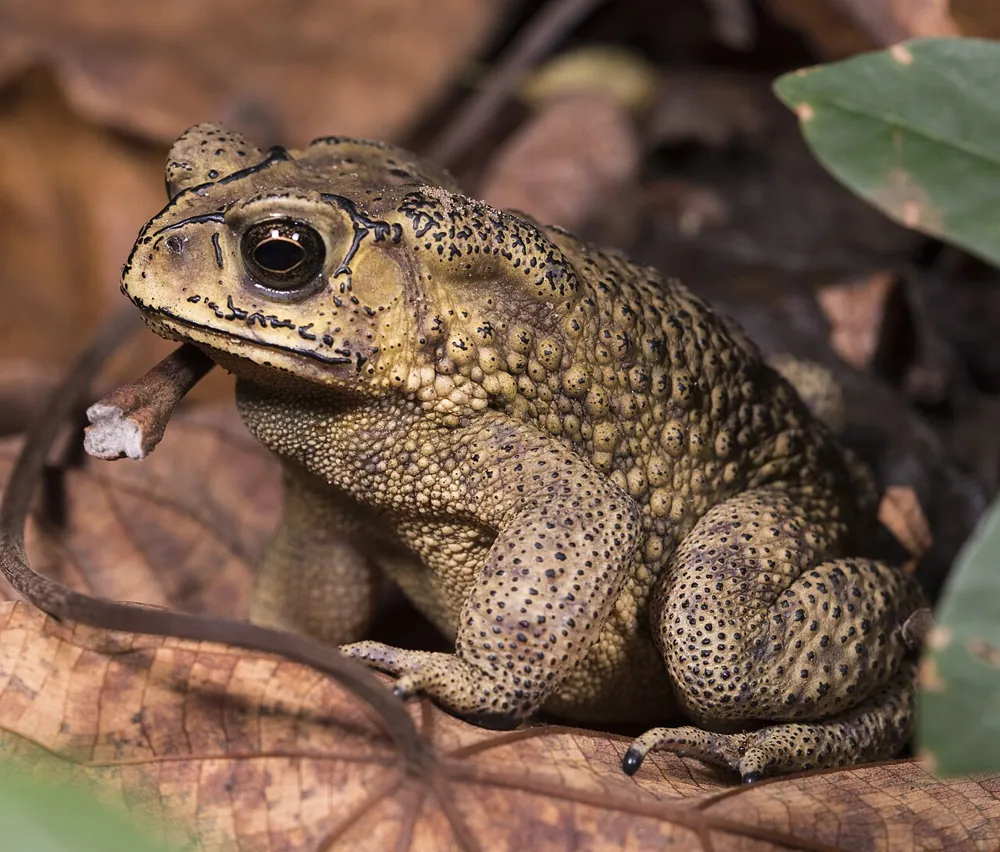
The Asian common toad is a large toad found across much of South and Southeast Asia. It grows to about 20 cm long and is often seen at night under street lamps. It matters because it has spread to places where it does not belong, and experts worry it could harm local wildlife.1

 No anndirto nde
- Grows to about 20 cm long1
- Back is yellowish or brownish, with black spines and ridges1
- Large, kidney-shaped or elongated parotoid glands behind the eyes, which are prominent1
- Ear drum (tympanum) is very distinct, at least two-thirds the width of the eye1
- Short, blunt snout and several bony ridges on top of the head1
Doole tooke
Nguru mum ko tooke. Ina bone memde nde, memde nde e ɗemngal walla ñaamde nde.
Hol ko tooke mum (memde walla ñaamde) waɗata?
Its parotoid glands secrete milky white bufotoxin, a toxin, from its back. It uses this to deter predators. The toxin would beyond reasonable doubt severely affect native predators such as snakes, goannas and quolls.1
Hol no nde woni bone e yimɓe?
Bone e yimɓe: Bone mawɗoSi neɗɗo memii nde walla ñaamii nde, yah to doktaa. Maayde ina woodi seeɗa sanne.Hol ko nde waɗata si nde hulii?
Its glands in the back release toxin to deter predators.1
 Si neɗɗo memii nde walla ñaamii nde
- Si neɗɗo memii gooto: lootu juuɗe moƴƴa, taa memu gite walla hunnduko. Si ɓiɗɗo walla dabbaare galle memii gooto e ɗemngal walla ñaamii nde: noddu nokku ballal tooke walla lamba ballal yaawngal.
Sahaa fof, noddu lamba ballal yaawngal (112, 000, 911) ko adii. Ɗum ko ballal arano kuuɓal, wonaa wasiyya doktaa. Aslu ballal arano
 Reen hoore maa
- Taa memu, taa nanngu, taa aaɓnu dabbaare ladde abada, hay pamaro, hay si ina wayi no ɗaanii walla maayii.
- Accu nde nokku. Si a fottii e gooto, deeƴu, ruttu caggal seeɗa seeɗa, accu nde yaha laawol mum.
- Si a memii nde walla a ñaamii nde: taa momtu gite maa walla hunnduko maa, lootu juuɗe maa, heɓu ballal doktaa.
Nde ɗaɓɓaaki ma. Tooke mum ina woodi tan ngam taa huunde ñaama nde. Ɓeydu anndude no reentorto
Hol to e aduna?
Hol no nde mawni?
Hol no nde juuti?
 juuti no bulok fijo 6 jokkondiraaɗi
 ina waawi dogde meeter 100 nder sakan 180 (neɗɗo ɓurɗo yaawde ina haani 9,6)
Hol no Asian common toad mawni, fottindaade e AAN?
Hiisa tan nder browser maa. Alaa ko mooftetee walla ko neletee.
Hol no nde yaawi?


Anndal
It has been described as one of Australia's '10 most unwanted' species, and as potentially more damaging than the cane toad.1
Madagascar's native predators lack resistance to its toxins, which could affect local wildlife there.1
Tadpoles have been shown to be able to recognise their kin.1
Tadpoles grown in sibling groups metamorphosed faster than those kept in mixed groups.1
Ɗo anndal iwi
- Duttaphrynus melanostictus (Wikipedia (CC BY-SA 4.0))
- Duttaphrynus melanostictus (iNaturalist): inɗe e tolnugol.
- Venom Wiki: darja bone, mawnude woowaaɗo e miijo yaawre ko amen. Ndaar no min hiisirta ɗum: No min betiri bone.
Kala anndal e ngoo hello ina jogii limre hollirnde iwdi mum. Si min juumii, accu min, min yiɗɓe dabbaaji, wonaa jaridaa ganndal. Wiy min e [email protected] min feewnitay.
 Yaare nden ina heege! Venom Wiki ko golle neɗɗo gooto: meere, tawa tallaaji alaa, trackers alaa. Ballal pamarngal ina walla heddinde ɗum e internet.Ñaamnu yaare nden
Goɗɗi e fedde wootere: Kwaɗoji tooke, kwaɗoji mawɗi e newt
 Japanese fire-bellied newtKwaɗoji tooke, kwaɗoji mawɗi e newtIna haani doktaaTaa memu
 Common toadKwaɗoji tooke, kwaɗoji mawɗi e newtIna muusa tanTaa memu
 Oriental fire-bellied toadKwaɗoji tooke, kwaɗoji mawɗi e newtAlaa bone
 Asiatic toadKwaɗoji tooke, kwaɗoji mawɗi e newtIna muusa tanTaa memu
 Emperor newtKwaɗoji tooke, kwaɗoji mawɗi e newtIna muusa tanTaa memu
 Himalayan newtKwaɗoji tooke, kwaɗoji mawɗi e newtIna muusa tanTaa memu
 Yaare deathstalker
 Cobra Indiya
 Viper kiifi kaasa Indiya
 King cobra
 Puff adder
 Mboddi Russell
.jpg)