
 Afirik
 Asiya
Asiya Turai
Turai Amerik Worgo
 Australiya e Oseaniya
 Antarktika
 Baharu Pasifik
 Baharu Atlantik
 Baharu Indiya
 Baharu Arktik
 Baharu Mediterane
 Baharu Boɗeeru
 Baharu Karibiya
 Baharu Koral
 Baharu Ciina Worgo
 Baharu Filipin
 Baharu Andaman
 Baharu Rewo
 Baharu Timor e Arafura
 Baharu Bengal
 Baharu Kaliforniya
Fire urchin
 Gi'e tooke
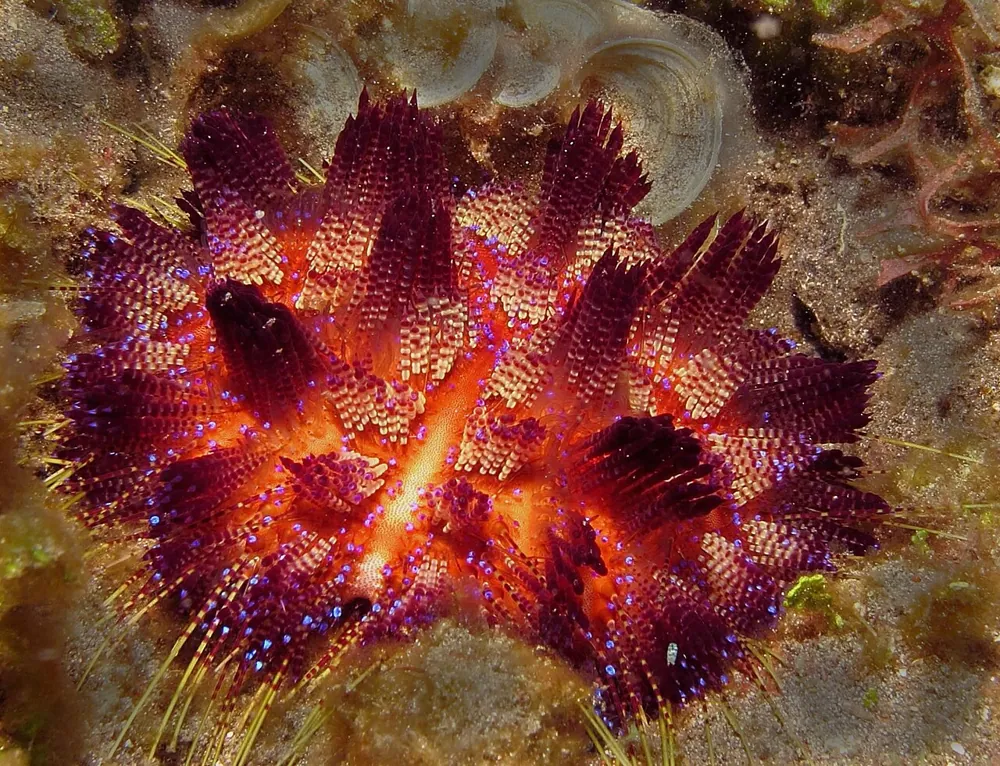
The fire urchin is a large sea urchin that grows up to 25 cm across. It lives on sand and rubble sea floors and in coral areas across the Indo-Pacific. Its venomous spines can give a painful sting, so it is best left alone.1
 No anndirto nde
Doole tooke
Gi'e ceeɓɗe ina njogii tooke. Yaabude nde walla nanngude nde ina muusa.
Hol ko tooke mum (ŋatol walla fiɗol) waɗata?
Each venomous spine has several hollow, spherical capsules filled with toxin, separated by constrictions. These work like hypodermic syringes, injecting the toxin when the spines pierce the skin. The sting is painful and the pain can last several hours.1
Hol no nde woni bone e yimɓe?
Bone e yimɓe: Bone mawɗoSi gi'e mum naatii e ɓanndu maa, yah to doktaa. Maayde ina woodi seeɗa sanne.Handling the urchin can cause a painful sting. The pain can last several hours.1
Hol ko nde waɗata si nde hulii?
Its bright colouration warns other animals that its spines are venomous.1
 Si gi'e mum naatii e ɓanndu maa
- Naatnu barme e ndiyam wulɗam, wulɗam no neɗɗo oo waawi muñde tawa sumataa, heɓu ballal doktaa ngam ittude gi'e. Taa asu ɗe e hoore maa.
Sahaa fof, noddu lamba ballal yaawngal (112, 000, 911) ko adii. Ɗum ko ballal arano kuuɓal, wonaa wasiyya doktaa. Aslu ballal arano
 Reen hoore maa
- Taa memu, taa nanngu, taa aaɓnu dabbaare ladde abada, hay pamaro, hay si ina wayi no ɗaanii walla maayii.
- Accu nde nokku. Si a fottii e gooto, deeƴu, ruttu caggal seeɗa seeɗa, accu nde yaha laawol mum.
- Si gi'e mum naatii e ɓanndu maa: deeƴu, taa dillu, noddu lamba ballal yaawngal (112, 000, 911) walla yah asibiti law. Siftor no nde wayri, foto ina walla.
Nde ɗaɓɓaaki ma. Nde huutora tooke mum ngam nanngude ñaamdu walla reende hoore mum, nde ɓuri yiɗde suuɗaade. Ɓeydu anndude no reentorto
Hol to e aduna?
Hol no nde mawni?
Hol no nde juuti?
 juuti no bulok fijo 8 jokkondiraaɗi
 ɓuri leeltude katantanwa ngesa
Hol no Fire urchin mawni, fottindaade e AAN?
Hiisa tan nder browser maa. Alaa ko mooftetee walla ko neletee.
Hol no nde yaawi?


Anndal
Its venomous spines are hollow and filled with toxin, working like tiny syringes.1
Several small fish and some cephalopods shelter among its toxic spines for protection.1
Its body shell is flexible, because its plates overlap like roof tiles instead of being rigidly joined.1
Shrimps and a zebra crab live on or with the urchin, and the urchin is their host.1
Its secondary spines have sensory cells at the tip and help it move and right itself.1
Ngam ganduɓe tooke
- Innde ganndal
- Asthenosoma varium
- Fedde
- Sea urchin, sea star e gilɗi baharu
- Besngu
- Echinothuriidae2
- Tolno
- Echinothurioida
- Nahiyaaji
- Baharu Indiya, Baharu Pasifik, Baharu Koral, Baharu Filipin, Baharu Timor e Arafura, Baharuuji mawɗi
- Ɓikkoy
- The sexes are separate, and eggs (gametes) are released into the water, where fertilisation takes place. The larvae drift for several months before settling on the seabed and becoming juvenile sea urchins.1
- Bone e yimɓe
- 3 / 5: Bone mawɗo3
Ɗo anndal iwi
- Asthenosoma varium (Wikipedia (CC BY-SA 4.0))
- Asthenosoma varium (iNaturalist): inɗe e tolnugol.
- Venom Wiki: darja bone, mawnude woowaaɗo e miijo yaawre ko amen. Ndaar no min hiisirta ɗum: No min betiri bone.
Kala anndal e ngoo hello ina jogii limre hollirnde iwdi mum. Si min juumii, accu min, min yiɗɓe dabbaaji, wonaa jaridaa ganndal. Wiy min e [email protected] min feewnitay.
 Yaare nden ina heege! Venom Wiki ko golle neɗɗo gooto: meere, tawa tallaaji alaa, trackers alaa. Ballal pamarngal ina walla heddinde ɗum e internet.Ñaamnu yaare nden
Goɗɗi e fedde wootere: Sea urchin, sea star e gilɗi baharu
 Crown-of-thorns starfishSea urchin, sea star e gilɗi baharuIna haani doktaaTaa memu
 Flower urchinSea urchin, sea star e gilɗi baharuIna waawi warde
 Bearded firewormSea urchin, sea star e gilɗi baharuIna muusa tanTaa memu
 Black long-spined urchinSea urchin, sea star e gilɗi baharuIna muusa tanTaa memu
 BloodwormSea urchin, sea star e gilɗi baharuIna muusa tan
 Bobbit wormSea urchin, sea star e gilɗi baharuIna muusa tan
Ina wona kadi e: Baharu Indiya
 Australian box jellyfishJellyfish e fiɗooji baharuWarooɗoTaa memu
 Geography coneCone snail e octopusWarooɗo
 Greater blue-ringed octopusCone snail e octopusWarooɗo
 Southern blue-ringed octopusCone snail e octopusWarooɗo
 Hawksbill sea turtleDabbaaji goɗɗi tooke memde walla ñaamdeIna waawi warde
 Irukandji jellyfishJellyfish e fiɗooji baharuIna waawi wardeTaa memu