
 Afirik
 Asiya
Asiya Turai
Turai Amerik Worgo
 Australiya e Oseaniya
 Antarktika
 Baharu Pasifik
 Baharu Atlantik
 Baharu Indiya
 Baharu Arktik
 Baharu Mediterane
 Baharu Boɗeeru
 Baharu Karibiya
 Baharu Koral
 Baharu Ciina Worgo
 Baharu Filipin
 Baharu Andaman
 Baharu Rewo
 Baharu Timor e Arafura
 Baharu Bengal
 Baharu Kaliforniya
Gila monster
 Ina ŋata
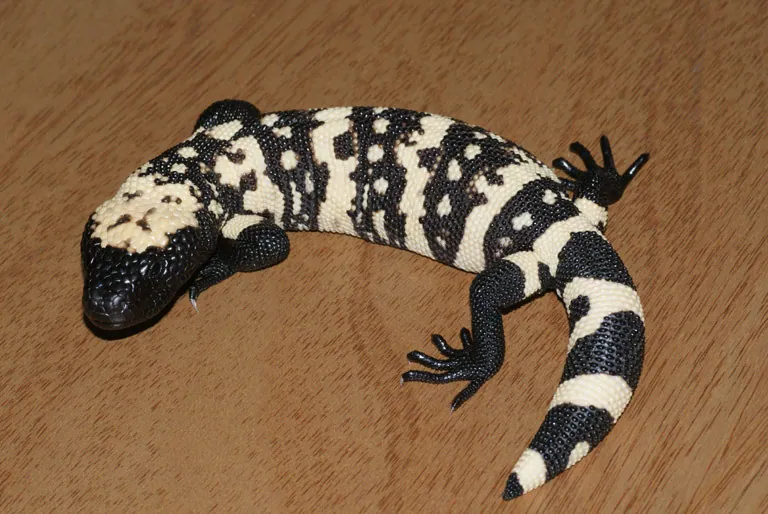
The Gila monster is a heavy, slow-moving lizard with a venomous bite. It lives in the south-western United States and the Mexican state of Sonora. It is the only venomous lizard native to the United States, but it rarely poses a real threat to people.1



 No anndirto nde
- Adults are yellow to pink on a black background.1
- Hatchlings have a simple, uniform pattern that is less colourful, and it changes over their first 6 months.1
- It has a heavy body, a stout snout and a massive head.1
- Adults can reach 56 cm in total length.1
- Males often have larger, more triangular heads than females.1
Ina jiiɓindiree e: Its closest relatives are beaded lizards, which live in Mexico and Guatemala. In the United States, the Gila monster is the only venomous lizard.1
Doole tooke
Tooke ina yalta e ñiiƴe mum si nde ŋatii.
Hol ko tooke mum (ŋatol walla fiɗol) waɗata?
The venom is made in glands in the lower jaw and flows along grooves in the lower teeth into the bite. It contains more than a dozen peptides and other substances, which cause pain and swelling. Four potentially lethal toxins have been found, which can cause bleeding inside the organs.1
Hol no nde woni bone e yimɓe?
Bone e yimɓe: Bone mawɗoŊatol ina haani doktaa. Maayde ina woodi seeɗa sanne.The venom is usually not fatal to healthy adults. One death has been confirmed since 1930, on 16 February 2024. Earlier deaths involved adults who were drunk or whose bite was treated badly. Bites are painful and can cause shock, but the lizard is sluggish and rarely a real threat.1
Hol ko nde waɗata si nde hulii?
Its bright colours may warn predators to keep away, because it can inflict pain.1
 Si nde ŋatii
- Bites are painful and need emergency medical care, because the venom may cause shock. Get medical help as quickly as possible.1
- Lootu barme, deeƴin neɗɗo oo, heɓu ballal doktaa.
Sahaa fof, noddu lamba ballal yaawngal (112, 000, 911) ko adii. Ɗum ko ballal arano kuuɓal, wonaa wasiyya doktaa. Aslu ballal arano
 Reen hoore maa
- Taa memu, taa nanngu, taa aaɓnu dabbaare ladde abada, hay pamaro, hay si ina wayi no ɗaanii walla maayii.
- Accu nde nokku. Si a fottii e gooto, deeƴu, ruttu caggal seeɗa seeɗa, accu nde yaha laawol mum.
- Si gooto e majji ŋatii ma: deeƴu, taa dillu, noddu lamba ballal yaawngal (112, 000, 911) walla yah asibiti law. Siftor no nde wayri, foto ina walla.
Nde ɗaɓɓaaki ma. Nde huutora tooke mum ngam nanngude ñaamdu walla reende hoore mum, nde ɓuri yiɗde suuɗaade. Ɓeydu anndude no reentorto
Hol to e aduna?
Hol no nde mawni?
Hol no nde juuti?
Hol no nde teddi?
 juuti no ayaba 3 jokkondiraaɗi
 juuti no bulok fijo 18 jokkondiraaɗi
 ina waawi dogde meeter 100 nder sakan 150 (neɗɗo ɓurɗo yaawde ina haani 9,6)
Hol no Gila monster mawni, fottindaade e AAN?
Hiisa tan nder browser maa. Alaa ko mooftetee walla ko neletee.
Hol no nde yaawi?


Anndal
Exendin-4, one of the venom's peptides, led to the development of GLP-1 receptor agonists, which treat type 2 diabetes and obesity.1
Young Gila monsters can swallow up to half of their body weight in a single meal.1
It can store fat in its tail and survive a whole season on three to four large meals in spring.1
Its venom is thought to have evolved mainly for defence, because its prey is mostly eggs, small animals and other helpless prey.1
It can climb trees, cacti and fairly straight, rough-surfaced walls.1
Its teeth are replaced throughout its life, and broken teeth are replaced by the teeth behind them.1
Feññinoowo goonga
Fenaande: Its bite is always fatal, and its breath is poisonous.
Goonga: The venom is usually not fatal to healthy adult humans. One death has been confirmed since 1930.1
Ɗo anndal iwi
- Gila monster (Wikipedia (CC BY-SA 4.0))
- Heloderma suspectum (iNaturalist): inɗe e tolnugol.
- Venom Wiki: darja bone, mawnude woowaaɗo e miijo yaawre ko amen. Ndaar no min hiisirta ɗum: No min betiri bone.
Kala anndal e ngoo hello ina jogii limre hollirnde iwdi mum. Si min juumii, accu min, min yiɗɓe dabbaaji, wonaa jaridaa ganndal. Wiy min e [email protected] min feewnitay.
 Yaare nden ina heege! Venom Wiki ko golle neɗɗo gooto: meere, tawa tallaaji alaa, trackers alaa. Ballal pamarngal ina walla heddinde ɗum e internet.Ñaamnu yaare nden
Goɗɗi e fedde wootere: Kadangareeji tooke
 Mexican beaded lizardKadangareeji tookeIna haani doktaa
 Chiapan beaded lizardKadangareeji tookeIna haani doktaa
 Guatemalan beaded lizardKadangareeji tookeIna haani doktaa
 Rio Fuerte beaded lizardKadangareeji tookeIna haani doktaa
 Komodo dragonKadangareeji tookeIna waawi warde
 Desert monitorKadangareeji tookeIna muusa tan
 Terciopelo
 Eastern coral snake
 Eastern diamondback rattlesnake
 Eyelash viper
 Timber rattlesnake
 Western diamondback rattlesnake