
 Afirik
 Asiya
Asiya Turai
Turai Amerik Worgo
 Australiya e Oseaniya
 Antarktika
 Baharu Pasifik
 Baharu Atlantik
 Baharu Indiya
 Baharu Arktik
 Baharu Mediterane
 Baharu Boɗeeru
 Baharu Karibiya
 Baharu Koral
 Baharu Ciina Worgo
 Baharu Filipin
 Baharu Andaman
 Baharu Rewo
 Baharu Timor e Arafura
 Baharu Bengal
 Baharu Kaliforniya
Iberian ribbed newt
 Gi'e tookeIna ñaama: TeewuTooke memde walla ñaamde, wonaa tooke ŋatol walla fiɗol
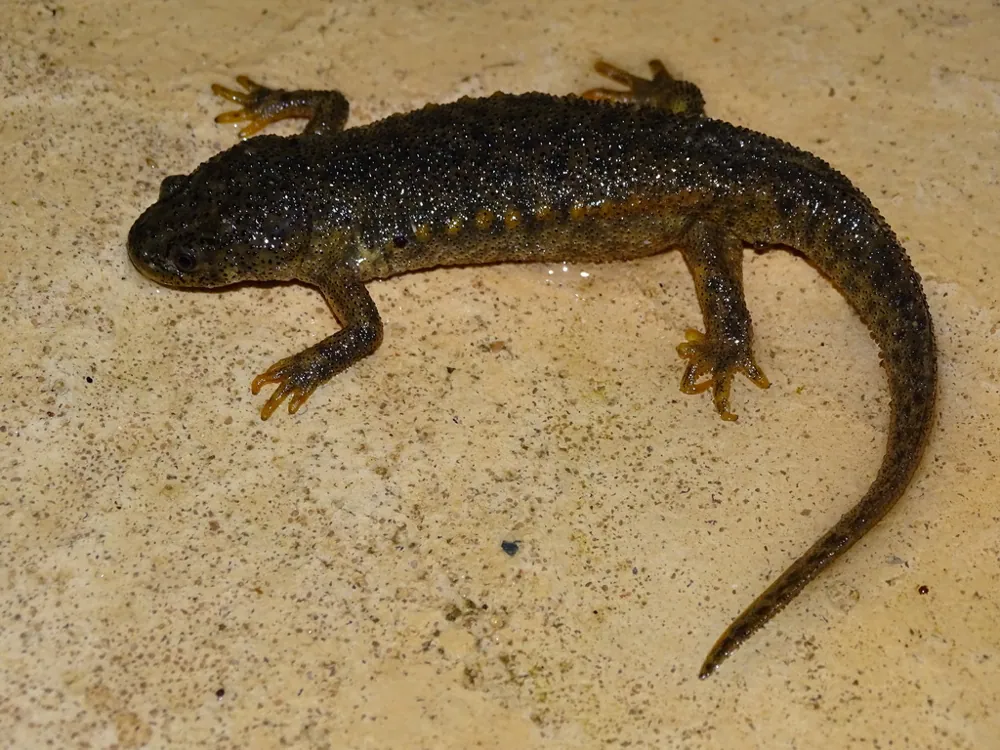
The Iberian ribbed newt is a salamander that lives in ponds and wells in Spain, Portugal and northern Morocco. It is the largest European newt species. When threatened, it can push its sharp ribs out through its skin, which gives it a way to defend itself against predators.1



 No anndirto nde
- Dark grey on its back and lighter grey on its belly, with small rust-coloured spots1
- Usually 8 to 10 orange, wart-like bumps (tubercles) running down each side of the body1
- Flat, spade-shaped head and a long tail, about half of its body length1
- Males are more slender and usually smaller than females1
- Larvae have bushy external gills and paler colours than adults1
Ina jiiɓindiree e: It is sometimes confused with the Iberian newt (Lissotriton boscai), a different species with a similar common name.1
Doole tooke
Gi'e ceeɓɗe ina njogii tooke. Yaabude nde walla nanngude nde ina muusa.
Hol ko tooke mum (ŋatol walla fiɗol) waɗata?
When threatened, the newt releases a milky, thick poison from glands on its neck, back, sides and tail as its ribs push out. The poison coats the ribs, which can pierce the skin of a predator's mouth and inject toxins.1
Hol no nde woni bone e yimɓe?
Bone e yimɓe: HoyɗoNo fiɗol nyaaku walla ɓuri famɗude. Ɓadii alaa bone e yimɓe.The rib defence is completely harmless to humans. The ribs cause only little harm to the newt itself, and its skin quickly heals without infection.1
Hol ko nde waɗata si nde hulii?
It tries to run away from predators first. If it cannot escape, it pushes its sharp ribs through its sides and releases poison.1
 Si gi'e mum naatii e ɓanndu maa
- Si neɗɗo memii gooto: lootu juuɗe moƴƴa, taa memu gite walla hunnduko. Si ɓiɗɗo walla dabbaare galle memii gooto e ɗemngal walla ñaamii nde: noddu nokku ballal tooke walla lamba ballal yaawngal.
Sahaa fof, noddu lamba ballal yaawngal (112, 000, 911) ko adii. Ɗum ko ballal arano kuuɓal, wonaa wasiyya doktaa. Aslu ballal arano
 Reen hoore maa
- Taa memu, taa nanngu, taa aaɓnu dabbaare ladde abada, hay pamaro, hay si ina wayi no ɗaanii walla maayii.
- Accu nde nokku. Si a fottii e gooto, deeƴu, ruttu caggal seeɗa seeɗa, accu nde yaha laawol mum.
- Si gi'e mum naatii e ɓanndu maa: deeƴu, taa dillu, noddu lamba ballal yaawngal (112, 000, 911) walla yah asibiti law. Siftor no nde wayri, foto ina walla.
Nde ɗaɓɓaaki ma. Nde huutora tooke mum ngam nanngude ñaamdu walla reende hoore mum, nde ɓuri yiɗde suuɗaade. Ɓeydu anndude no reentorto
Hol to e aduna?
Hol no nde mawni?
Hol no nde juuti?
 juuti no bulok fijo 9 jokkondiraaɗi
Hol no Iberian ribbed newt mawni, fottindaade e AAN?
Hiisa tan nder browser maa. Alaa ko mooftetee walla ko neletee.
Hol no nde yaawi?


Anndal
Its ribs can push through its skin to act as a defence, a primitive and rudimentary form of envenomation.1
It is a model animal for regeneration research. It can regrow lost limbs, injured heart tissue, brain cells, eye lenses and parts of its spinal cord.1
This newt has been sent into space on at least six missions, starting in 1985.1
In genetic males and females, temperature can override sex chromosomes. Some ZW larvae reared at 32 °C (90 °F) become functional males.1
Its immune system, rib-coated collagen and antimicrobial peptides let the pierced skin heal quickly without infection.1
Females can keep live sperm in their cloaca for up to five months.1
Feññinoowo goonga
Fenaande: The newt's ribs and poison are dangerous to people.
Goonga: The ribs and poison are a defence against predators. The rib defence is completely harmless to humans.1
Ngam ganduɓe tooke
- Innde ganndal
- Pleurodeles waltl
- Fedde
- Kwaɗoji tooke, kwaɗoji mawɗi e newt
- Besngu
- Salamandridae2
- Tolno
- Caudata
- Nahiyaaji
- Turai, Afirik
- Ɓikkoy
- The young are born in water as larvae, breathing through gills. They lose their gills as their limbs grow and can then live on land as well as in water.1
- Hol no nde wonata e ladde
- Least Concern (IUCN, assessed October 2020)1
- Bone e yimɓe
- 1 / 5: Hoyɗo3
Ɗo anndal iwi
- Iberian ribbed newt (Wikipedia (CC BY-SA 4.0))
- Pleurodeles waltl (iNaturalist): inɗe e tolnugol.
- Venom Wiki: darja bone, mawnude woowaaɗo e miijo yaawre ko amen. Ndaar no min hiisirta ɗum: No min betiri bone.
Kala anndal e ngoo hello ina jogii limre hollirnde iwdi mum. Si min juumii, accu min, min yiɗɓe dabbaaji, wonaa jaridaa ganndal. Wiy min e [email protected] min feewnitay.
 Yaare nden ina heege! Venom Wiki ko golle neɗɗo gooto: meere, tawa tallaaji alaa, trackers alaa. Ballal pamarngal ina walla heddinde ɗum e internet.Ñaamnu yaare nden
Goɗɗi e fedde wootere: Kwaɗoji tooke, kwaɗoji mawɗi e newt
 Fire salamanderKwaɗoji tooke, kwaɗoji mawɗi e newtIna muusa tanTaa memu
 Common toadKwaɗoji tooke, kwaɗoji mawɗi e newtIna muusa tanTaa memu
 European fire-bellied toadKwaɗoji tooke, kwaɗoji mawɗi e newtAlaa bone
 Golden mantellaKwaɗoji tooke, kwaɗoji mawɗi e newtAlaa bone
 Natterjack toadKwaɗoji tooke, kwaɗoji mawɗi e newtAlaa bone
 Tomato frogKwaɗoji tooke, kwaɗoji mawɗi e newtAlaa bone
Ina wona kadi e: Turai
 Common European adderViper e adderIna haani doktaa
 Spanish flyDabbaaji goɗɗi tooke memde walla ñaamdeIna haani doktaaTaa memu
 Common waspNyaakuuje, zanzaro e zanzaro mawɓeIna muusa tan
 European hornetNyaakuuje, zanzaro e zanzaro mawɓeIna muusa tan
 Western honey beeNyaakuuje, zanzaro e zanzaro mawɓeIna muusa tan
 Blunt-nosed viperViper e adderIna waawi warde