
 Afirik
 Asiya
Asiya Turai
Turai Amerik Worgo
 Australiya e Oseaniya
 Antarktika
 Baharu Pasifik
 Baharu Atlantik
 Baharu Indiya
 Baharu Arktik
 Baharu Mediterane
 Baharu Boɗeeru
 Baharu Karibiya
 Baharu Koral
 Baharu Ciina Worgo
 Baharu Filipin
 Baharu Andaman
 Baharu Rewo
 Baharu Timor e Arafura
 Baharu Bengal
 Baharu Kaliforniya
Lion's mane jellyfish
 Tentacle fiɗooji
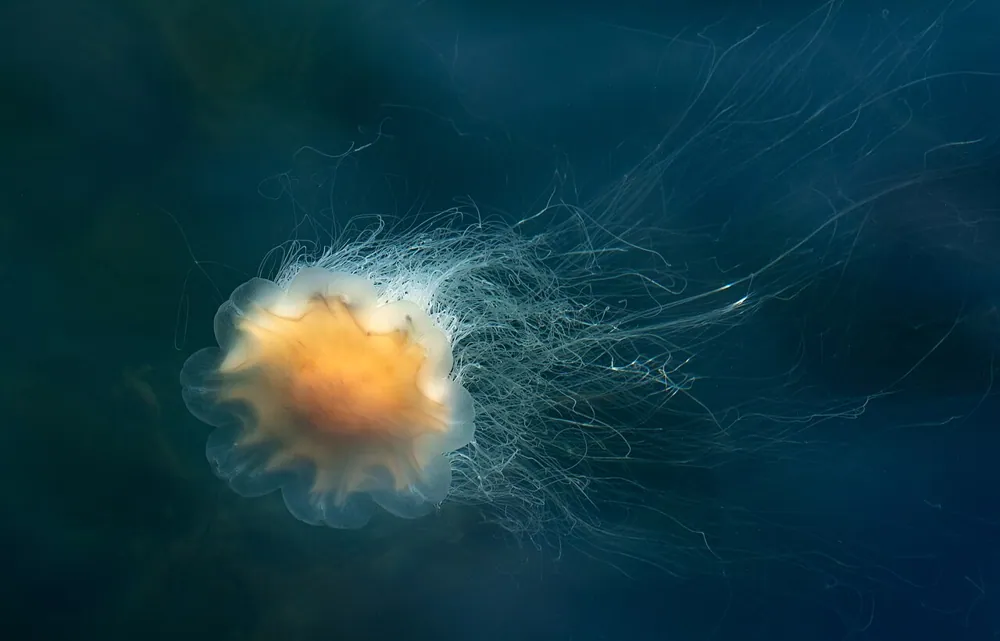
The lion's mane jellyfish is one of the largest jellyfish known, and its bell can be over 2 m across in the far north. It lives in cold northern seas, including the English Channel, the North Sea and the Irish Sea. Its long, trailing stinging tentacles can wash up on beaches in late summer and autumn.1



 No anndirto nde
- Bell is divided into eight lobes, giving it the look of an eight-point star1
- Young ones are light orange or tan, darkening to red and purple as they grow1
- Long, thin, trailing tentacles, with many more tentacles around the mouth1
- Bell is often about 50 cm across in lower latitudes, and much larger in the far north1
- Usually found alone, rarely in groups1
Ina jiiɓindiree e: The blue jellyfish (Cyanea lamarckii) is sometimes found in the same waters. It is blue rather than red, and smaller, with a bell of about 10 to 20 cm across.1
Doole tooke
Ujunaaje selluuji pamari fiɗooji ina fiɗa si huunde memii ɗi.
Hol ko tooke mum (ŋatol walla fiɗol) waɗata?
Its tentacles carry stinging cells, called nematocysts, which inject a sting when touched. The sting is very painful and feels like intense itching or burning, and it can cause temporary pain and redness where the skin was touched. Stings across large parts of the body can cause whole-body (systemic) effects, and medical attention is recommended in that case.1
Hol no nde woni bone e yimɓe?
Bone e yimɓe: Ina muusaIna waawi muusude sanne, kono ɓadii abada wonaa bone mawɗo.Stings are not known to be fatal in healthy people, and there is normally no real danger, though people with special allergies may be at risk. Rare severe stings in deep water can cause panic, which may lead to drowning. In July 2010, about 150 beachgoers were stung by the remains of one broken-up jellyfish on a beach in New Hampshire, US.1
 Si nde fiɗii
- Vinegar can be used to deactivate the stinging cells. If you have touched a large number of tentacles, get medical attention after exposure.1
- Yaltu e ndiyam, ittu kala tentacle (e kaddule juuɗe walla wudere).
- Ngam box jellyfish leyɗe tulɓe: loow vinegar dow fiɗe ɗe, ko famɗi fof sakan 30, noddu ballal, wonu hebbinaaɗo waɗde CPR. Ngam bluebottle e ɓurɗi ɗuuɗde: lootu e ndiyam baharu, refti ndiyam wulɗam ngam muusu.
Sahaa fof, noddu lamba ballal yaawngal (112, 000, 911) ko adii. Ɗum ko ballal arano kuuɓal, wonaa wasiyya doktaa. Aslu ballal arano
 Reen hoore maa
- Taa memu, taa nanngu, taa aaɓnu dabbaare ladde abada, hay pamaro, hay si ina wayi no ɗaanii walla maayii.
- Accu nde nokku. Si a fottii e gooto, deeƴu, ruttu caggal seeɗa seeɗa, accu nde yaha laawol mum.
- Si gooto e majji fiɗii ma: deeƴu, taa dillu, noddu lamba ballal yaawngal (112, 000, 911) walla yah asibiti law. Siftor no nde wayri, foto ina walla.
Nde ɗaɓɓaaki ma. Nde huutora tooke mum ngam nanngude ñaamdu walla reende hoore mum, nde ɓuri yiɗde suuɗaade. Ɓeydu anndude no reentorto
Hol to e aduna?
Hol no nde mawni?
Hol no nde juuti?
 juuti no ullundi galle 4, hinere haa laaci
 juuti no ayaba 12 jokkondiraaɗi
 ina waawi lumbaade njuuteendi pisin mawɗo (50 m) nder sakan 140
Hol no Lion's mane jellyfish mawni, fottindaade e AAN?
Hiisa tan nder browser maa. Alaa ko mooftetee walla ko neletee.
Hol no nde yaawi?

Anndal
The longest recorded tentacles were 36.6 m long, longer than a blue whale.1
Its tentacles can still sting for up to 25 days after they have detached from the jellyfish.1
Each of the eight lobes of its bell has about 70 to 150 tentacles, and it has around 1,200 tentacles near its mouth.1
The leatherback sea turtle feeds almost exclusively on lion's mane jellyfish in large numbers during summer around Eastern Canada.1
Unlike most jellyfish that drift in groups, the lion's mane is completely solitary.1
Feññinoowo goonga
Fenaande: The lion's mane jellyfish is the longest animal in the world.
Goonga: This claim was made on a TV show, but it was corrected. A bootlace worm reported in 1864 was said to be over 55 m long, and that report is doubted because bootlace worms can stretch well beyond their natural length. If that report is wrong, the lion's mane would be the longest animal.1
Ngam ganduɓe tooke
- Innde ganndal
- Cyanea capillata
- Fedde
- Jellyfish e fiɗooji baharu
- Besngu
- Cyaneidae2
- Tolno
- Semaeostomeae
- Nahiyaaji
- Baharu Arktik, Baharu Atlantik, Baharu Pasifik, Baharu Rewo, Baharuuji mawɗi
- Ɓikkoy
- The female carries fertilised eggs in a tentacle, and they grow into larvae that settle on a hard surface and become polyps, which then produce young jellyfish called ephyrae.1
- Duuɓi nguurndam
- ɓadii duuɓi 11
- Bone e yimɓe
- 2 / 5: Ina muusa3
Ɗo anndal iwi
- Lion's mane jellyfish (Wikipedia (CC BY-SA 4.0))
- Cyanea capillata (iNaturalist): inɗe e tolnugol.
- Venom Wiki: darja bone, mawnude woowaaɗo e miijo yaawre ko amen. Ndaar no min hiisirta ɗum: No min betiri bone.
Kala anndal e ngoo hello ina jogii limre hollirnde iwdi mum. Si min juumii, accu min, min yiɗɓe dabbaaji, wonaa jaridaa ganndal. Wiy min e [email protected] min feewnitay.
 Yaare nden ina heege! Venom Wiki ko golle neɗɗo gooto: meere, tawa tallaaji alaa, trackers alaa. Ballal pamarngal ina walla heddinde ɗum e internet.Ñaamnu yaare nden
Goɗɗi e fedde wootere: Jellyfish e fiɗooji baharu
 Box jellyfish OstireliyaJellyfish e fiɗooji baharuWarooɗoTaa memu
 Irukandji jellyfishJellyfish e fiɗooji baharuIna waawi wardeTaa memu
 Portuguese man o' warJellyfish e fiɗooji baharuIna haani doktaaTaa memu
 Moon jellyfishJellyfish e fiɗooji baharuAlaa bone
 Common kingslayerJellyfish e fiɗooji baharuIna waawi wardeTaa memu
 Hell's fire anemoneJellyfish e fiɗooji baharuIna haani doktaaTaa memu
 Greenland shark
 Spiny dogfish
 Bootlace worm