
 Afrik
Afrik Aazi
Aazi Orop
Orop Amerik Worgo
 Ostaraali e Oseyaani
 Antarktik
 Geec Pasifik
 Geec Atlantik
 Geec Enndo
 Geec Arktik
 Geec Mediteraane
 Geec Boɗeejo
 Geec Karayib
 Geec Korayl
 Geec Siin Worgo
 Geec Filipiin
 Geec Andaman
 Geec Rewo
 Geec Timor e Arafura
 Gulf Bengal
 Gulf Kaliforni
Aquatic coral snake
 Ŋatgol
The aquatic coral snake is a venomous snake that spends much of its time in water. It is one of the heaviest and sturdiest coral snakes, and it lives in the forests of northern South America. It is special because it swims well and can stay underwater for a long time.1



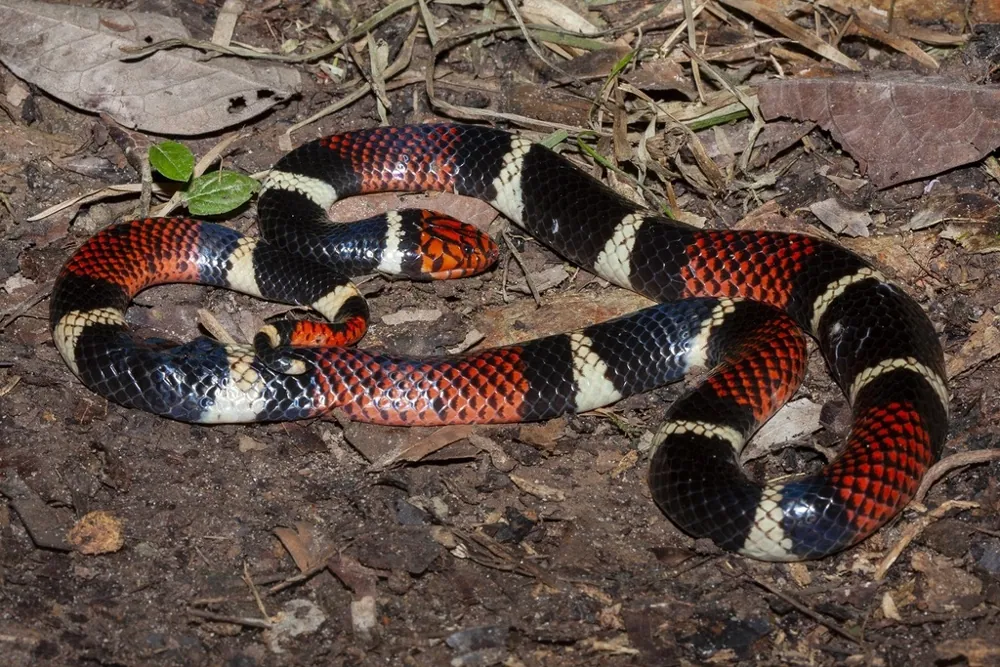
 No anndirte ngal
- The head is mainly red with black edging on the scales.1
- The head is large with a long snout, and the eyes and nostrils sit higher on the head than in other coral snakes.1
- The body has wide red rings separated by groups of three black rings, with narrow cream or yellowish rings between the black bands.1
- The scales are smooth and shiny, and arranged in 15 rows.1
- Adults usually measure 80 to 100 cm, tail included.1
Doole tooke
Tooke ngal ina yaltira ñiiƴe mum so ina ŋata.
Hol ko tooke ŋatgol mum waɗata?
Its venom is neurotoxic, meaning it attacks the nerves. It blocks signals between nerves and muscles, which causes paralysis. Symptoms can include blurred vision, difficulty speaking, swallowing and walking, and breathing failure. In a well-reported case in the Amazon, the victim reached hospital about 20 minutes after the bite.1
Hol no bone mum heewiri e yimɓe?
Bone e yimɓe: Bone sanneIna waawi warde neɗɗo mo safraaka.Bites are rare, but the venom can cause paralysis of the cranial nerves and can be fatal. The estimated lethal dose for an adult human is 18–20 mg, which is higher than the 4–7 mg for smaller coral snake species. Because it is a large snake, it can carry a lot of venom, with an average yield of 56 mg and a maximum of 160 mg when milked by scientists.1
 Kabaaru moƴƴo: doktooruuji ina njogii lekki (sérum antivenimeux) walla safaara ngam ɗum.1
Hol ko ngal waɗata so ina hula?
When threatened, it flattens its body and raises its tail.1
 So ina ŋata
- A bite needs hospital care. In a recorded case, the victim needed mechanical ventilation because paralysis of the breathing muscles made it hard to breathe, and was given specific Micrurus antivenom.1
- Haɗ neɗɗo oo dillaade, deƴƴin mo, yahra mo opitaal law, hay so nokku ŋataaɗo oo ina famɗi: maandeeji ina mbaawi fuɗɗaade caggal waktuuji.
Adii fof noddu nimero urgence (112, 000, 911). Ɗum ko anndinal ballal adiingal, wonaa saaraangal doktoor. Ko adii e ballal adiingal
 Reen hoore maa
- Wota a meem, wota a nanngu, wota a ñiŋŋu kullal ladde haa abada, hay so ngal ina famɗi, hay so ina nanndi e ɗaaniingal walla maayngal.
- Accu ngal nokku. So a fotti e ngal, deƴƴu, ruttu ɓaawo seeɗa seeɗa, accu ngal yaha laawol mum.
- So gooto ŋatii ma: deƴƴu, wota a dillu, noddu nimero urgence (112, 000, 911) walla yahu opitaal law. Jogo e hakkille no ngal nanndi, natal ina walla.
Ngal faalaaka gaañde ma. Ina huutoroo tooke mum ngam nanngude ñaamdu walla reenaade, ina ɓuri yiɗde suuɗaade. Ɓeydu anndude no reentortoo
Hol to e aduna?
Hol no mawniri?
Hol no juutiri?
 juutde no ulluuɗi galle 2,5, hinere haa lawol
 juutde no banaanaaji 8 sammondiraaɗi
 ina waawi taƴde 100 meeteer e segonde 68 (neɗɗo ɓurɗo yaawde ina sokli 9,6)
Hol no Aquatic coral snake mawniri, so fooɗondiraama e AN?
Limgal tan e navigatoor maa. Alaa ko danndetee walla ko neldetee.
Hol no yaawiri?


Humpito
It swims very well and can stay submerged for a long period.1
Although its venom is weaker than that of smaller members of its genus, it can carry a large amount of venom because of its size.1
It is one of the heaviest and most robust coral snakes.1
It is mainly active at night, though it can also be active during the day.1
It is not aggressive towards humans.1
Ɗo humpito iwri
- Aquatic coral snake (Wikipedia (CC BY-SA 4.0))
- Micrurus surinamensis (iNaturalist): inɗe e ceergal.
- Venom Wiki: tolno bone, mawnude heewnde e miijo yaawde ko amen. Yiy no men keɓirta ɗum: No men tolnirta bone.
Kala humpito e ngoo hello ina jogii limoore hollirnde iwdi mum. So men juumii, yaafo, men ko yiɗɓe kulle, wonaa jaaynde ganndal. Wiy men e [email protected], men feewnita.
 Yaare nden ina weelaa! Venom Wiki ko golle neɗɗo gooto: yoɓetaake, alaa ko jeeyetee, alaa rewɓe. Ndokkal seeɗa ina walla ngam heddude e enternet.Ñaam yaare nden
 Central American coral snake
 Amazonian coral snake
 Argentinian coral snake
 Caatinga coral snake
 Dumeril's coral snake
 Mesopotamian coral snake
 Faaɓru tooke kaŋŋe
 Terciopelo
 Brazilian wandering spider
 Eyelash viper
 Golden lancehead
 South American bushmaster