
 Afrik
Afrik Aazi
Aazi Orop
Orop Amerik Worgo
 Ostaraali e Oseyaani
 Antarktik
 Geec Pasifik
 Geec Atlantik
 Geec Enndo
 Geec Arktik
 Geec Mediteraane
 Geec Boɗeejo
 Geec Karayib
 Geec Korayl
 Geec Siin Worgo
 Geec Filipiin
 Geec Andaman
 Geec Rewo
 Geec Timor e Arafura
 Gulf Bengal
 Gulf Kaliforni
Radiant sea urchin
 Gaaɗe tooke
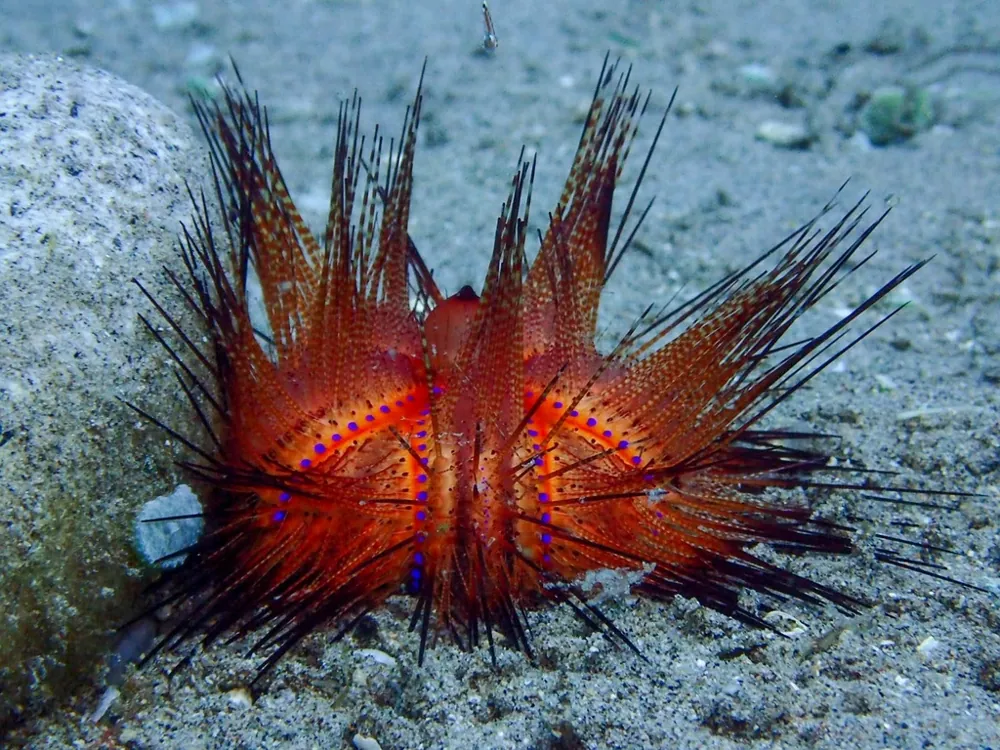
The radiant sea urchin is a large, colourful sea urchin with long, spiky spines. It lives in warm, shallow seas across the Indo-Pacific, from the African coast to Hawaii and Australia. Its spines are venomous, so it is one to admire from a distance.1

 No anndirte ngal
- A large urchin, with a body (test) up to 20 cm across.1
- Long, hollow spines up to 4 cm, in five vertical clusters.1
- Between the clusters are bare, V-shaped red areas with lines of iridescent blue dots.1
- The rest of the body and spines range from reddish brown to purple, dark brown or nearly black.1
- Juveniles have spines with banding across them, and this sometimes stays into adulthood.1
Ina heewi waylondireede e: It is often called the false fire urchin to tell it apart from the true fire urchin, Asthenosoma varium.1
Doole tooke
Gaaɗe ceeɓɗe ina ndondii tooke. Yaabde e mum walla nanngude ɗum ina muusi.
Hol ko tooke ŋatgol mum waɗata?
Its spines are venomous and can cause painful wounds. The spines are long and hollow, and the shorter of the two kinds are the venomous ones.1
Hol no bone mum heewiri e yimɓe?
Bone e yimɓe: MuusɗoIna waawi muusde sanne, kono hertaani wonde huunde mawnde.It is not deadly to humans, but its spines can cause painful wounds. Because it is large and brightly coloured, divers can usually see it, so injuries from stepping on one are fairly rare. On the 'Kings of Pain' pain index it scores 12 out of 30.1
Hol ko ngal waɗata so ina hula?
It is sensitive to light and can angle its spines towards an approaching threat.1
 So gaaɗe mum tuƴii ma
- Naatnu gaañande nden e ndiyam guleeɗam, guleeɗam no neɗɗo oo waawi muññude tawa sumaani, heɓ ballal cafrol ngam ittude gaaɗe ɗee. Wota a asu ngam ittude ɗe hoore maa.
Adii fof noddu nimero urgence (112, 000, 911). Ɗum ko anndinal ballal adiingal, wonaa saaraangal doktoor. Ko adii e ballal adiingal
 Reen hoore maa
- Wota a meem, wota a nanngu, wota a ñiŋŋu kullal ladde haa abada, hay so ngal ina famɗi, hay so ina nanndi e ɗaaniingal walla maayngal.
- Accu ngal nokku. So a fotti e ngal, deƴƴu, ruttu ɓaawo seeɗa seeɗa, accu ngal yaha laawol mum.
- So gaaɗe mum tuƴii ma: deƴƴu, wota a dillu, noddu nimero urgence (112, 000, 911) walla yahu opitaal law. Jogo e hakkille no ngal nanndi, natal ina walla.
Ngal faalaaka gaañde ma. Ina huutoroo tooke mum ngam nanngude ñaamdu walla reenaade, ina ɓuri yiɗde suuɗaade. Ɓeydu anndude no reentortoo
Hol to e aduna?
Hol no mawniri?
Hol no juutiri?
 juutde no kaaɗe mahirɗe 6 ɗaɓɓondiraaɗe
 ɓuri kokiyaas ngesa leelde
Hol no Radiant sea urchin mawniri, so fooɗondiraama e AN?
Limgal tan e navigatoor maa. Alaa ko danndetee walla ko neldetee.
Hol no yaawiri?

Humpito
A crab called Dorippe frascone carries the urchin on its back.1
Several shrimps, crabs and small fish live among its spines for shelter.1
Its scientific name refers to a star-shaped pattern around its anus, not to the animal's shape as a whole.1
Its bright colours and size make it a favourite subject for underwater photographers and some expert fish-keepers.1
Its young larvae drift in the ocean as plankton before they settle on the seabed.1
Ngam ganduɓe tooke
- Innde ganndal
- Astropyga radiata
- Fedde
- Ɓuuɓuuli geec gaaɗe, koode geec e ngilnooɗe
- Ɓesngu
- Diadematidae2
- Ordre
- Diadematoida
- Leyɗe mawɗe
- Geec Enndo, Geec Pasifik, Geec Korayl, Geec Filipiin, Geec Timor e Arafura, Gulf Bengal, Geece mawɗe
- Ɓiɓɓe tokooso
- Males and females are separate. Eggs and sperm are released into the water, and the larvae drift as plankton through several stages before settling on the seabed and becoming juveniles.1
- Bone e yimɓe
- 2 / 5: Muusɗo3
Ɗo humpito iwri
- Astropyga radiata (Wikipedia (CC BY-SA 4.0))
- Astropyga radiata (iNaturalist): inɗe e ceergal.
- Venom Wiki: tolno bone, mawnude heewnde e miijo yaawde ko amen. Yiy no men keɓirta ɗum: No men tolnirta bone.
Kala humpito e ngoo hello ina jogii limoore hollirnde iwdi mum. So men juumii, yaafo, men ko yiɗɓe kulle, wonaa jaaynde ganndal. Wiy men e [email protected], men feewnita.
 Yaare nden ina weelaa! Venom Wiki ko golle neɗɗo gooto: yoɓetaake, alaa ko jeeyetee, alaa rewɓe. Ndokkal seeɗa ina walla ngam heddude e enternet.Ñaam yaare nden
Goɗɗe e nder fedde wootere: Ɓuuɓuuli geec gaaɗe, koode geec e ngilnooɗe
 Crown-of-thorns starfishƁuuɓuuli geec gaaɗe, koode geec e ngilnooɗeIna sokli doktoorWota a meem
 Flower urchinƁuuɓuuli geec gaaɗe, koode geec e ngilnooɗeIna waawi warde
 Fire urchinƁuuɓuuli geec gaaɗe, koode geec e ngilnooɗeIna sokli doktoorWota a meem
 Bearded firewormƁuuɓuuli geec gaaɗe, koode geec e ngilnooɗeIna muusi tanWota a meem
 Black long-spined urchinƁuuɓuuli geec gaaɗe, koode geec e ngilnooɗeIna muusi tanWota a meem
 BloodwormƁuuɓuuli geec gaaɗe, koode geec e ngilnooɗeIna muusi tan
Ina wuuri kadi e: Geec Enndo
 Meduus kaaɗe OstaraaliMeduusaaji e kulle geec jukkoojeBareejoWota a meem
 Kokiyaas kone jeografiKokiyaas kone e pulpuujiBareejo
 Pulp mawɗo koode bulaajeKokiyaas kone e pulpuujiBareejo
 Pulp koode bulaaje worgoKokiyaas kone e pulpuujiBareejo
 Hawksbill sea turtleKulle goɗɗe jogiiɗe tooke ɓannduIna waawi warde
 Irukandji jellyfishMeduusaaji e kulle geec jukkoojeIna waawi wardeWota a meem