
 Afrique
 Asie
Asie Europe
 Amérique du Sud
 Australie et Océanie
 Antarctique
 Océan Pacifique
 Océan Atlantique
 Océan Indien
 Océan Arctique
 Mer Méditerranée
 Mer Rouge
 Mer des Caraïbes
 Mer de Corail
 Mer de Chine méridionale
 Mer des Philippines
 Mer d'Andaman
 Mer du Nord
 Mer de Timor et d'Arafura
 Golfe du Bengale
 Golfe de Californie
Garden tiger moth
 Poils urticants
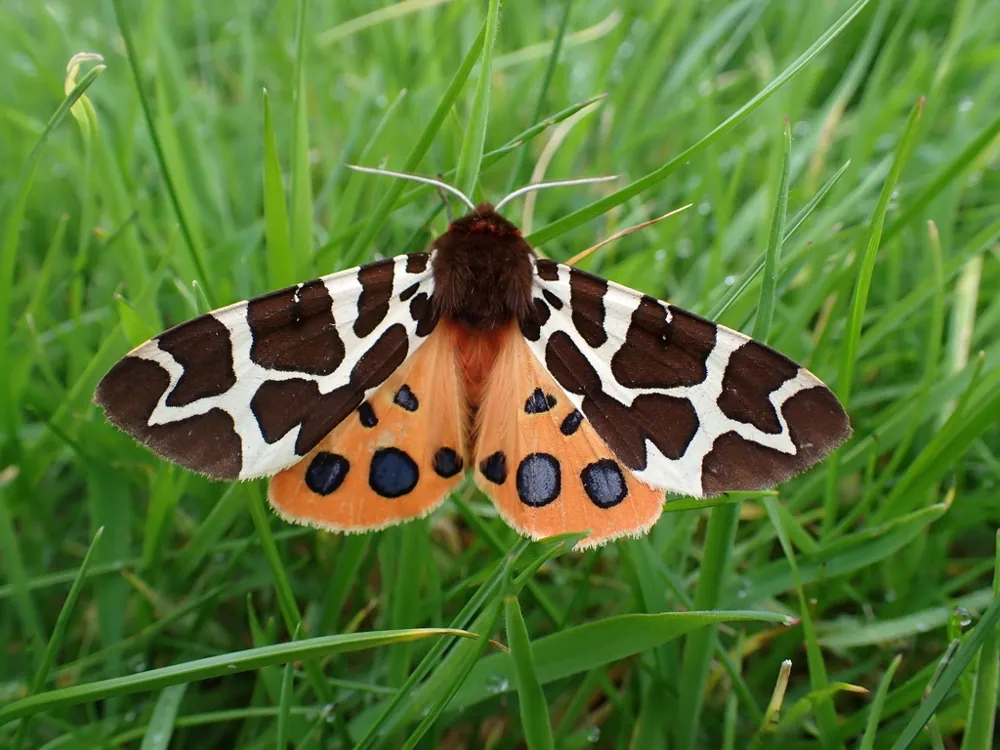
The garden tiger moth is a moth with bold patterned wings that warn predators it is unsafe to eat. It lives in cool, temperate parts of the northern United States, Canada, Europe and Asia. Its caterpillars are known as 'woolly bears' because of their fuzzy look.1

 Comment le reconnaître
- Adults have a wingspan of 4.5 to 6.5 cm.1
- The front wings are brown with a white pattern, which is sometimes missing.1
- The back wings are orange with dark blue dots that have black outlines.1
- The moth often hides its orange hindwings under its brown forewings when resting.1
- Caterpillars are fuzzy and can grow up to 6 cm long.1
Puissance du venin
De minuscules poils se cassent dans la peau et piquent.
Que fait son venin ?
This moth does not inject venom. Its body fluids are poisonous and contain neurotoxic choline esters, which are nerve-affecting chemicals that interfere with the acetylcholine receptor. The full effects of these toxins are not yet known. Caterpillars have hollow hairs that often contain irritating compounds.1
À quel point est-il dangereux pour l'homme ?
Danger pour l'homme: LégerComme une piqûre d'abeille ou moins. Pratiquement inoffensif pour l'homme.Que fait-il quand il a peur ?
When threatened, adults can spray an irritating compound from glands that are exposed at that moment, and their bright wing patterns warn predators.1
 Si tu touches ses poils
- Pour les poils urticants de chenille : enlève-les avec du ruban adhésif, puis lave la peau. Ne frotte pas.
- Pour les morsures : lave et refroidis. Va voir un médecin si la personne se sent mal ou saigne facilement.
Appelle toujours d'abord ton numéro d'urgence (112, 000, 911). Ce sont des conseils généraux de premiers secours, pas un avis médical. Les bases des premiers secours
 Reste en sécurité
- Ne touche, n'attrape et n'embête jamais un animal sauvage, même petit, et même s'il a l'air endormi ou mort.
- Laisse-lui de la place. Si tu en croises un, reste calme, recule doucement et laisse-le passer son chemin.
- Si tu touches ses poils : reste calme, ne bouge pas, appelle ton numéro d'urgence (112, 000, 911) ou va vite à l'hôpital. Souviens-toi de quoi il avait l'air, une photo aide.
Il ne t'en veut pas. Il utilise son venin pour attraper sa nourriture ou se protéger, et il préfère de loin se cacher. Plus d'infos pour rester en sécurité
Où dans le monde ?
Quelle taille fait-il ?
Quelle longueur fait-il ?
 aussi long que 2 briques de construction en ligne
 plus lent qu'un escargot de jardin
Quelle taille fait Garden tiger moth comparé à TOI ?
Juste des calculs dans ton navigateur. Rien n'est enregistré ni envoyé nulle part.
À quelle vitesse va-t-il ?

Faits
Adults can make rasping sounds with their wings and high-pitched squeaks that people can hear, and bats tend to avoid them.1
Caterpillars can break down the toxins in their host plants and reuse them in altered form for their own protection.1
The French entomologist Oberthür described about 500 different wing pattern and colour variants.1
Adults are mostly active at night, from June to September.1
Pour les experts en venin
- Nom scientifique
- Arctia caja
- Groupe
- Chenilles et insectes
- Famille
- Erebidae2
- Ordre
- Lepidoptera
- Continents
- Europe, Asie, Amérique du Nord
- Petits
- Eggs are laid on the surfaces of leaves, and the caterpillars hatch and begin feeding soon after.1
- Comment il se porte dans la nature
- Protected in the UK under the Biodiversity Action Plan, after its UK numbers fell by 89% over 30 years1
- Danger pour l'homme
- 1 / 5: Léger3
D'où viennent les faits
- Garden tiger moth (Wikipedia (CC BY-SA 4.0))
- Arctia caja (iNaturalist): noms et classification.
- Venom Wiki: le niveau de danger, la taille typique et la vitesse estimée sont les nôtres. Regarde comment on les calcule : Comment on évalue le danger.
Chaque fait sur cette page a un numéro qui renvoie à sa source. Si on s'est trompés, désolés, on est des fans d'animaux, pas une revue scientifique. Dis-le-nous à [email protected] et on corrigera.
 Le scorpion a faim ! Venom Wiki est le projet d'une seule personne : gratuit, sans pub et sans traceurs. Un petit pourboire aide à le garder en ligne.Nourris le scorpion
Plus du même groupe: Chenilles et insectes
 Giant water bugChenilles et insectesFait juste mal
 Oak processionaryChenilles et insectesFait juste malNe pas toucher
 Pine processionaryChenilles et insectesFait juste malNe pas toucher
 Puss caterpillarChenilles et insectesFait juste malNe pas toucher
 Saddleback caterpillarChenilles et insectesFait juste malNe pas toucher
 Wheel bugChenilles et insectesFait juste mal
Vit aussi en: Europe
 Common European adderVipèresNécessite un médecin
 Spanish flyAutres animaux vénéneuxNécessite un médecinNe pas toucher
 Common waspAbeilles, guêpes et frelonsFait juste mal
 European hornetAbeilles, guêpes et frelonsFait juste mal
 Fire salamanderGrenouilles toxiques, crapauds et tritonsFait juste malNe pas toucher
 Western honey beeAbeilles, guêpes et frelonsFait juste mal