
 Afrique
 Asie
Asie Europe
 Amérique du Sud
 Australie et Océanie
 Antarctique
 Océan Pacifique
 Océan Atlantique
 Océan Indien
 Océan Arctique
 Mer Méditerranée
 Mer Rouge
 Mer des Caraïbes
 Mer de Corail
 Mer de Chine méridionale
 Mer des Philippines
 Mer d'Andaman
 Mer du Nord
 Mer de Timor et d'Arafura
 Golfe du Bengale
 Golfe de Californie
Mangrove box jellyfish
 Tentacules urticants
The mangrove box jellyfish is a small, boxy jellyfish about 1 cm across. It lives in sunlit water among mangrove roots in the Caribbean Sea, the Central Indo-Pacific and off the north coast of South America. Its bell is see-through, so it can be hard to spot.1


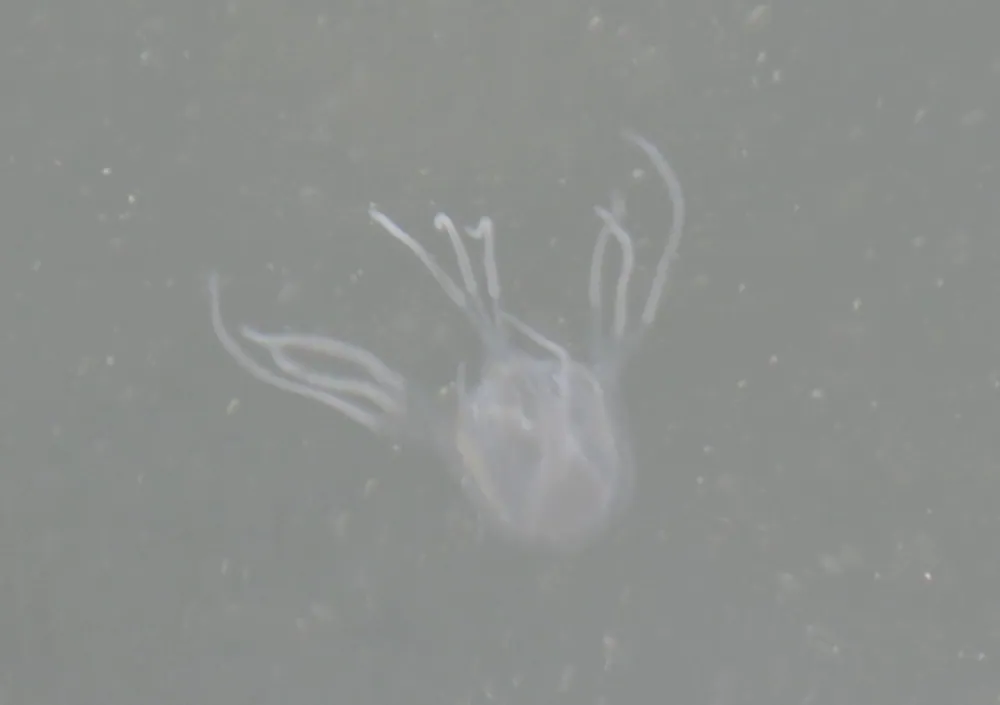
 Comment le reconnaître
Puissance du venin
Des milliers de minuscules cellules urticantes se déclenchent quand quelque chose les touche.
À quel point est-il dangereux pour l'homme ?
Danger pour l'homme: LégerComme une piqûre d'abeille ou moins. Pratiquement inoffensif pour l'homme. S'il pique
- Sors de l'eau et enlève les tentacules restés collés (avec des gants ou un tissu).
- Pour les cuboméduses tropicales : verse du vinaigre sur les piqûres pendant au moins 30 secondes, appelle les secours et sois prêt à faire un massage cardiaque. Pour les physalies et la plupart des autres : rince à l'eau de mer, puis à l'eau chaude contre la douleur.
Appelle toujours d'abord ton numéro d'urgence (112, 000, 911). Ce sont des conseils généraux de premiers secours, pas un avis médical. Les bases des premiers secours
 Reste en sécurité
- Ne touche, n'attrape et n'embête jamais un animal sauvage, même petit, et même s'il a l'air endormi ou mort.
- Laisse-lui de la place. Si tu en croises un, reste calme, recule doucement et laisse-le passer son chemin.
- S'il te pique : reste calme, ne bouge pas, appelle ton numéro d'urgence (112, 000, 911) ou va vite à l'hôpital. Souviens-toi de quoi il avait l'air, une photo aide.
Il ne t'en veut pas. Il utilise son venin pour attraper sa nourriture ou se protéger, et il préfère de loin se cacher. Plus d'infos pour rester en sécurité
Où dans le monde ?
Quelle taille fait-il ?
Quelle longueur fait-il ?
 assez petit pour tenir sur ton ongle
 pourrait nager la longueur d'une grande piscine (50 m) en 36 secondes
Quelle taille fait Mangrove box jellyfish comparé à TOI ?
Juste des calculs dans ton navigateur. Rien n'est enregistré ni envoyé nulle part.
À quelle vitesse va-t-il ?
Faits
It has six eyes in each of its four rhopalia, which are structures on the bell that contain light-sensitive cells.1
It can spot a cylindrical object such as a mangrove root when it gets close and swerve sharply to avoid it.1
It stays in shafts of sunlight where its copepod prey gathers, which helps it catch more food.1
Its life cycle includes a small polyp stage that attaches to the seabed before young jellyfish form.1
Pour les experts en venin
- Nom scientifique
- Tripedalia cystophora
- Groupe
- Méduses et piqueurs marins
- Famille
- Tripedaliidae2
- Ordre
- Carybdeida
- Continents
- Océan Atlantique, Mer des Caraïbes, Océan Pacifique, Les océans
- Petits
- After fertilisation, the female broods the planula larva inside her bell until it is expelled. The larva settles on the bottom and becomes a small polyp, which can bud new polyps and eventually produce young jellyfish.1
- Danger pour l'homme
- 1 / 5: Léger3
D'où viennent les faits
- Tripedalia cystophora (Wikipedia (CC BY-SA 4.0))
- Tripedalia cystophora (iNaturalist): noms et classification.
- Venom Wiki: le niveau de danger, la taille typique et la vitesse estimée sont les nôtres. Regarde comment on les calcule : Comment on évalue le danger.
Chaque fait sur cette page a un numéro qui renvoie à sa source. Si on s'est trompés, désolés, on est des fans d'animaux, pas une revue scientifique. Dis-le-nous à [email protected] et on corrigera.
 Le scorpion a faim ! Venom Wiki est le projet d'une seule personne : gratuit, sans pub et sans traceurs. Un petit pourboire aide à le garder en ligne.Nourris le scorpion
Plus du même groupe: Méduses et piqueurs marins
 Guêpe de merMéduses et piqueurs marinsMortelNe pas toucher
 Irukandji jellyfishMéduses et piqueurs marinsPeut tuerNe pas toucher
 Portuguese man o' warMéduses et piqueurs marinsNécessite un médecinNe pas toucher
 Lion's mane jellyfishMéduses et piqueurs marinsFait juste malNe pas toucher
 Moon jellyfishMéduses et piqueurs marinsInoffensif
 Common kingslayerMéduses et piqueurs marinsPeut tuerNe pas toucher
Vit aussi en: Océan Atlantique
 Hawksbill sea turtleAutres animaux vénéneuxPeut tuer
 Blue sea dragonCônes et pieuvresFait juste mal
 Greenland sharkAutres animaux vénéneuxFait juste mal
 Common octopusCônes et pieuvresInoffensif
 Common stingrayPoissons venimeuxNécessite un médecin
 Greater weeverPoissons venimeuxNécessite un médecinNe pas toucher