
 Afrique
 Asie
Asie Europe
 Amérique du Sud
 Australie et Océanie
 Antarctique
 Océan Pacifique
 Océan Atlantique
 Océan Indien
 Océan Arctique
 Mer Méditerranée
 Mer Rouge
 Mer des Caraïbes
 Mer de Corail
 Mer de Chine méridionale
 Mer des Philippines
 Mer d'Andaman
 Mer du Nord
 Mer de Timor et d'Arafura
 Golfe du Bengale
 Golfe de Californie
Mottled cup moth
 Poils urticants
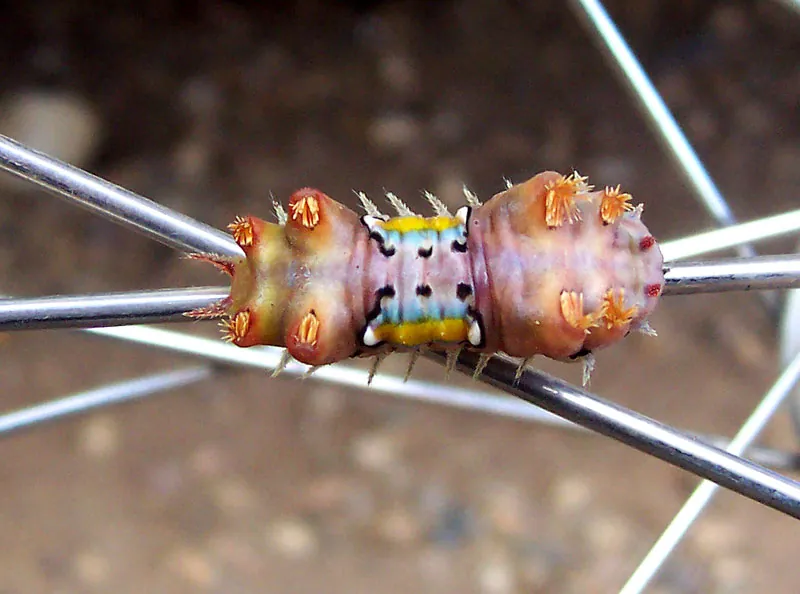
The mottled cup moth is a small Australian moth. Its caterpillar is the part to know about, because it has yellow stinging spines that release painful toxins when touched. The caterpillar's bright bands warn that it is dangerous.1

 Comment le reconnaître
- The adult moth has a rust-coloured body and a white area around its antennae.1
- Its two pairs of legs have white bands on the front pair.1
- The forewings are shiny rust-coloured with silvery edges, and the hindwings are dull white.1
- The caterpillar is only about 2 cm long, grey with many dark spots and streaks.1
- Each side of the caterpillar has a clear yellow band lined with green, and it has spiny projections at both ends.1
Puissance du venin
De minuscules poils se cassent dans la peau et piquent.
Que fait son venin ?
The caterpillar's yellow needle-like spines contain a mixture of at least 151 toxins, which are proteins or protein-like substances. The spines cause pain and can induce severely inflamed swellings. The toxins are released when the spine tips break on contact.1
À quel point est-il dangereux pour l'homme ?
Danger pour l'homme: DouloureuxÇa peut faire très mal, mais ce n'est presque jamais grave.Contact with the spines causes painful, severely inflamed swellings.1
Que fait-il quand il a peur ?
The caterpillar raises up to eight projections, each with about a hundred stinging spines, but only when it is disturbed or agitated. Its banded colours warn predators that it is dangerous.1
 Si tu touches ses poils
- Pour les poils urticants de chenille : enlève-les avec du ruban adhésif, puis lave la peau. Ne frotte pas.
- Pour les morsures : lave et refroidis. Va voir un médecin si la personne se sent mal ou saigne facilement.
Appelle toujours d'abord ton numéro d'urgence (112, 000, 911). Ce sont des conseils généraux de premiers secours, pas un avis médical. Les bases des premiers secours
 Reste en sécurité
- Ne touche, n'attrape et n'embête jamais un animal sauvage, même petit, et même s'il a l'air endormi ou mort.
- Laisse-lui de la place. Si tu en croises un, reste calme, recule doucement et laisse-le passer son chemin.
- Si tu touches ses poils : reste calme, ne bouge pas, appelle ton numéro d'urgence (112, 000, 911) ou va vite à l'hôpital. Souviens-toi de quoi il avait l'air, une photo aide.
Il ne t'en veut pas. Il utilise son venin pour attraper sa nourriture ou se protéger, et il préfère de loin se cacher. Plus d'infos pour rester en sécurité
Où dans le monde ?
Quelle taille fait-il ?
Quelle longueur fait-il ?
 plus court que ton petit doigt
 plus lent qu'un escargot de jardin
Quelle taille fait Mottled cup moth comparé à TOI ?
Juste des calculs dans ton navigateur. Rien n'est enregistré ni envoyé nulle part.
À quelle vitesse va-t-il ?


Faits
Researchers at the University of Queensland reported in 2021 that the caterpillar's venom contains at least 151 different toxins.1
The toxin cecropin causes the pain and also breaks down the cell membranes of bacteria and worms.1
A protein called DV33 can kill Haemonchus contortus, a roundworm that affects sheep.1
Some of the toxins have medicinal properties, such as the ability to kill harmful bacteria and parasitic worms.1
Some of the nervous-system proteins in the venom may have beneficial effects, such as in epilepsy.1
D'où viennent les faits
- Doratifera vulnerans (Wikipedia (CC BY-SA 4.0))
- Doratifera vulnerans (iNaturalist): noms et classification.
- Venom Wiki: le niveau de danger, la taille typique et la vitesse estimée sont les nôtres. Regarde comment on les calcule : Comment on évalue le danger.
Chaque fait sur cette page a un numéro qui renvoie à sa source. Si on s'est trompés, désolés, on est des fans d'animaux, pas une revue scientifique. Dis-le-nous à [email protected] et on corrigera.
 Le scorpion a faim ! Venom Wiki est le projet d'une seule personne : gratuit, sans pub et sans traceurs. Un petit pourboire aide à le garder en ligne.Nourris le scorpion
Plus du même groupe: Chenilles et insectes
 Bag-shelter mothChenilles et insectesFait juste malNe pas toucher
 Common Australian assassin bugChenilles et insectesInoffensif
 Giant silkworm moth caterpillarChenilles et insectesPeut tuerNe pas toucher
 Vinchuca kissing bugChenilles et insectesNécessite un médecin
 Giant water bugChenilles et insectesFait juste mal
 Oak processionaryChenilles et insectesFait juste malNe pas toucher
Vit aussi en: Australie et Océanie
 Taïpan du littoralSerpents australiensMortel
 Vipère de la mort communeSerpents australiensMortel
 Serpent brun de l'EstSerpents australiensMortel
 Taïpan du désertSerpents australiensMortel
 Araignée à toile en entonnoir de SydneyMygales et araignées à toile en entonnoirMortel
 Serpent-tigreSerpents australiensMortel