
 Afrique
 Asie
Asie Europe
 Amérique du Sud
 Australie et Océanie
 Antarctique
 Océan Pacifique
 Océan Atlantique
 Océan Indien
 Océan Arctique
 Mer Méditerranée
 Mer Rouge
 Mer des Caraïbes
 Mer de Corail
 Mer de Chine méridionale
 Mer des Philippines
 Mer d'Andaman
 Mer du Nord
 Mer de Timor et d'Arafura
 Golfe du Bengale
 Golfe de Californie
Yellow-bellied toad
 Poison dans la peau
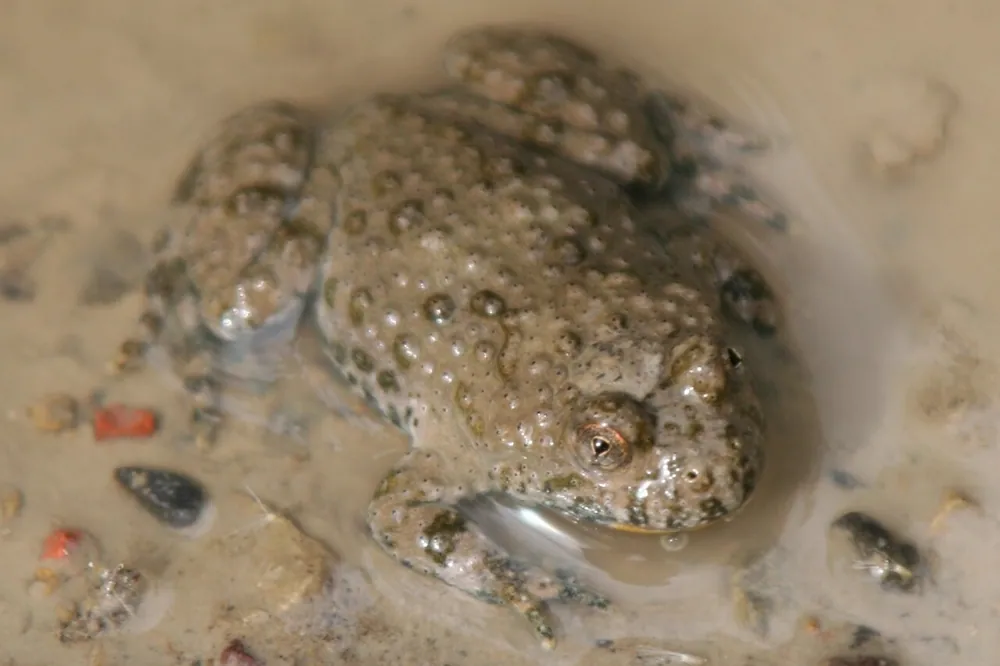
The yellow-bellied toad is a small toad with a bright yellow and black belly that it shows only when it feels threatened. It lives mainly in mountain areas of western Europe. Its skin toxins are not fatal to people, but they can harm smaller animals.1
 Comment le reconnaître
- Grey-brown or dark brown and green upper body, often with faded, bright spots1
- Bright yellow to orange patches on the underside, usually covering more than half of the belly1
- Underside is grey-blue to black-blue between the yellow patches1
- Compact body and a rounded snout1
- Heart-shaped pupils, with the eardrums not visible1
- Warty skin with raised swirls on the back1
Souvent confondu avec : The European fire-bellied toad (Bombina bombina) is a close relative and lives in the same region. The yellow-bellied toad has a more compact body that is not as flat.1
Puissance du poison
Sa peau est toxique. Il est dangereux de le toucher, de le lécher ou de le manger.
Que fait son poison ?
The toad has toxins in its skin, released through the warts on its back when it is threatened. The toxin is not fatal to humans, but it can cause significant discomfort to most animals and is fatal to smaller ones.1
À quel point est-il dangereux pour l'homme ?
Danger pour l'homme: LégerComme une piqûre d'abeille ou moins. Pratiquement inoffensif pour l'homme.The toxin is not fatal to humans, although it can still cause discomfort to most animals.1
Que fait-il quand il a peur ?
It stays still and camouflaged most of the time, and when threatened it shows its yellow belly, puffs up its chest and releases toxins from its warts.1
 Si quelqu'un l'a touché ou mangé
- Si quelqu'un en a touché un : lave-toi bien les mains et ne touche pas tes yeux ni ta bouche. Si un enfant ou un animal en a léché ou mangé un : appelle le centre antipoison ou ton numéro d'urgence.
Appelle toujours d'abord ton numéro d'urgence (112, 000, 911). Ce sont des conseils généraux de premiers secours, pas un avis médical. Les bases des premiers secours
 Reste en sécurité
- Ne touche, n'attrape et n'embête jamais un animal sauvage, même petit, et même s'il a l'air endormi ou mort.
- Laisse-lui de la place. Si tu en croises un, reste calme, recule doucement et laisse-le passer son chemin.
- Si tu l'as touché ou mangé : ne frotte pas tes yeux ni ta bouche, lave-toi les mains et va voir un médecin.
Il ne t'en veut pas. Son poison ne sert qu'à ce que personne ne le mange. Plus d'infos pour rester en sécurité
Où dans le monde ?
Quelle taille fait-il ?
Quelle longueur fait-il ?
Combien pèse-t-il ?
 plus court que ton petit doigt
 si léger que tu ne le sentirais pas sur ta main
 pourrait parcourir 100 mètres en 180 secondes (l'humain le plus rapide met 9,6)
Quelle taille fait Yellow-bellied toad comparé à TOI ?
Juste des calculs dans ton navigateur. Rien n'est enregistré ni envoyé nulle part.
À quelle vitesse va-t-il ?


Faits
When a male is threatened or wants to attract a female, he kicks his hind legs into a small pond to make a wave-like pattern. This marks his territory and only works in ponds of a certain depth.1
They can change the shade of their colour to suit lighter or darker surroundings by moving pigment within their cells.1
Yellow-bellied toads breed in unpredictable places, such as shallow pools that can disappear overnight. Within their family, they are the only species that chooses such sites.1
Their life span ranges from 5 to 23 years, and climate plays a large role in how long an individual lives.1
Males have longer forelimbs than females, which is thought to help them during mating and fights with other males.1
Pour les experts en venin
- Nom scientifique
- Bombina variegata
- Groupe
- Grenouilles toxiques, crapauds et tritons
- Famille
- Bombinatoridae2
- Ordre
- Anura
- Continents
- Europe
- Petits
- Females can lay over 200 eggs at one time, but typically lay about 40. Eggs are laid in ponds, and tadpoles develop rapidly.1
- Comment il se porte dans la nature
- Endangered in Germany1
- Danger pour l'homme
- 1 / 5: Léger3
D'où viennent les faits
- Yellow-bellied toad (Wikipedia (CC BY-SA 4.0))
- Bombina variegata (iNaturalist): noms et classification.
- Venom Wiki: le niveau de danger, la taille typique et la vitesse estimée sont les nôtres. Regarde comment on les calcule : Comment on évalue le danger.
Chaque fait sur cette page a un numéro qui renvoie à sa source. Si on s'est trompés, désolés, on est des fans d'animaux, pas une revue scientifique. Dis-le-nous à [email protected] et on corrigera.
 Le scorpion a faim ! Venom Wiki est le projet d'une seule personne : gratuit, sans pub et sans traceurs. Un petit pourboire aide à le garder en ligne.Nourris le scorpion
Plus du même groupe: Grenouilles toxiques, crapauds et tritons
 Fire salamanderGrenouilles toxiques, crapauds et tritonsFait juste malNe pas toucher
 Common toadGrenouilles toxiques, crapauds et tritonsFait juste malNe pas toucher
 European fire-bellied toadGrenouilles toxiques, crapauds et tritonsInoffensif
 Iberian ribbed newtGrenouilles toxiques, crapauds et tritonsInoffensif
 Natterjack toadGrenouilles toxiques, crapauds et tritonsInoffensif
 Alpine salamanderGrenouilles toxiques, crapauds et tritonsInoffensif
Vit aussi en: Europe
 Common European adderVipèresNécessite un médecin
 Spanish flyAutres animaux vénéneuxNécessite un médecinNe pas toucher
 Common waspAbeilles, guêpes et frelonsFait juste mal
 European hornetAbeilles, guêpes et frelonsFait juste mal
 Western honey beeAbeilles, guêpes et frelonsFait juste mal
 Blunt-nosed viperVipèresPeut tuer