
 Afrique
 Asie
Asie Europe
 Amérique du Sud
 Australie et Océanie
 Antarctique
 Océan Pacifique
 Océan Atlantique
 Océan Indien
 Océan Arctique
 Mer Méditerranée
 Mer Rouge
 Mer des Caraïbes
 Mer de Corail
 Mer de Chine méridionale
 Mer des Philippines
 Mer d'Andaman
 Mer du Nord
 Mer de Timor et d'Arafura
 Golfe du Bengale
 Golfe de Californie
Yellow stingray
 Piqûres
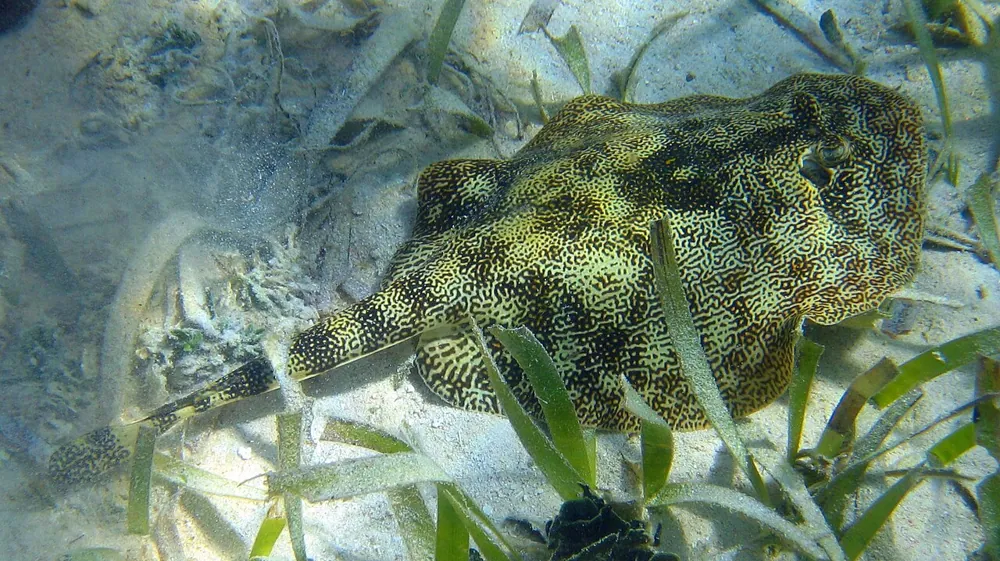
The yellow stingray is a small ray that lives on the sandy, muddy or seagrass bottoms of shallow coastal waters in the western Atlantic, the Gulf of Mexico and the Caribbean. It spends much of the day buried under sand or lying still. It can sting with a venomous spine on its tail, but it usually ignores divers unless it is stepped on or provoked.1



 Comment le reconnaître
- Nearly round pectoral fin disc with a short tail and a small, leaf-shaped tail fin.1
- Pattern of spots and blotches, either light on dark or dark on light, which varies a lot between individuals.1
- Can quickly change the tone and contrast of its colour to match its surroundings.1
- Underside is yellowish, greenish or brownish white, with small darker spots near the edge of the disc and the tail.1
- A serrated spine sits about halfway along the tail.1
Puissance du venin
Le venin sort par un dard.
Que fait son venin ?
The tail spine is coated in potent venom. The wound it causes is extremely painful, but it is seldom life-threatening.1
À quel point est-il dangereux pour l'homme ?
Danger pour l'homme: DouloureuxÇa peut faire très mal, mais ce n'est presque jamais grave.It is not aggressive towards people. It injures people only when it is stepped on or otherwise provoked, and the resulting wound is very painful but seldom life-threatening.1
Que fait-il quand il a peur ?
When threatened it mostly stays still, buried under sediment or lying in vegetation, and if stepped on or provoked it defends itself with its tail spine.1
 S'il pique
- Plonge la plaie dans de l'eau chaude, aussi chaude que la personne peut supporter sans se brûler (teste avec ta propre main), pendant 30 à 90 minutes. Va voir un médecin, surtout pour les poissons-pierres et les raies.
Appelle toujours d'abord ton numéro d'urgence (112, 000, 911). Ce sont des conseils généraux de premiers secours, pas un avis médical. Les bases des premiers secours
 Reste en sécurité
- Ne touche, n'attrape et n'embête jamais un animal sauvage, même petit, et même s'il a l'air endormi ou mort.
- Laisse-lui de la place. Si tu en croises un, reste calme, recule doucement et laisse-le passer son chemin.
- S'il te pique : reste calme, ne bouge pas, appelle ton numéro d'urgence (112, 000, 911) ou va vite à l'hôpital. Souviens-toi de quoi il avait l'air, une photo aide.
Il ne t'en veut pas. Il utilise son venin pour attraper sa nourriture ou se protéger, et il préfère de loin se cacher. Plus d'infos pour rester en sécurité
Où dans le monde ?
Quelle taille fait-il ?
Quelle longueur fait-il ?
 aussi long que 4 bananes mises bout à bout
 pourrait nager la longueur d'une grande piscine (50 m) en 13 secondes
Quelle taille fait Yellow stingray comparé à TOI ?
Juste des calculs dans ton navigateur. Rien n'est enregistré ni envoyé nulle part.
À quelle vitesse va-t-il ?


Faits
It glows green when lit by blue or ultraviolet light, a effect called biofluorescence that may help it communicate and camouflage itself.1
It can raise the front of its disc to form a shaded 'cave' that draws in small creatures looking for shelter.1
Off Jamaica, up to one yellow stingray per square metre gathers under mangrove roosts used by cattle egrets, possibly because bird droppings feed the small animals that attract the rays.1
Its eyes give it a 360° view of its surroundings, and each eye has a covering that controls how much light enters.1
It can live for 15 to 25 years.1
Démêle le vrai du faux
Idée reçue : Stingrays attack people in the water.
Vérité : Yellow stingrays generally pay little attention to divers and can be approached closely. They only sting when they are stepped on or otherwise provoked.1
Pour les experts en venin
- Nom scientifique
- Urobatis jamaicensis
- Groupe
- Poissons venimeux
- Famille
- Urotrygonidae2
- Ordre
- Myliobatiformes
- Continents
- Océan Atlantique, Mer des Caraïbes, Golfe du Mexique, Les océans
- Petits
- It gives birth to live young, with litters of up to seven. Females have two litters a year in seagrass beds after a gestation period of 5–6 months.1
- Durée de vie
- environ 25 ans1
- Comment il se porte dans la nature
- Least Concern1
- Danger pour l'homme
- 2 / 5: Douloureux3
D'où viennent les faits
- Yellow stingray (Wikipedia (CC BY-SA 4.0))
- Urobatis jamaicensis (iNaturalist): noms et classification.
- Venom Wiki: le niveau de danger, la taille typique et la vitesse estimée sont les nôtres. Regarde comment on les calcule : Comment on évalue le danger.
Chaque fait sur cette page a un numéro qui renvoie à sa source. Si on s'est trompés, désolés, on est des fans d'animaux, pas une revue scientifique. Dis-le-nous à [email protected] et on corrigera.
 Le scorpion a faim ! Venom Wiki est le projet d'une seule personne : gratuit, sans pub et sans traceurs. Un petit pourboire aide à le garder en ligne.Nourris le scorpion
Plus du même groupe: Poissons venimeux
 Reef stonefishPoissons venimeuxPeut tuerNe pas toucher
 Red lionfishPoissons venimeuxNécessite un médecinNe pas toucher
 Estuarine stonefishPoissons venimeuxPeut tuerNe pas toucher
 Short-tail stingrayPoissons venimeuxPeut tuer
 Striped eel catfishPoissons venimeuxPeut tuerNe pas toucher
 Bluespotted ribbontail rayPoissons venimeuxNécessite un médecin
Vit aussi en: Océan Atlantique
 Hawksbill sea turtleAutres animaux vénéneuxPeut tuer
 Portuguese man o' warMéduses et piqueurs marinsNécessite un médecinNe pas toucher
 Blue sea dragonCônes et pieuvresFait juste mal
 Greenland sharkAutres animaux vénéneuxFait juste mal
 Lion's mane jellyfishMéduses et piqueurs marinsFait juste malNe pas toucher
 Common octopusCônes et pieuvresInoffensif