
 África
 Asia
Asia Europa
 América do Sur
 Australia e Oceanía
 Antártida
 Océano Pacífico
 Océano Atlántico
 Océano Índico
 Océano Glacial Ártico
 Mar Mediterráneo
 Mar Vermello
 Mar Caribe
 Mar do Coral
 Mar da China Meridional
 Mar de Filipinas
 Mar de Andamán
 Mar do Norte
 Mar de Timor e de Arafura
 Golfo de Bengala
 Golfo de California
Northern tree-dwelling funnel-web spider
 Morde
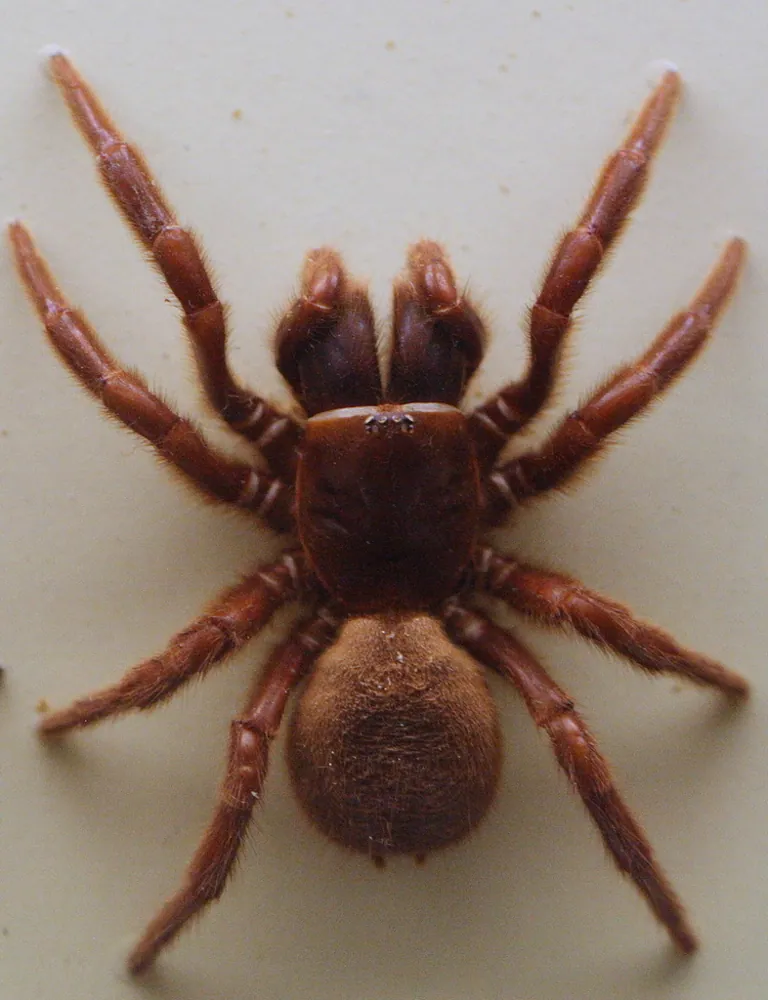
MordeThe northern tree-dwelling funnel-web spider is a large spider from eastern Australia. It lives mostly in trees, from South East Queensland to the Hunter River in New South Wales. Its venom can be deadly to people, so it is important to know what it looks like.1

 Como recoñecelo
- Has a glossy black carapace (the hard upper shell of the body).1
- Chelicerae (fang-bearing parts), legs and abdomen are matte black or dark brown.1
- The top of the abdomen may have a plum or purplish tinge.1
- Body length is 40-50 mm, the largest of the funnel-web subfamily Atracinae.1
- Cannot jump.1
Adoita confundirse con: The ground-dwelling Darling Downs funnel-web spider (Hadronyche infensa) is very similar. Male northern tree-dwelling funnel-web spiders have a knobby spur on the tibia (a leg segment) of the second pair of legs, which male Darling Downs funnel-web spiders lack. Trapdoor spiders are browner overall.1
Poder da pezoña
A pezoña sae polos seus cairos ou dentes cando morde.
Que fai a súa pezoña?
The venom is potentially deadly to humans and is regarded as the most toxic of the venoms in the family Atracidae. Symptoms can start within 15 to 20 minutes. Common symptoms include sweating, high blood pressure, a fast heart rate, muscle spasms, nausea, vomiting, changes in consciousness and pain at the bite site. Fluid in the lungs (pulmonary oedema) is frequent and comes on early.1
Que perigoso é para as persoas?
Perigo para as persoas: MortalUn dos animais máis perigosos do mundo.The venom is potentially deadly. Of eight recorded bites, five caused severe symptoms of envenomation. Because the spider is larger than the Sydney funnel-web, it may inject more venom, which could make it possibly the deadliest venomous spider in the world per volume of venom.1
 Boas novas: os médicos teñen un medicamento (antiveleno) ou un tratamento para isto.1
Que fai cando ten medo?
When threatened, it rears up, displays its fangs, and drops of venom appear on the fang tips.1
 Se morde
- Pressure bandages and immobilising the patient can significantly delay the onset of symptoms. This remains a critical part of managing a bite from an Australian funnel-web spider.1
- Lava a mordedura e arrefríaa. Busca axuda médica se a dor é forte ou a persoa se sente mal.
- En Australia, trata calquera mordedura dunha araña negra grande como unha mordedura de araña de tea en funil: Inmobilización con presión: envolve cunha venda elástica firme a mordedura e despois todo o membro cara arriba, ponlle unha férula e mantén a persoa completamente quieta ata que chegue a axuda.
Chama sempre primeiro ao teu número de emerxencias (112, 000, 911). Isto son consellos xerais de primeiros auxilios, non consello médico. Primeiros auxilios básicos
 Mantente a salvo
- Nunca toques, collas nin molestes un animal salvaxe, aínda que sexa pequeno e aínda que pareza durmido ou morto.
- Déixalle espazo. Se atopas un, mantén a calma, recúa amodo e déixao ir polo seu camiño.
- Se un te morde: mantén a calma, non te movas, chama ao teu número de emerxencias (112, 000, 911) ou vai rápido a un hospital. Lembra como era, unha foto axuda.
Non vai a por ti. Usa a súa pezoña para cazar comida ou para defenderse, e prefire con moito agocharse. Máis sobre como estar a salvo
En que lugar do mundo?
Que tamaño ten?
Canto mide?
 máis curto ca o teu dedo meniño
 podería percorrer 100 metros en 260 segundos (o humano máis rápido precisa 9,6)
Que tamaño ten Northern tree-dwelling funnel-web spider comparado CONTIGO?
Só son contas no teu navegador. Non se garda nin se envía nada a ningures.
Que rápido é?


Datos
It may be possibly the deadliest venomous spider in the world per volume of venom, because it is larger than the Sydney funnel-web and may inject more venom.1
It is the largest member of the funnel-web subfamily Atracinae, with a body length of 40-50 mm.1
It has been recorded living in trees 30 m above the ground.1
It is one of only two Australian funnel-web species that live mostly in trees. The other is the southern tree-dwelling funnel-web.1
It cannot jump.1
De onde veñen os datos
- Hadronyche formidabilis (Wikipedia (CC BY-SA 4.0))
- Hadronyche formidabilis (iNaturalist): nomes e clasificación.
- Venom Wiki: o nivel de perigo, o tamaño típico e a velocidade estimada son nosos. Mira como os calculamos: Como valoramos o perigo.
Cada dato desta páxina ten un número que leva á súa fonte. Se nos equivocamos nalgo, sentímolo, somos fans dos animais, non unha revista científica. Dínolo en [email protected] e arranxarémolo.
 O escorpión ten fame! Venom Wiki é un proxecto dunha soa persoa: gratis, sen anuncios e sen rastrexadores. Unha pequena propina axuda a mantelo en liña.Dálle de comer ao escorpión
Máis do mesmo grupo: Tarántulas e arañas de tea en funil
 Sydney funnel-web spiderTarántulas e arañas de tea en funilMortal
 Red-headed mouse spiderTarántulas e arañas de tea en funilPrecisa un médico
 Queensland whistling tarantulaTarántulas e arañas de tea en funilSó doe
 Blue Mountains funnel-web spiderTarántulas e arañas de tea en funilPode matar
 Darling Downs funnel-web spiderTarántulas e arañas de tea en funilPode matar
 Illawarra funnel-web spiderTarántulas e arañas de tea en funilPode matar
 Coastal taipan
 Common death adder
 Eastern brown snake
 Inland taipan
 Tiger snake
 Redback spider