
 África
 Asia
Asia Europa
 América do Sur
 Australia e Oceanía
 Antártida
 Océano Pacífico
 Océano Atlántico
 Océano Índico
 Océano Glacial Ártico
 Mar Mediterráneo
 Mar Vermello
 Mar Caribe
 Mar do Coral
 Mar da China Meridional
 Mar de Filipinas
 Mar de Andamán
 Mar do Norte
 Mar de Timor e de Arafura
 Golfo de Bengala
 Golfo de California
Coastal taipan
 Morde
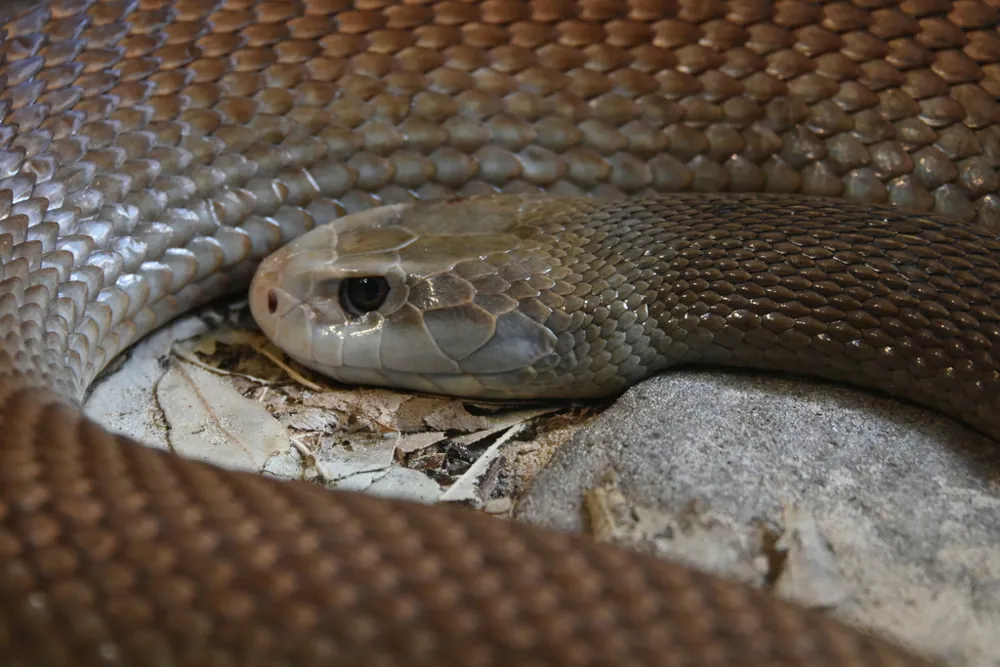
MordeThe coastal taipan is one of the most feared snakes in Australia. It is a large, fast snake with a powerful venom, and it lives along the coasts of northern and eastern Australia and on the island of New Guinea. It is one of the reasons snake bite safety matters so much in these areas.1



 Como recoñecelo
- Light olive or reddish-brown upperparts, sometimes dark grey to black1
- Paler sides and a creamy-white to pale yellow belly, often marked with orange or pink flecks1
- Long, narrow head with an angular brow and a lighter-coloured face1
- Large, round, light brown or hazel eyes with large pupils1
- Typically about 2.0 m long as an adult, with a slender body1
Adoita confundirse con: It is often confused with the eastern brown snake, northern brown snake and king brown snake. The coastal taipan has a larger head and a narrow neck, and a lighter face and snout. In the other species, the head and neck are the same width.1
Poder da pezoña
A pezoña sae polos seus cairos ou dentes cando morde.
Que fai a súa pezoña?
Its venom is mainly neurotoxic, which means it attacks the nerves, and it is also coagulopathic, which means it disturbs blood clotting. In a recorded bite case, the victim became unwell within 15 to 30 minutes, with drooping eyelids, nausea and difficulty breathing. Some victims have also lost their sense of smell for a time.1
Que perigoso é para as persoas?
Perigo para as persoas: MortalUn dos animais máis perigosos do mundo.It is considered one of the most dangerous snakes in the region and is classified by the World Health Organization as a snake of medical importance. Several deaths were recorded from its bites in the 1930s and 1940s, and more were added later as historical cases.1
 Boas novas: os médicos teñen un medicamento (antiveleno) ou un tratamento para isto.1
Que fai cando ten medo?
It tends to avoid confrontation but becomes highly defensive if provoked.1
 Se morde
- Any suspected bite needs urgent medical care. In one recorded case, the bitten man was taken to hospital, where he was given fluids and tiger snake antivenom, and he recovered after 19 days in hospital.1
- Inmobilización con presión: envolve cunha venda elástica firme a mordedura e despois todo o membro cara arriba, ponlle unha férula e mantén a persoa completamente quieta ata que chegue a axuda.
- Non laves a mordedura: no hospital poden analizar a pezoña que queda na pel para escoller o antiveleno axeitado.
Chama sempre primeiro ao teu número de emerxencias (112, 000, 911). Isto son consellos xerais de primeiros auxilios, non consello médico. Primeiros auxilios básicos
 Mantente a salvo
- Nunca toques, collas nin molestes un animal salvaxe, aínda que sexa pequeno e aínda que pareza durmido ou morto.
- Déixalle espazo. Se atopas un, mantén a calma, recúa amodo e déixao ir polo seu camiño.
- Se un te morde: mantén a calma, non te movas, chama ao teu número de emerxencias (112, 000, 911) ou vai rápido a un hospital. Lembra como era, unha foto axuda.
Non vai a por ti. Usa a súa pezoña para cazar comida ou para defenderse, e prefire con moito agocharse. Máis sobre como estar a salvo
En que lugar do mundo?
Que tamaño ten?
Canto mide?
Canto pesa?
 mide coma 3 cans do fociño á cola
 mide coma 16 bananas postas en fila
 pesa máis ou menos coma un gato doméstico
 podería percorrer 100 metros en 41 segundos (o humano máis rápido precisa 9,6)
Que tamaño ten Coastal taipan comparado CONTIGO?
Só son contas no teu navegador. Non se garda nin se envía nada a ningures.
Que rápido é?


Datos
The longest recorded coastal taipan was 2.9 m long and weighed 6.5 kg, and larger specimens of up to 3.3 m are widely believed to exist.1
Its hunting method, freezing, striking and releasing prey, is similar to that of the African black mamba.1
It is the second-longest venomous snake in Australia, after the king brown snake.1
Newly hatched young grow quickly, reaching about 1.0 m in their first year.1
It may have become more common since cane toads were introduced to Australia in 1935.1
Desmontamitos
Mito: The snake hides in trees and drops onto people, and it chases people for hours.
Verdade: Stories of it hiding in trees and dropping on victims were spread in newspapers and books, but snake handlers say it is shy and avoids confrontation. It only becomes highly defensive when provoked.1
Para expertos en pezoñas
- Nome científico
- Oxyuranus scutellatus
- Grupo
- Serpes australianas
- Familia
- Elapidae2
- Orde
- Squamata
- Continentes
- Australia e Oceanía
- Crías
- It lays a clutch of 7 to 20 eggs. The eggs take 60 to 80 days to hatch, and the young are 30 to 34 cm long.1
- Como lle vai na natureza
- Least Concern (IUCN)1
- Perigo para as persoas
- 5 / 5: Mortal3
De onde veñen os datos
- Coastal taipan (Wikipedia (CC BY-SA 4.0))
- Oxyuranus scutellatus (iNaturalist): nomes e clasificación.
- Venom Wiki: o nivel de perigo, o tamaño típico e a velocidade estimada son nosos. Mira como os calculamos: Como valoramos o perigo.
Cada dato desta páxina ten un número que leva á súa fonte. Se nos equivocamos nalgo, sentímolo, somos fans dos animais, non unha revista científica. Dínolo en [email protected] e arranxarémolo.
 O escorpión ten fame! Venom Wiki é un proxecto dunha soa persoa: gratis, sen anuncios e sen rastrexadores. Unha pequena propina axuda a mantelo en liña.Dálle de comer ao escorpión
Máis do mesmo grupo: Serpes australianas
 Common death adder
 Eastern brown snake
 Inland taipan
 Tiger snake
 Collett's snake
 Desert death adder
Tamén vive en: Australia e Oceanía
 Sydney funnel-web spiderTarántulas e arañas de tea en funilMortal
 Redback spiderArañasPrecisa un médico
 Brown tree snakeSerpes con cairos traseirosSó doe
 Hooded pitohuiOutros animais velenososSó doeNon tocar
 PlatypusMamíferos pezoñentosSó doe
 Northern tree-dwelling funnel-web spiderTarántulas e arañas de tea en funilMortal