
 África
 Asia
Asia Europa
 América do Sur
 Australia e Oceanía
 Antártida
 Océano Pacífico
 Océano Atlántico
 Océano Índico
 Océano Glacial Ártico
 Mar Mediterráneo
 Mar Vermello
 Mar Caribe
 Mar do Coral
 Mar da China Meridional
 Mar de Filipinas
 Mar de Andamán
 Mar do Norte
 Mar de Timor e de Arafura
 Golfo de Bengala
 Golfo de California
Inland taipan
 Morde
MordeThe inland taipan is a snake of the dry interior of Australia. Its venom is considered the most toxic of any snake in the world, though the snake is usually shy and rarely meets people. It lives on remote, hot clay plains, which is why bites are very rare.1

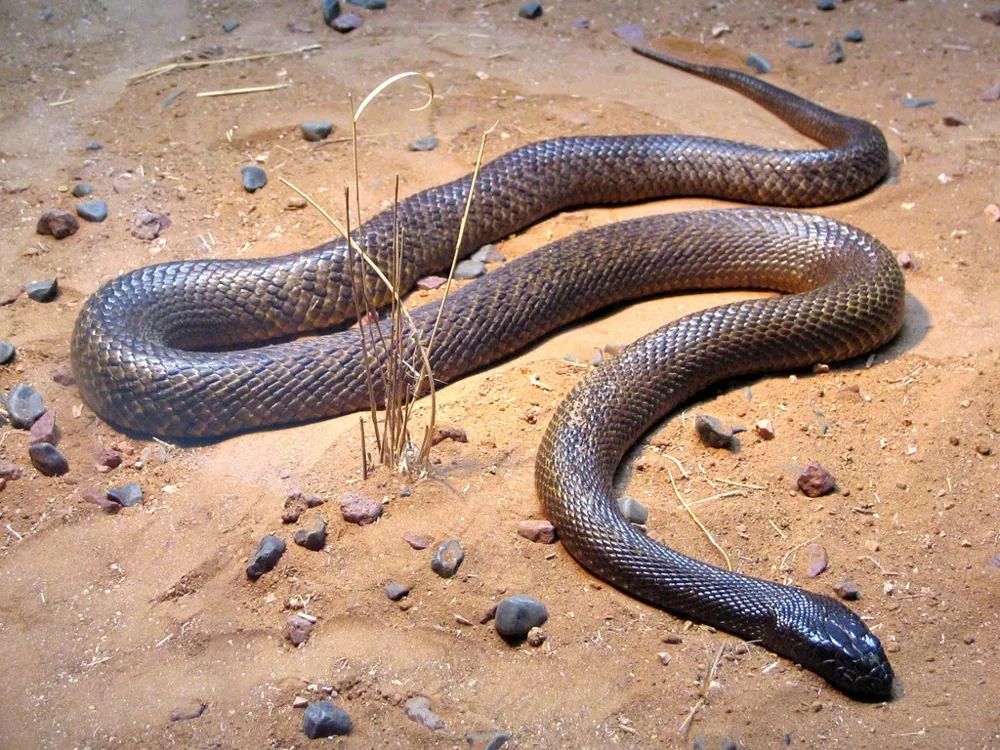
 Como recoñecelo
- Typically dark tan overall, ranging from rich dark brown to brownish light green depending on the season.1
- Many scales have broad blackish edges, forming broken chevron-like markings that slope backwards and downwards on the body.1
- The head, snout and neck are darker than the body: glossy black in winter and dark brown in summer.1
- Scales are smooth, without keels, arranged in 23 rows at midbody.1
- Adults average about 180 cm in total length, and larger individuals can reach 250 cm.1
Adoita confundirse con: The coastal taipan (Oxyuranus scutellatus) is a close relative. The inland taipan's fangs are somewhat shorter, at about 3.5 to 6.2 mm. The coastal taipan lives closer to populated coastal regions and is more often met by people.1
Poder da pezoña
A pezoña sae polos seus cairos ou dentes cando morde.
Que fai a súa pezoña?
The venom is extremely toxic and is particularly adapted to killing warm-blooded animals. Tests in laboratory mice and on human heart cell cultures show it is more toxic than the venom of any tested sea snake. A single bite is estimated to contain enough venom to kill more than 100 adult humans. In prey, the venom causes almost immediate incapacitation.1
Que perigoso é para as persoas?
Perigo para as persoas: MortalUn dos animais máis perigosos do mundo.Its venom is among the most potent of any snake, but it is usually shy, reclusive and placid, and it rarely comes into contact with people because it lives in remote areas. The coastal taipan is considered the more dangerous species in practice because of its behaviour around people and its closer proximity to populated coastal regions.1
Que fai cando ten medo?
It is usually shy and reclusive, with a generally placid disposition.1
 Se morde
- Inmobilización con presión: envolve cunha venda elástica firme a mordedura e despois todo o membro cara arriba, ponlle unha férula e mantén a persoa completamente quieta ata que chegue a axuda.
- Non laves a mordedura: no hospital poden analizar a pezoña que queda na pel para escoller o antiveleno axeitado.
Chama sempre primeiro ao teu número de emerxencias (112, 000, 911). Isto son consellos xerais de primeiros auxilios, non consello médico. Primeiros auxilios básicos
 Mantente a salvo
- Nunca toques, collas nin molestes un animal salvaxe, aínda que sexa pequeno e aínda que pareza durmido ou morto.
- Déixalle espazo. Se atopas un, mantén a calma, recúa amodo e déixao ir polo seu camiño.
- Se un te morde: mantén a calma, non te movas, chama ao teu número de emerxencias (112, 000, 911) ou vai rápido a un hospital. Lembra como era, unha foto axuda.
Non vai a por ti. Usa a súa pezoña para cazar comida ou para defenderse, e prefire con moito agocharse. Máis sobre como estar a salvo
En que lugar do mundo?
Que tamaño ten?
Canto mide?
 mide coma 2,5 cans do fociño á cola
 mide coma 14 bananas postas en fila
 podería percorrer 100 metros en 43 segundos (o humano máis rápido precisa 9,6)
Que tamaño ten Inland taipan comparado CONTIGO?
Só son contas no teu navegador. Non se garda nin se envía nada a ningures.
Que rápido é?


Datos
A single bite is estimated to contain enough venom to kill more than 100 adult humans.1
Based on lab tests in mice, it is widely regarded as the most venomous snake in the world.1
It was thought to be lost to science for almost 90 years, until it was rediscovered in 1972.1
Its darkness changes with the seasons: it is darker in winter, which helps it absorb heat, and paler in summer.1
Its name "fierce" refers to the strength of its venom, not to its temperament.1
In captivity it usually lives 10 to 15 years, and one at Australia Zoo reportedly lived for more than 20 years.1
Desmontamitos
Mito: The "fierce" in its name means it is an aggressive snake.
Verdade: The word "fierce" refers to how strong its venom is. The snake is usually shy and placid.1
Para expertos en pezoñas
- Nome científico
- Oxyuranus microlepidotus
- Grupo
- Serpes australianas
- Familia
- Elapidae2
- Orde
- Squamata
- Continentes
- Australia e Oceanía
- Crías
- It lays eggs, typically clutches of 10 to 24, usually in abandoned mammal burrows or deep rock crevices.1
- Como lle vai na natureza
- Least concern (IUCN Red List, 2018). It is presumed extinct in New South Wales and regionally extinct in Victoria.1
- Perigo para as persoas
- 5 / 5: Mortal3
De onde veñen os datos
- Inland taipan (Wikipedia (CC BY-SA 4.0))
- Oxyuranus microlepidotus (iNaturalist): nomes e clasificación.
- Venom Wiki: o nivel de perigo, o tamaño típico e a velocidade estimada son nosos. Mira como os calculamos: Como valoramos o perigo.
Cada dato desta páxina ten un número que leva á súa fonte. Se nos equivocamos nalgo, sentímolo, somos fans dos animais, non unha revista científica. Dínolo en [email protected] e arranxarémolo.
 O escorpión ten fame! Venom Wiki é un proxecto dunha soa persoa: gratis, sen anuncios e sen rastrexadores. Unha pequena propina axuda a mantelo en liña.Dálle de comer ao escorpión
Máis do mesmo grupo: Serpes australianas
 Coastal taipan
 Common death adder
 Eastern brown snake
 Tiger snake
 Collett's snake
 Desert death adder
Tamén vive en: Australia e Oceanía
 Sydney funnel-web spiderTarántulas e arañas de tea en funilMortal
 Redback spiderArañasPrecisa un médico
 Brown tree snakeSerpes con cairos traseirosSó doe
 Hooded pitohuiOutros animais velenososSó doeNon tocar
 PlatypusMamíferos pezoñentosSó doe
 Northern tree-dwelling funnel-web spiderTarántulas e arañas de tea en funilMortal