
 Afirka
 Asiya
Asiya Turai
Turai Kudancin Amurka
 Ostareliya da Oceania
 Antatika
 Tekun Pasifik
 Tekun Atlantika
 Tekun Indiya
 Tekun Arctic
 Bahar Rum
 Bahar Maliya
 Tekun Caribbean
 Tekun Coral
 Tekun Kudancin China
 Tekun Philippines
 Tekun Andaman
 Tekun Arewa
 Tekun Timor da Arafura
 Gaɓar Tekun Bengal
 Gaɓar Tekun California
Eastern brown snake
 Cizo
CizoThe eastern brown snake is a slender snake that lives across eastern and central Australia and in southern New Guinea. It is one of the most venomous land snakes in the world, so it is important to know what it looks like. It often lives near farms and the edges of towns, where it hunts house mice.1

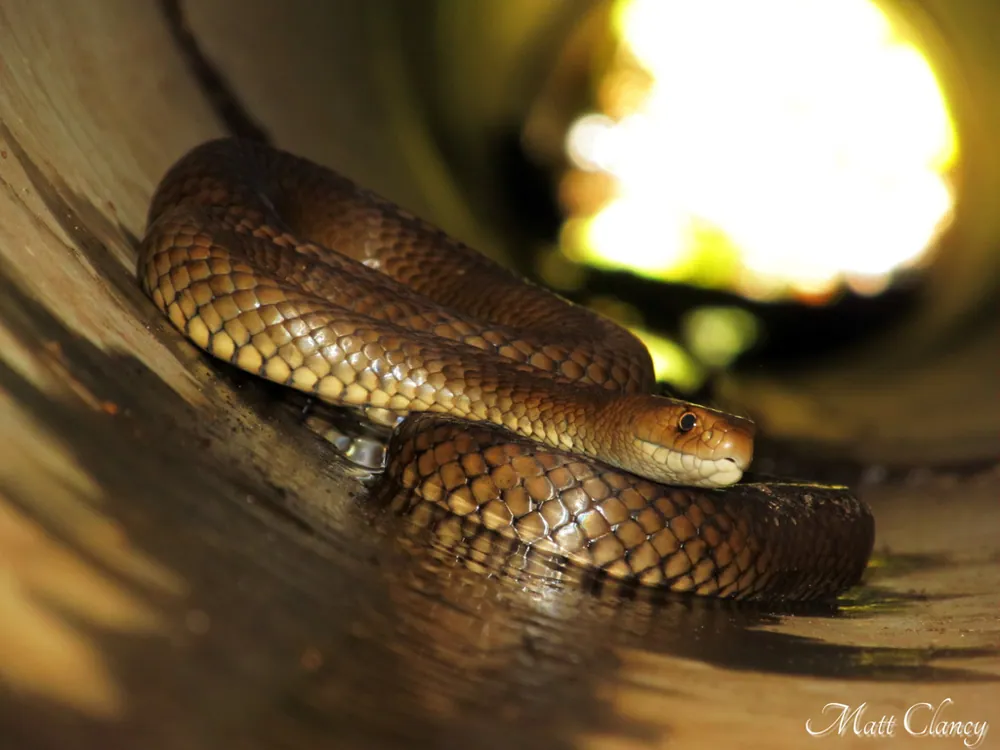
 Yadda za ka gane shi
- Slender build, with no clear line between the head and neck.1
- Upper parts range from pale brown to black, and sometimes orange or russet.1
- Underside is pale cream or yellow, often with orange, brown or dark grey blotches.1
- Young snakes usually have a black head and may have dark bands or a pattern across the body. These markings fade as the snake grows.1
- Inside of the mouth is flesh-pink.1
Ana yawan rikita shi da: Large eastern brown snakes are often confused with mulga snakes, which share their habitat in many areas; they can be told apart by head size. Its yellowish underparts separate it from the dugite and peninsula brown snake, which are entirely brown or have grey underparts. Young eastern brown snakes have head markings similar to red-naped snakes, grey snakes, Dwyer's snakes and curl snakes.1
Ƙarfin dafi
Dafi yana fitowa ta haƙoransa na dafi ko haƙoransa idan ya ciza.
Me dafinsa yake yi?
Its venom mainly affects the circulatory system, which carries blood around the body. The main effects are coagulopathy (a problem with blood clotting), haemorrhage (bleeding), cardiovascular collapse (the heart and blood vessels failing) and cardiac arrest (the heart stopping). One of the main components is pseutarin-C, a prothrombinase complex that breaks down prothrombin, a substance needed for blood to clot.1
Yaya haɗarinsa yake ga mutane?
Haɗari ga mutane: Mai kisaƊaya daga cikin dabbobi mafi haɗari a duniya.It is considered the world's second-most venomous land snake after the inland taipan, based on laboratory tests in mice.1
 Idan ya ciji
- Ɗaurin matsi don hana motsi: ka naɗe bandeji mai roba (elastic) da ƙarfi a kan wurin cizon sannan ka ci gaba da naɗewa har dukan gaɓar, ka ɗaure ta da katako (splint), kuma ka sa mutumin ya zauna ba motsi kwata-kwata har taimako ya iso.
- Kada ka wanke wurin cizon: asibitoci za su iya gwada dafin da ya rage a fata don zaɓar maganin dafi (antivenom) da ya dace.
Kullum ka fara kiran lambar gaggawa (112, 000, 911). Wannan jagorar agajin gaggawa ce ta gaba ɗaya, ba shawarar likita ba. Muhimman abubuwan agajin gaggawa
 Kiyaye lafiya
- Kada ka taɓa, kada ka kama, kada ka tsokani dabbar daji, ko da ƙarama ce, kuma ko da tana kama da tana barci ko ta mutu.
- Ka ba shi sarari. Idan ka haɗu da ɗaya, ka natsu, ka koma baya a hankali kuma ka bar shi ya bi hanyarsa.
- Idan ɗaya ya ciji ka: ka natsu, ka zauna ba motsi, ka kira lambar gaggawarka (112, 000, 911) ko ka je asibiti da sauri. Ka tuna yadda yake, hoto yana taimakawa.
Ba ya neman cutar da kai. Yana amfani da dafinsa don kama abinci ko don kare kansa, kuma ya fi son ya ɓuya. Ƙarin bayani game da kiyaye lafiya
Yaya girmansa yake?
Yaya tsawonsa yake?
 tsawon kyanwoyin gida 5 daga hanci zuwa wutsiya
 tsawon ayaba 13 a jere
 zai iya gudun mita 100 cikin daƙiƙa 46 (mutum mafi sauri yana buƙatar 9,6)
Yaya girman Eastern brown snake yake idan aka kwatanta da KAI?
Lissafi ne kawai a cikin burauzarka. Ba a adana komai ko a aika ko'ina.
Yaya saurinsa yake?


Bayanai
In December 2023, an eastern brown snake paused a match at the Brisbane International tennis tournament for 40 minutes until a professional snake catcher removed it.1
In winter, it brumates (goes into a state of rest like hibernation). Groups have been found sheltering under concrete slabs of houses in Sydney.1
Its fangs are small compared with other Australian venomous snakes, averaging 2.8 mm and reaching up to 4 mm in larger specimens.1
Within its genus, it has the largest number of chromosomes, at 38 in its cells.1
Local Aboriginal peoples in Sydney, the Illawarra and the Wiradjuri region had their own names for it, and the Dharawal and Awabakal held ceremonies for it.1
Mai karya tatsuniya
Tatsuniya: Young and adult brown snakes are different species.
Gaskiya: Early scientists thought they were different because their markings differ. Later research showed that the markings of young snakes fade as they grow, and all these forms are the same species.1
Inda bayanan suka fito
- Eastern brown snake (Wikipedia (CC BY-SA 4.0))
- Pseudonaja textilis (iNaturalist): sunaye da rarrabuwa.
- Venom Wiki: matakin haɗari, girman al'ada da ƙiyasin sauri namu ne. Ga yadda muke lissafa su: Yadda muke auna haɗari.
Kowane bayani a wannan shafi yana da lamba da ke nuna tushensa. Idan mun yi kuskure, ka yi haƙuri, mu masoya dabbobi ne, ba mujallar kimiyya ba. Ka gaya mana a [email protected] kuma za mu gyara.
 Kunama tana jin yunwa! Venom Wiki aikin mutum ɗaya ne: kyauta, ba talla kuma ba masu bin diddigi. Ɗan ƙaramin kyauta yana taimakawa wajen ci gaba da kasancewarsa a intanet.Ciyar da kunama
Ƙari daga rukuni ɗaya: Macizan Ostareliya
 Coastal taipan
 Common death adder
 Tafan na cikin ƙasa
 Macijin damisa
 Collett's snake
 Desert death adder
Yana kuma zaune a: Ostareliya da Oceania
 Sydney funnel-web spiderTarantulas da funnel-websMai kisa
 Redback spiderGizo-gizoYana buƙatar likita
 Brown tree snakeMacizai masu haƙoran bayaCiwo kawai
 Hooded pitohuiSauran dabbobi masu gubaCiwo kawaiKada ka taɓa
 PlatypusDabbobi masu shayarwa masu dafiCiwo kawai
 Northern tree-dwelling funnel-web spiderTarantulas da funnel-websMai kisa