
 Afrika
 Asia
Asia Eropa
Eropa Amerika Selatan
 Australia dan Oseania
 Antarktika
 Samudra Pasifik
 Samudra Atlantik
 Samudra Hindia
 Samudra Arktik
 Laut Tengah
 Laut Merah
 Laut Karibia
 Laut Koral
 Laut Cina Selatan
 Laut Filipina
 Laut Andaman
 Laut Utara
 Laut Timor dan Laut Arafura
 Teluk Benggala
 Teluk California
Kokoe poison frog
 Racun di kulitnya
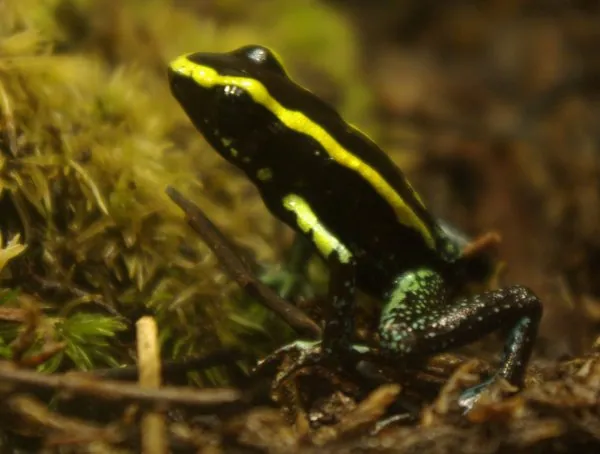
The Kokoe poison frog is a small, brightly striped frog that lives on the forest floor of western Colombia. It is one of the most poisonous frogs in the world. Its skin holds a toxin that can be deadly, so it should never be handled.1



 Cara mengenalinya
- Black back, sometimes with orange patches.1
- Green, yellow, orange or brownish gold stripes along each side of the body.1
- Black belly with blue or green dots.1
- The smallest of the poison dart frogs in its genus, Phyllobates.1
- Two forms exist: a smaller form with large stripes and a larger form with small stripes.1
Kekuatan racun
Kulitnya beracun. Berbahaya untuk disentuh, dijilat, atau dimakan.
Apa efek racunnya?
This frog is poisonous rather than venomous, because its toxin is held in its skin and does not come from a bite or sting. The toxin, batrachotoxin, is a steroidal alkaloid. It keeps the sodium channels in nerve and muscle cells permanently open, which stops the cells from resetting. The result is paralysis, and often death, as affected muscles stay locked in a contracted state.1
Seberapa berbahaya bagi manusia?
Bahaya bagi manusia: Sangat berbahayaBisa membunuh orang yang tidak diobati.Wild frogs are extremely deadly to humans, and the toxin can be fatal in doses as small as 100 μg. Frogs raised in captivity are generally non-toxic.1
Apa yang dilakukannya saat takut?
It releases its toxin from skin glands only when under stress.1
 Jika seseorang menyentuh atau memakannya
- Jika seseorang menyentuhnya: cuci tangan sampai bersih dan jangan menyentuh mata atau mulut. Jika anak atau hewan peliharaan menjilat atau memakannya: hubungi pusat informasi keracunan atau nomor darurat.
Selalu hubungi nomor darurat dulu (112, 000, 911). Ini panduan pertolongan pertama umum, bukan nasihat medis. Dasar-dasar pertolongan pertama
 Tetap aman
- Jangan pernah menyentuh, menangkap, atau mengganggu hewan liar, walaupun kecil, dan walaupun tampak tidur atau mati.
- Beri ia ruang. Jika bertemu, tetap tenang, mundur perlahan, dan biarkan ia pergi.
- Jika kamu menyentuh atau memakannya: jangan mengucek mata atau mulut, cuci tangan, dan cari bantuan medis.
Ia tidak mengincarmu. Racunnya hanya ada supaya tidak ada yang memakannya. Lebih lanjut tentang tetap aman
Di mana di dunia?
Seberapa besar dia?
Seberapa panjang dia?
 kira-kira sepanjang penjepit kertas
 bisa menempuh 100 meter dalam 100 detik (manusia tercepat butuh 9,6)
Seberapa besar Kokoe poison frog dibandingkan KAMU?
Hanya hitungan di browsermu. Tidak ada yang disimpan atau dikirim ke mana pun.
Seberapa cepat dia?


Fakta
It is known as the third most poisonous frog in the world.1
Indigenous peoples of Colombia have used its poison on hunting darts.1
Unlike many other dart frogs, males do not wrestle. Rivals face off and call loudly until one backs down.1
Its mating calls are a loud, bird-like whirring twitter, which can last up to 45 seconds.1
Unlike other Phyllobates species, it does not breed in coconut shells. It lays its eggs in narrow tubes on the ground instead.1
Pembongkar mitos
Mitos: All poison frogs make their own poison.
Faktanya: These frogs probably do not make batrachotoxin themselves. They take it in from their diet of beetles, millipedes and flies, and from the leaf litter. That is why captive frogs are generally non-toxic.1
Untuk ahli bisa
- Nama ilmiah
- Phyllobates aurotaenia
- Kelompok
- Katak beracun, kodok, dan kadal air
- Keluarga
- Dendrobatidae2
- Urutan
- Anura
- Benua
- Amerika Selatan
- Anak
- The female lays a clutch of eggs in leaf litter, averaging 15 to 20. After the eggs hatch, the male carries the tadpoles to slow-flowing water.1
- Bagaimana keadaannya di alam liar
- Least Concern (IUCN), although its numbers and range are declining, mainly due to habitat loss1
- Bahaya bagi manusia
- 4 / 5: Sangat berbahaya3
Dari mana faktanya berasal
- Phyllobates aurotaenia (Wikipedia (CC BY-SA 4.0))
- Phyllobates aurotaenia (iNaturalist): nama dan klasifikasi.
- Venom Wiki: tingkat bahaya, ukuran umum, dan perkiraan kecepatan adalah buatan kami. Lihat cara kami menghitungnya: Cara kami menilai bahaya.
Setiap fakta di halaman ini punya nomor yang menunjuk ke sumbernya. Kalau kami salah, maaf ya, kami penggemar hewan, bukan jurnal ilmiah. Beri tahu kami di [email protected] dan kami akan memperbaikinya.
 Kalajengkingnya lapar! Venom Wiki adalah proyek satu orang: gratis, tanpa iklan, dan tanpa pelacak. Tip kecil membantu menjaganya tetap online.Beri makan kalajengking
Lainnya dari kelompok yang sama: Katak beracun, kodok, dan kadal air
 Katak panah beracun emasKatak beracun, kodok, dan kadal airMematikanJangan sentuh
 Cane toadKatak beracun, kodok, dan kadal airPerlu ke dokterJangan sentuh
 Dyeing poison dart frogKatak beracun, kodok, dan kadal airHanya sakitJangan sentuh
 Black-legged poison frogKatak beracun, kodok, dan kadal airBisa membunuhJangan sentuh
 Bruno's casque-headed frogKatak beracun, kodok, dan kadal airPerlu ke dokterJangan sentuh
 Harlequin poison frogKatak beracun, kodok, dan kadal airPerlu ke dokterJangan sentuh
 Terciopelo
 Brazilian wandering spider
 Eyelash viper
 Golden lancehead
 South American bushmaster
 Peruvian giant centipede