
 Afrika
 Asia
Asia Eropa
Eropa Amerika Selatan
 Australia dan Oseania
 Antarktika
 Samudra Pasifik
 Samudra Atlantik
 Samudra Hindia
 Samudra Arktik
 Laut Tengah
 Laut Merah
 Laut Karibia
 Laut Koral
 Laut Cina Selatan
 Laut Filipina
 Laut Andaman
 Laut Utara
 Laut Timor dan Laut Arafura
 Teluk Benggala
 Teluk California
Pumpkin toadlet
 Racun di kulitnya
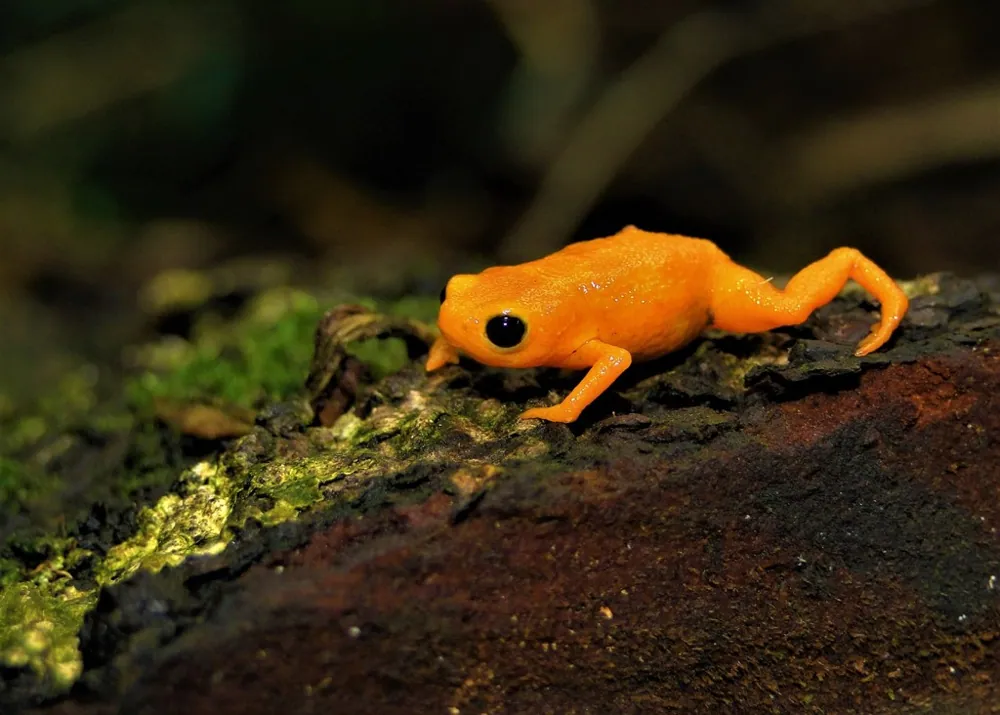
The pumpkin toadlet is a tiny, brightly coloured frog that lives in the leaf litter of the Atlantic rainforests of southeastern Brazil. Adults are bright yellow-orange, a warning sign that their skin and body carry a strong toxin. Scientists have found that the head and back of this frog glow under ultraviolet light.1
 Cara mengenalinya
- Adults are bright yellow-orange.1
- Newly hatched young are brown and well camouflaged.1
- It is very small, with adults measuring 12.5 to 19.7 mm from snout to vent.1
- Females tend to be larger than males.1
Sering tertukar dengan: It is closely related to the red pumpkin toadlet (B. pitanga), which also glows under ultraviolet light and shares its inability to hear its own call.1
Kekuatan racun
Kulitnya beracun. Berbahaya untuk disentuh, dijilat, atau dimakan.
Apa efek racunnya?
This frog is poisonous rather than venomous, so it does not inject venom. Its main toxin is 11-oxotetrodotoxin, which is extremely rare in animals, even marine ones, and is four to five times more potent than tetrodotoxin. The toxins are found in the skin and ovaries but are mostly concentrated in the liver.1
Seberapa berbahaya bagi manusia?
Bahaya bagi manusia: MenyakitkanBisa sangat sakit, tetapi hampir tidak pernah serius.Apa yang dilakukannya saat takut?
Its bright yellow-orange colour is a warning display (aposematism) that tells predators it is toxic.1
 Jika seseorang menyentuh atau memakannya
- Jika seseorang menyentuhnya: cuci tangan sampai bersih dan jangan menyentuh mata atau mulut. Jika anak atau hewan peliharaan menjilat atau memakannya: hubungi pusat informasi keracunan atau nomor darurat.
Selalu hubungi nomor darurat dulu (112, 000, 911). Ini panduan pertolongan pertama umum, bukan nasihat medis. Dasar-dasar pertolongan pertama
 Tetap aman
- Jangan pernah menyentuh, menangkap, atau mengganggu hewan liar, walaupun kecil, dan walaupun tampak tidur atau mati.
- Beri ia ruang. Jika bertemu, tetap tenang, mundur perlahan, dan biarkan ia pergi.
- Jika kamu menyentuh atau memakannya: jangan mengucek mata atau mulut, cuci tangan, dan cari bantuan medis.
Ia tidak mengincarmu. Racunnya hanya ada supaya tidak ada yang memakannya. Lebih lanjut tentang tetap aman
Di mana di dunia?
Seberapa besar dia?
Seberapa panjang dia?
 lebih pendek dari jari kelingkingmu
 bisa menempuh 100 meter dalam 180 detik (manusia tercepat butuh 9,6)
Seberapa besar Pumpkin toadlet dibandingkan KAMU?
Hanya hitungan di browsermu. Tidak ada yang disimpan atau dikirim ke mana pun.
Seberapa cepat dia?


Fakta
In 2019, scientists found that the head and back of this frog glow under ultraviolet light because of fluorescent skeletons. Young frogs that have gained adult colours still do not glow.1
Adults cannot hear the frequency of their own calls because their ears are underdeveloped. They communicate with movements such as inflating the vocal sac, gaping the mouth and waving their arms.1
Its main toxin, 11-oxotetrodotoxin, is extremely rare in animals, even in marine species.1
Its young hatch directly into tiny toadlets, skipping the tadpole stage.1
It is among the largest frogs in its genus, Brachycephalus.1
Pembongkar mitos
Mitos: Its glow under ultraviolet light is a warning signal to predators.
Faktanya: Studies suggest this is unlikely. Predators attack the frogs at the same rate whether or not they glow.1
Untuk ahli bisa
- Nama ilmiah
- Brachycephalus ephippium
- Kelompok
- Katak beracun, kodok, dan kadal air
- Keluarga
- Brachycephalidae2
- Urutan
- Anura
- Benua
- Amerika Selatan
- Anak
- It breeds by direct development. The female lays a few eggs on land, which hatch into young toadlets with no tadpole stage.1
- Bagaimana keadaannya di alam liar
- Not considered threatened1
- Bahaya bagi manusia
- 2 / 5: Menyakitkan3
Dari mana faktanya berasal
- Pumpkin toadlet (Wikipedia (CC BY-SA 4.0))
- Brachycephalus ephippium (iNaturalist): nama dan klasifikasi.
- Venom Wiki: tingkat bahaya, ukuran umum, dan perkiraan kecepatan adalah buatan kami. Lihat cara kami menghitungnya: Cara kami menilai bahaya.
Setiap fakta di halaman ini punya nomor yang menunjuk ke sumbernya. Kalau kami salah, maaf ya, kami penggemar hewan, bukan jurnal ilmiah. Beri tahu kami di [email protected] dan kami akan memperbaikinya.
 Kalajengkingnya lapar! Venom Wiki adalah proyek satu orang: gratis, tanpa iklan, dan tanpa pelacak. Tip kecil membantu menjaganya tetap online.Beri makan kalajengking
Lainnya dari kelompok yang sama: Katak beracun, kodok, dan kadal air
 Golden poison frogKatak beracun, kodok, dan kadal airMematikanJangan sentuh
 Cane toadKatak beracun, kodok, dan kadal airPerlu ke dokterJangan sentuh
 Dyeing poison dart frogKatak beracun, kodok, dan kadal airHanya sakitJangan sentuh
 Black-legged poison frogKatak beracun, kodok, dan kadal airBisa membunuhJangan sentuh
 Bruno's casque-headed frogKatak beracun, kodok, dan kadal airPerlu ke dokterJangan sentuh
 Harlequin poison frogKatak beracun, kodok, dan kadal airPerlu ke dokterJangan sentuh
 Terciopelo
 Brazilian wandering spider
 Eyelash viper
 Golden lancehead
 South American bushmaster
 Peruvian giant centipede