
 Africa
 Asia
Asia Europa
 Sud America
 Australia e Oceania
 Antartide
 Oceano Pacifico
 Oceano Atlantico
 Oceano Indiano
 Oceano Artico
 Mar Mediterraneo
 Mar Rosso
 Mar dei Caraibi
 Mar dei Coralli
 Mar Cinese Meridionale
 Mar delle Filippine
 Mare delle Andamane
 Mare del Nord
 Mar di Timor e Mar degli Arafura
 Golfo del Bengala
 Golfo di California
Giant leaf frog
 Tossine nella pelle
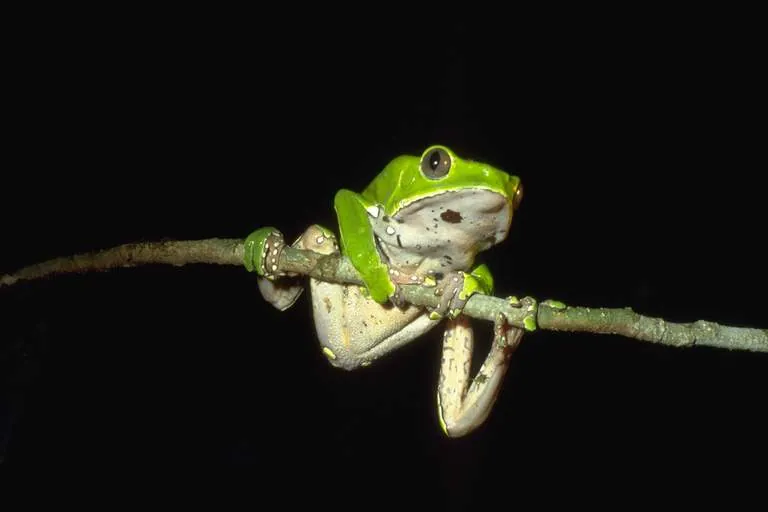
The giant leaf frog is a large tree frog with lime green skin and a white or cream belly. It lives in the rainforests of the Amazon basin in South America. Its skin releases chemicals that act as a defence against predators.1
 Come riconoscerlo
- Lime green back with a white to yellow-white or cream belly1
- Sparse white spots with dark frames on the lower lips, chest and front legs, denser on the flanks and hind legs1
- Transparent brown fingers with large green adhesive discs1
- A prominent gland behind each eye, extending over the eardrum1
- Dark grey iris1
Potere tossico
La sua pelle è tossica. È pericoloso toccarlo, leccarlo o mangiarlo.
Cosa fanno le sue tossine?
The giant leaf frog's skin secretion contains opioid peptides, including deltorphin and dermorphin. Its skin peptides act as a chemical defence against predators. In kambo rituals, where the secretion is used, it induces intense vomiting.1
Quanto è pericoloso per le persone?
Pericolo per le persone: DolorosoPuò fare davvero male, ma non è quasi mai grave.Cosa fa quando ha paura?
When threatened, its skin produces peptides that act as a chemical defence against predators.1
 Se qualcuno l'ha toccato o mangiato
- Se qualcuno ne ha toccato uno: lava bene le mani e non toccare occhi o bocca. Se un bambino o un animale domestico ne ha leccato o mangiato uno: chiama il centro antiveleni o il numero di emergenza.
Chiama sempre prima il numero di emergenza (112, 000, 911). Queste sono indicazioni generali di primo soccorso, non consigli medici. Primo soccorso di base
 Stai al sicuro
- Non toccare, catturare o stuzzicare mai un animale selvatico, anche se è piccolo e anche se sembra addormentato o morto.
- Lasciagli spazio. Se ne incontri uno, resta calmo, indietreggia piano e lascialo andare per la sua strada.
- Se l'hai toccato o mangiato: non strofinarti gli occhi o la bocca, lavati le mani e cerca aiuto medico.
Non ce l'ha con te. Le sue tossine servono solo perché nessuno lo mangi. Altro su come stare al sicuro
Dove nel mondo?
Quanto è grande?
Quanto è lungo?
 lungo come 4 mattoncini da costruzione in fila
 potrebbe percorrere 100 metri in 72 secondi (l'uomo più veloce ci mette 9,6)
Quanto è grande Giant leaf frog rispetto a TE?
Solo calcoli nel tuo browser. Niente viene salvato o inviato da nessuna parte.
Quanto è veloce?


Informazioni
Its skin secretion is known as Vacina do sapo, or frog vaccine, and is used in a ritual called kambo or sapo.1
Up to 61% of the eggs of the giant leaf frog are eaten by predators.1
Males fight rivals for mating rights by using their heads to separate a rival male from a female, and by pushing with their hind legs.1
Males are more likely to be targeted by predators during mating season, because their loud fights can be heard easily.1
Eggs are eaten by rove beetles, phorid flies, possibly tufted capuchins and banded cat-eyed snakes, because they are a source of protein.1
Per gli esperti di veleni
- Nome scientifico
- Phyllomedusa bicolor
- Gruppo
- Rane dardo, rospi e tritoni
- Famiglia
- Phyllomedusidae2
- Ordine
- Anura
- Continenti
- Sud America
- Cuccioli
- The female and male build a leaf-nest above forest pools and lay eggs in a gelatinous mass about 70 cm above the water. The eggs hatch in about 14 days, and the tadpoles fall into the water to develop into adult frogs.1
- Come se la passa in natura
- Least Concern1
- Pericolo per le persone
- 2 / 5: Doloroso3
Da dove vengono le informazioni
- Phyllomedusa bicolor (Wikipedia (CC BY-SA 4.0))
- Phyllomedusa bicolor (iNaturalist): nomi e classificazione.
- Venom Wiki: il livello di pericolo, la taglia tipica e la stima della velocità sono nostri. Guarda come li calcoliamo: Come valutiamo il pericolo.
Ogni informazione in questa pagina ha un numero che rimanda alla sua fonte. Se abbiamo sbagliato qualcosa, scusa, siamo appassionati di animali, non una rivista scientifica. Scrivici a [email protected] e lo correggeremo.
 Lo scorpione ha fame! Venom Wiki è un progetto di una sola persona: gratis, senza pubblicità e senza tracker. Una piccola mancia aiuta a tenerlo online.Dai da mangiare allo scorpione
Altri dello stesso gruppo: Rane dardo, rospi e tritoni
 Golden poison frogRane dardo, rospi e tritoniMortaleNon toccare
 Cane toadRane dardo, rospi e tritoniServe un medicoNon toccare
 Dyeing poison dart frogRane dardo, rospi e tritoniFa solo maleNon toccare
 Black-legged poison frogRane dardo, rospi e tritoniPuò uccidereNon toccare
 Bruno's casque-headed frogRane dardo, rospi e tritoniServe un medicoNon toccare
 Harlequin poison frogRane dardo, rospi e tritoniServe un medicoNon toccare
 Terciopelo
 Brazilian wandering spider
 Eyelash viper
 Golden lancehead
 South American bushmaster
 Peruvian giant centipede