
 Africa
 Asia
Asia Europa
 Sud America
 Australia e Oceania
 Antartide
 Oceano Pacifico
 Oceano Atlantico
 Oceano Indiano
 Oceano Artico
 Mar Mediterraneo
 Mar Rosso
 Mar dei Caraibi
 Mar dei Coralli
 Mar Cinese Meridionale
 Mar delle Filippine
 Mare delle Andamane
 Mare del Nord
 Mar di Timor e Mar degli Arafura
 Golfo del Bengala
 Golfo di California
South American bushmaster
 Morsi
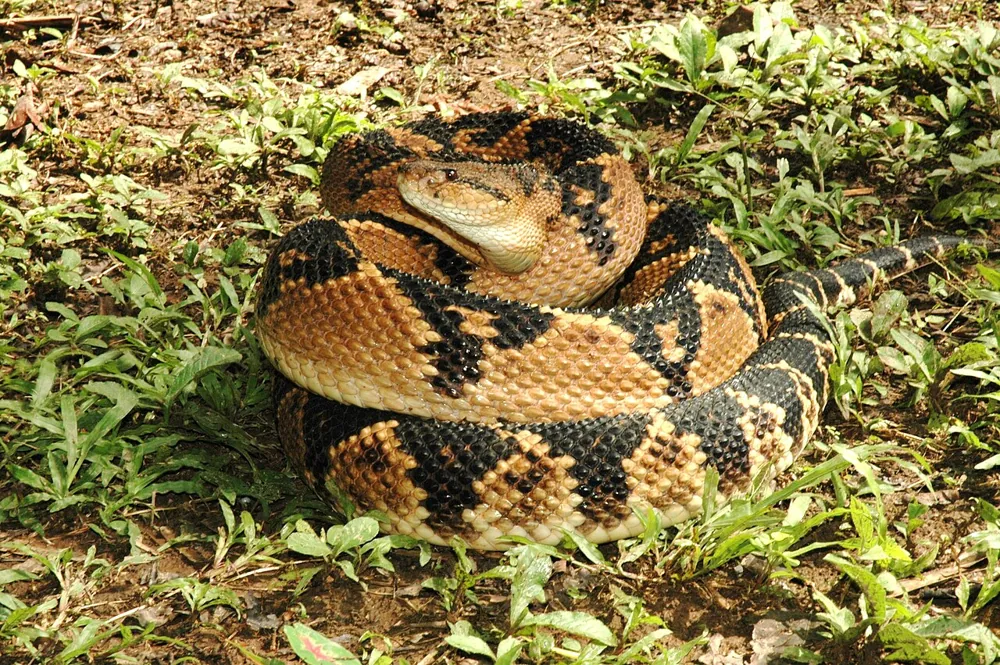
MorsiThe South American bushmaster is one of the longest vipers in the world, and it is the longest venomous snake in the Western Hemisphere. It lives in the equatorial forests east of the Andes and on the island of Trinidad. Its bite is dangerous, so it is important to know what it looks like.1



 Come riconoscerlo
- Its ground colour is yellowish, reddish or grey-brown.1
- Dark brown or black blotches run along the body, forming inverted triangles on the sides.1
- Adults are usually 2 to 2.5 m long, and 3 m is not unusual.1
- The head is broad and clearly separate from the narrow neck.1
- The tail is short and ends in a spine. When alarmed it vibrates the tail, which makes a loud rustling in undergrowth.1
Spesso confuso con: It is similar in appearance to rattlesnakes. It has no rattle, so its tail vibration sounds like rustling leaves rather than a rattle.1
Potere del veleno
Il veleno esce dalle zanne o dai denti quando morde.
Cosa fa il suo veleno?
Its venom breaks down tissue, stops blood from clotting, and can cause bleeding. It also has effects on the nerves. At the bite there is pain, swelling, bruising, blisters and skin death. Whole-body effects include low blood pressure, dizziness, vision problems, a slow heartbeat, vomiting, diarrhoea and kidney failure.1
Quanto è pericoloso per le persone?
Pericolo per le persone: Molto pericolosoPuò uccidere una persona che non riceve cure.Its bites are often fatal. Lab tests show its venom is weak, but the mortality rate of bite victims is high. In reported cases, a 7-year-old boy in Brazil died about 15 minutes after being bitten, and a 5-year-old child in Mato Grosso went into shock about 30 minutes after a bite and died within 90 minutes.1
Cosa fa quando ha paura?
When threatened it vibrates its tail, which makes a loud rustling sound in the undergrowth.1
 Se morde
- Tieni la persona ferma e calma, tieni l'arto morso all'altezza del cuore, togli anelli e cose strette e portala subito in ospedale.
Chiama sempre prima il numero di emergenza (112, 000, 911). Queste sono indicazioni generali di primo soccorso, non consigli medici. Primo soccorso di base
 Stai al sicuro
- Non toccare, catturare o stuzzicare mai un animale selvatico, anche se è piccolo e anche se sembra addormentato o morto.
- Lasciagli spazio. Se ne incontri uno, resta calmo, indietreggia piano e lascialo andare per la sua strada.
- Se uno ti morde: resta calmo, stai fermo, chiama il numero di emergenza (112, 000, 911) o vai subito in ospedale. Ricorda com'era, una foto aiuta.
Non ce l'ha con te. Usa il veleno per procurarsi il cibo o per difendersi, e preferisce di gran lunga nascondersi. Altro su come stare al sicuro
Dove nel mondo?
Quanto è grande?
Quanto è lungo?
Quanto pesa?
 lungo come 4 cani dal naso alla coda
 lungo come 20 banane in fila
 pesante più o meno come un gatto di casa
 potrebbe percorrere 100 metri in 71 secondi (l'uomo più veloce ci mette 9,6)
Quanto è grande South American bushmaster rispetto a TE?
Solo calcoli nel tuo browser. Niente viene salvato o inviato da nessuna parte.
Quanto è veloce?


Informazioni
It is the longest viper in the world.1
It is the third longest venomous snake in the world, after the king cobra and the black mamba.1
Stress also lowers its venom yield. One specimen's yield fell from 233 mg to 64 mg while it was kept in captivity.1
Its name Lachesis comes from one of the three Fates of Greek mythology, who was said to decide how long a person would live.1
It rarely lives long in captivity, because stress makes it unwell.1
Sfatiamo i miti
Mito: Its venom is weak, so its bite is not very serious.
Verità: Lab tests show low toxicity, but bite victims die at a high rate, so the bite is very dangerous.1
Da dove vengono le informazioni
- Lachesis muta (Wikipedia (CC BY-SA 4.0))
- Lachesis muta (iNaturalist): nomi e classificazione.
- Venom Wiki: il livello di pericolo, la taglia tipica e la stima della velocità sono nostri. Guarda come li calcoliamo: Come valutiamo il pericolo.
Ogni informazione in questa pagina ha un numero che rimanda alla sua fonte. Se abbiamo sbagliato qualcosa, scusa, siamo appassionati di animali, non una rivista scientifica. Scrivici a [email protected] e lo correggeremo.
 Lo scorpione ha fame! Venom Wiki è un progetto di una sola persona: gratis, senza pubblicità e senza tracker. Una piccola mancia aiuta a tenerlo online.Dai da mangiare allo scorpione
 Terciopelo
 Eyelash viper
 Golden lancehead
 Common lancehead
 Jararaca
 Jararacussu
 Rana dardo dorata
 Brazilian wandering spider
 Cane toad
 Peruvian giant centipede
 Bullet ant
 Common vampire bat