
 Africa
 Asia
Asia Europa
 Sud America
 Australia e Oceania
 Antartide
 Oceano Pacifico
 Oceano Atlantico
 Oceano Indiano
 Oceano Artico
 Mar Mediterraneo
 Mar Rosso
 Mar dei Caraibi
 Mar dei Coralli
 Mar Cinese Meridionale
 Mar delle Filippine
 Mare delle Andamane
 Mare del Nord
 Mar di Timor e Mar degli Arafura
 Golfo del Bengala
 Golfo di California
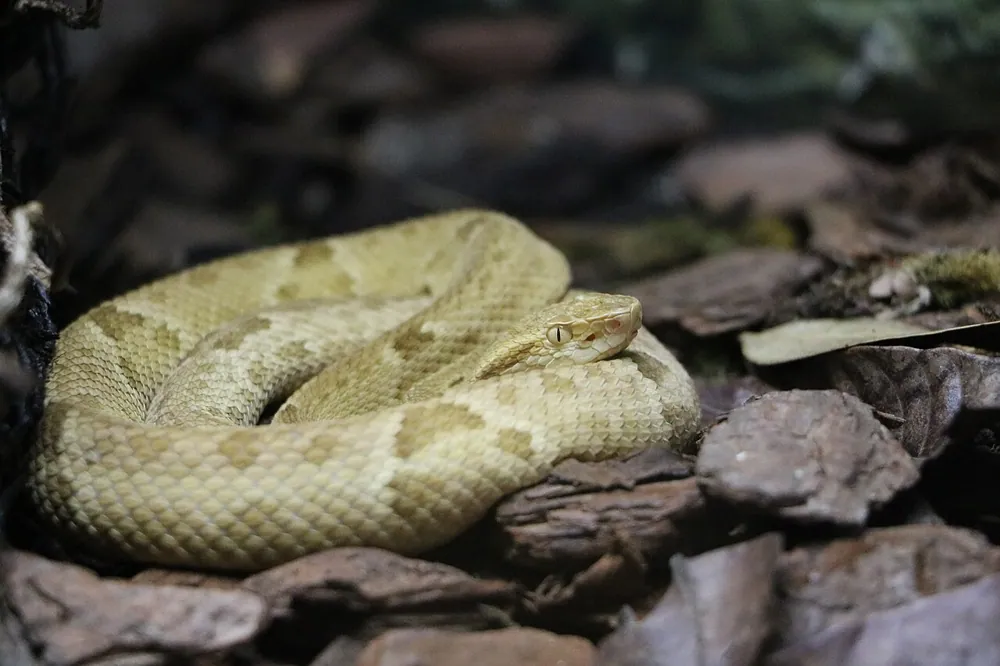
Golden lancehead
 Morsi
MorsiThe golden lancehead is an extremely venomous pit viper that lives only on one small Brazilian island, Ilha da Queimada Grande. It is one of the most venomous snakes in Latin America. Because the island is uninhabited and closed to visitors, it is very unlikely that people will ever meet one.1


 Come riconoscerlo
- Pale yellowish-brown body with a series of dorsal blotches that may be triangular or square.1
- Belly is a uniform pale yellow or cream.1
- Lance-shaped head that comes to a point at the nose.1
- No well-defined stripe running behind the eye.1
- Has a longer tail than its closest relative, B. jararaca.1
Spesso confuso con: Its closest relative is B. jararaca, which lives in southern Brazil, Paraguay and northern Argentina. The golden lancehead can be told apart from it mainly by its longer tail.1
Potere del veleno
Il veleno esce dalle zanne o dai denti quando morde.
Cosa fa il suo veleno?
Its venom is adapted to the animals of the island, mainly reptiles, arthropods and migrating birds, so it works better on these than on mammals. Chemical analysis suggests it is five times as potent as the venom of B. jararaca and is the fastest-acting venom in the genus Bothrops. Its venom becomes more potent as the snake matures. Effects reported in envenomations include swelling, pain, nausea, vomiting, blood blisters, bruising, bleeding into the gut and brain, kidney failure and severe muscle damage.1
Quanto è pericoloso per le persone?
Pericolo per le persone: Molto pericolosoPuò uccidere una persona che non riceve cure.No official report of a human bite from this species has been made, because the island is uninhabited. Other lanceheads cause more human deaths than any other group of snakes in North or South America. One researcher reports four human envenomations by this species, three of which were fatal. For lanceheads in general, the mortality rate is 0.5 to 3.0% with treatment and 7.0% without it.1
 Se morde
- Tieni la persona ferma e calma, tieni l'arto morso all'altezza del cuore, togli anelli e cose strette e portala subito in ospedale.
Chiama sempre prima il numero di emergenza (112, 000, 911). Queste sono indicazioni generali di primo soccorso, non consigli medici. Primo soccorso di base
 Stai al sicuro
- Non toccare, catturare o stuzzicare mai un animale selvatico, anche se è piccolo e anche se sembra addormentato o morto.
- Lasciagli spazio. Se ne incontri uno, resta calmo, indietreggia piano e lascialo andare per la sua strada.
- Se uno ti morde: resta calmo, stai fermo, chiama il numero di emergenza (112, 000, 911) o vai subito in ospedale. Ricorda com'era, una foto aiuta.
Non ce l'ha con te. Usa il veleno per procurarsi il cibo o per difendersi, e preferisce di gran lunga nascondersi. Altro su come stare al sicuro
Dove nel mondo?
Quanto è grande?
Quanto è lungo?
 lungo come 2,5 gatti di casa dal naso alla coda
 lungo come 7 banane in fila
 potrebbe percorrere 100 metri in 100 secondi (l'uomo più veloce ci mette 9,6)
Quanto è grande Golden lancehead rispetto a TE?
Solo calcoli nel tuo browser. Niente viene salvato o inviato da nessuna parte.
Quanto è veloce?


Informazioni
Its venom is thought to be five times as potent as that of its closest relative, B. jararaca.1
Its venom has evolved to suit the animals of its island, which has no native mammals.1
Its tail is longer than that of its closest relative, which may help it climb through trees and catch larger birds from a younger age.1
The island's population was estimated at between 2,414 and 2,899 snakes in 2021.1
Travel to the island is strictly prohibited by the Brazilian government.1
It is found only on Ilha da Queimada Grande, an island of about 43 hectares, and nowhere else in the wild.1
Per gli esperti di veleni
- Nome scientifico
- Bothrops insularis
- Gruppo
- Vipere a fossetta
- Famiglia
- Viperidae2
- Ordine
- Squamata
- Continenti
- Sud America
- Cuccioli
- Like most vipers, it gives birth to live young. The average number of young per pregnancy is 6.5.1
- Come se la passa in natura
- Critically Endangered (IUCN Red List)1
- Pericolo per le persone
- 4 / 5: Molto pericoloso3
Da dove vengono le informazioni
- Golden lancehead (Wikipedia (CC BY-SA 4.0))
- Bothrops insularis (iNaturalist): nomi e classificazione.
- Venom Wiki: il livello di pericolo, la taglia tipica e la stima della velocità sono nostri. Guarda come li calcoliamo: Come valutiamo il pericolo.
Ogni informazione in questa pagina ha un numero che rimanda alla sua fonte. Se abbiamo sbagliato qualcosa, scusa, siamo appassionati di animali, non una rivista scientifica. Scrivici a [email protected] e lo correggeremo.
 Lo scorpione ha fame! Venom Wiki è un progetto di una sola persona: gratis, senza pubblicità e senza tracker. Una piccola mancia aiuta a tenerlo online.Dai da mangiare allo scorpione
 Terciopelo
 Eyelash viper
 South American bushmaster
 Common lancehead
 Jararaca
 Jararacussu
 Golden poison frog
 Brazilian wandering spider
 Cane toad
 Peruvian giant centipede
 Bullet ant
 Common vampire bat